0
0

Pakistan-India peace talks
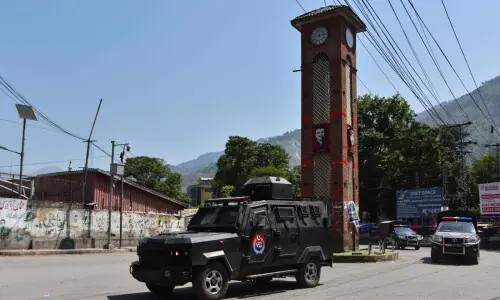
PRIME Minister Atal Behari Vajpayee was seen shaking enthusiastically what looked like an olive branch towards Pakistan, during his recent visit to Srinagar. He talked about dialogue with Pakistan. Later, in the Lok Sabha, he repeated the statement that talks with Pakistan were possible on all issues, including Kashmir.
The departure from the bellicose statements was a pleasant surprise and was due to America’s prodding. The dialogue offer was a sign of flexibility on the part of India. Pakistan, therefore, responded with alacrity to the Vajpayee statement. President Musharraf and Prime Minister Jamali both welcomed the Vajpayee statement, hoping it reflected a sincere desire on India’s part to resolve the disputes.
But skeptics are doubtful. It has all happened so many times before. There is such a gulf between the respective approaches of the two sides. Pakistan treats Kashmir as the entrance to the arena; India prefers entry through back doors. Pakistan wants discussions with an open mind, without preconditions. India demands that intrusion by militants into the Valley from Pakistan’s side must first cease. And, finally, it insists that the status of Kashmir is not negotiable, which Pakistan refuses to accept.
This endless repetition of India’s accusation and Pakistan’s denial has led to a widespread suspicion that leaders in the two countries are more interested in the status quo than in permanent peace. Indeed, vested interests, the ruling elite and businessmen alike, have become so used to perpetual stand-off between the two countries that the prospect of peace scares them. They have honed hostility to suit their own selfish interests. Peace would be dangerous for their political power and the flow of wealth that comes with power.
Therefore, whenever signs of a thaw and progress emerge, they are promptly sabotaged. Either a spurt in militancy occurs in the Valley, or guns start booming across the Line of Control, or India moves troops to the border. Or, as in Agra, when an agreement is on the point of being inked, wires are pulled from behind and love’s labour is lost.
Meanwhile, the dumb multitude, hostage to the caprice of unkind rulers, wallows in want, without education, without health care, without potable water.
SYED JAWAID IQBAL
Karachi
THERE is cautious optimism regarding the resumption of peace talks between Pakistan and India. As an ordinary citizen I would like to suggest possible solutions.
There seems to be two likely solutions: independent Kashmir or the Line of Control becoming a permanent border. An independent Kashmir would be ideal for the Kashmiris but neither Pakistan nor India can afford it.
Therefore, the LoC becoming a permanent border seems to be the most realistic solution. The Kashmiris on both sides should be given a special status as citizens with freedom to travel and live on either part of Kashmir.
The difference this time is that the vested interests on both sides, which wanted hostilities to continue, are worried that the US will no longer tolerate the status quo.
SALMAN ALI
Karachi
Speed-checking by radar
THE capital police have recently initiated radar speed-checking to apprehend and fine over-speeding vehicles. I too was fined last month for driving over 65km per hour in Islamabad. I have to say that the attitude of the police sergeant was most cordial and professional.
While I was pleasantly surprised and happy that day to see that the police are finally waking up to their duty of protecting the lives and property of citizens, a rather unpleasant incident has now left a bitter taste in my mouth.
Having been fined once, I was cruising along the Islamabad highway, strictly observing the speed-limit, when a huge, clearly over-speeding bus, overtook me. We all know what a menace such recklessly driven buses are and how they are often involved in horrific accidents. Fortunately, that bus was radar-checked and, on getting close to the turning for the airport, a contingent of police personnel signalled it to pull over. However, the bus driver ignored the policeman and wildly swerved to get around him, almost running over the poor chap in the process.
While I was shocked to see this, what really dismayed me was the reaction of the two motorcycled police sergeants present right there. Instead of chasing the offending culprit, they ignored the fleeing bus and kept relaxing on their bikes as the bus got away. Apparently, the safety of citizens is not as important as the convenience of police sergeants.
This not only shows the rather careless and lazy attitude of our law enforcers but also sends the message that you are guilty only if you get caught. In fact, you are only guilty if you volunteer to getting caught; as clearly if you choose to break the law and then make a run for it, the police are not bothered to actually come after you!
I think the police should be trained to recognize the real dangers to the public, in this case the overspeeding buses and mini-vans, and to make actual efforts to apprehend them rather than enjoying the Islamabad sunshine. If this is not done, bus/van drivers will continue to break the law with impunity, and the police will then be partly responsible for any resulting loss of lives.
Usman I. Malik
Islamabad
National parks in Kaghan
THIS is with reference to your editorial regarding the two national parks in Kaghan, Lakes Saiful Maluk and Lulusar. I think it is about time that this was done and I entirely agree with your idea of involving the local population in preserving the two parks. The local inhabitants can benefit in a number of ways from the activity that can be generated from these parks.
On a peak summer day up to 7,000 visitors throng to see the romantic Saiful Maluk. The jeep and pony owners do a roaring trade taking people up and down to the lake from Naran. There is a glacier conveniently parked halfway up the lake, so even if you have your own jeep you still cannot cross it, and have to rent transport on the other side. There are also a lot of small restaurants selling karahi chicken and pakoras at the lake. They, too, do a roaring business.
However, all this means a lot of garbage being dumped into and around the lake. This despite the fact that garbage cans have been provided by the lake side. I have seen the pristine waters of the lake being defiled by people hurling mango peels into it. I suggest the following measures to preserve the environment:
1. Locals should be trained as guides. These can be hired to take you around the lake, tell you the story of the romance of Saif and the Princess. They could also take you trekking up beyond the lake to the two passes, and up the sides of neighbouring mountains. The park authority should have tents and basic equipment for hire.
2. Locals should be employed to clean up the surroundings of the lake. No matter what we do, there will be some litter and this needs to be collected.
3. A small fee can be charged at the entrance to the park to pay for the above-mentioned jobs.
TAHIR JAHANGIR
Lahore
Auction of Jinnah House
JINNAH House, the London residence used by the Quaid-i-Azam, Mohammad Ali Jinnah, during his student days, was finally auctioned on April 28 to a bidder whose name could not be ascertained owing to weekly holidays in England.
Despite the best efforts made by the property agent, Mr Khalid Hassan, to sell the property either to an individual Pakistani settled in England, or to the Pakistan High Commission in London, he was unable to convince either the Pakistanis or the Pakistan High Commissioner to purchase Jinnah House for 1.2 million pounds being the total price of the property, which was actually 50,000 pounds less than the actual price of the property.
According to a press report, Pakistan’s High Commissioner did refer this matter to Islamabad but till the closing of the bid the High Commission did not receive “any response” from Islamabad.
Prime Minister Mir Zafarullah Khan Jamali should tell the nation why Jinnah House could not be purchased although property agent Khalid Hassan, who received two identical bids, one from a British couple and the other from a Russian couple, made a last-ditch effort to sell it to the government of Pakistan, but the government showed no interest in it. This is a highly irresponsible act and needs to be rectified on a priority basis. Our government must re-purchase Jinnah House from its present owner, at any cost, so that it is retained and maintained as Jinnah House in London for our future generations.
SYED A. MATEEN
Karachi
Police and union councils
THIS is with reference to a half-page ad about “Awami tahffuzat”. I fail to understand the logic behind the ad. There are so many ambiguities in the policy as advertised by the NRB.
Insofar as the preamble of the ad is concerned, I whole-heartedly endorse it. Now let us come to the crux of the ad, i.e. “for the first time the good conduct of the police will be recognized through the local government system without undue intervention”. Then it has been explained that the government has decided to release funds to the local government for subsequent doling out to the police personnel as honorarium for their good work.
The NRB envisages paying this honorarium to selected policemen along with their monthly salaries. I fail to understand why the NRB is taking such a circuitous route when the best course would have been to raise the salaries of the entire police force (specially the junior lot), give them perks and privileges equivalent to that of the armed forces, ensure their pick-and-drop facility, provide them with free board and lodging, and education to their children.
Unless the policeman is recruited from the same union council, deputed to organize beats within the same area to which a policeman belongs, has a loyalty to his area, mohallah or the union council, any amount of honorarium will be simply sending the taxpayers money down the drain. I hope and pray that the president and the prime minister would seriously re-think this latest venture of the NRB.
TALAAT KHURSHID
Rawalpindi
Private schools’ affairs
THE piece published in your May 5 issue on private schools is one-sided and misleading. It says that the parents want the control of private schools but do not offer any suggestions about the nature of regulations.
The most important question to ask is: do the parents and the pupils want private schools to be regulated by the very same people who are already monitoring and running government schools? If so, the fate of private education can easily be predicted.
Already the government keeps adding new regulations to control private education. One may ask: what have the bureaucrats and the new ordinances done to improve the schools already under their own control? If one wants to know how well these regulations and officers work, one only needs to peek at public-sector schools.
What we need is an independent body of private schools to look into the quality of teaching, fee structure and other parental concerns. The body should have all the older trust-run schools, as well as noted organizations such as the Aga Khan Education foundation.
Finally, the best way to improve private schools and their attitude is by providing a viable and healthy alternative in well-run government schools. Instead of haranguing and pressuring private schools, these same government officials should be taken to task for not improving the schools already under their control.
AMIN QURESHI
Karachi
Housing policy for retired govt staff
THE government does not seem to be interested at all in providing any easy incentive to its employees to discourage them from committing corruption.
The military already has a retirement housing policy for its own personnel, but for the civilians, the government has, despite repeated requests, not budged an inch from its cruel policy of evicting the employees immediately upon retirement.
The government of Punjab is requested not to throw out from their official houses those retired employees who are building their own houses with the gratuity money they just received from the government, for a period of one year from their entitlement expiry date, if not free then on payment of a normal rent.
AHMAD JUNAID
Muzaffargarh
Tenants’ ordeal at mly farms
SOON after the fall of the Nawaz government, harassment of the mazareen of various military farms began by the army which wants to repossess these lands. These mazareen have been beaten, tortured, and jailed but they have not given up.
Recently, the general secretary and two other activists of the Anjuman-i-Mazareen were kidnapped by the rangers. It was only when a habeas corpus petition was filed in the Lahore High Court that they were released.
I am told that these lands, in thousands of acres, belong to the army. If so, did the army file any declaration before the Land Reform Commission in 1972, and if not, why? Is this not a breach of the land reform law? Secondly, by the law of pre-emption the land belongs to the mazareen who have been cultivation these lands for almost 100 years.
M. AKRAM
Karachi
Cheering up elderly people
WHILE endorsing the views expressed by Sultan Ahmed Chowdhry in his letter (May 12), I wish to add that it is high time the government did its bit in removing pressures on them.
The long-promised and much-awaited medical and other concessions due to senior citizens need to be implemented forthwith. In fact, this act of the government would itself serve as a sure tonic to the flagging spirits of the elderly. Why is it dragging its feet over this issue? So far all such pleas seem to have fallen on deaf ears.
However, I hope that necessary steps will be taken and that somebody is indeed listening.
MIA
Karachi
Errant drivers
WHILE travelling on a Blue Line bus on the Larkana-Karachi route I had a very bad experience. It was a revelation to me to know that most drivers handle fare vouchers themselves — handing out tickets with one hand and driving the vehicle with another. They further risk the safety of the passengers when they use mobile phones without stopping their vehicles.
Whenever passengers protest against this, the drivers turn a deaf ear. This is violation of the rule. The highway police should take immediate action to stop this.
M. ANWAR CHANNA
Larkana
Restarting the KCR service
THE Karachi Circular Railway is fast developing into a major kutchi abadi, adding to the black spots of terror and a relic of the railway’s waste of its resources and the valuable land given to it by the KDA and the provincial government.
In such cases other land allottees are liable to pay non-utilization charges. If such charges are calculated for the non-utilization of the KCR land, these might be many times the value of the entire land and its dwindling assets, as acquired for the PR for providing public service, which it failed to do.
To avoid such an eventuality, the PR would be well advised to restart the service on the KCR, providing entraining and detraining facilities for upcountry passengers of some of the inter-city trains like Tezgam, Tezrao and the Awam Express from a few KCR stations. This can be easily done by operating a shuttle carrying a few bogies of such trains on the KCR about an hour earlier, rejoining these with the trains at the Drigh Colony station.
It may be noted that this was a major justification for building the KCR, as it included building a new terminal station in Gulshan-i-Iqbal, named initially as Karachi Central Station, since renamed as Gilani.
This scheme was abandoned by the PR unilaterally for unknown reasons. Even today it is the responsibility of the PR. This will ease the mad rush on the city roads towards the cantonment and city stations at all train timings, saving loss of many lives in road accidents, besides providing convenience to the long-distance passengers, at stations near their colonies. How can the PR now absolve itself of this responsibility by passing the ball onto the provincial and city government courts? This is precisely being done to kill the project.
As regards its recurring losses, of the paltry sum of about five million rupees, this can easily be converted into many times the profit if three branches are built to serve North Karachi, Sohrab Goth and Korangi, as envisaged in the 1952 MRVP Master Plan, as also in the 1990 Mass Transit Master Plan, which was approved and even notified by the federal government. Even the main line local trains can be made as profitable as in Mumby if the station approaches are cleared of encroachments, besides effective rail-bus coordination and some essential facilities.
These can be developed in suitable stages, starting with the first one, which is likely to serve about one-third of the city’s population, living along this alignment, offering them fast, convenient and economical rail service. This aspect has also been raised, time and again by Urban Resource Centre, a well-known NGO.
As a first step, an effective rail-bus feeder service can be developed, in close collaboration with the relevant city authorities and operating about five or six train convoys at close intervals at morning and evening peaks for about an hour. To attract the commuters, total journey time and fare be kept comparable with the buses and only one ticket for the entire origin to destination journey. During this period all level crossings can be closed, diverting the residual road traffic to the nearest fly-overs.
This scheme can be enforced within a very short time at a very little cost. Of course, some immediate steps are required to remove all encroachments along the KCR and a sincere coordination is needed to ensure feeder bus services at both ends, namely between North Karachi and Nazimabad station, besides between Tower and destinations along Chundrigar Road, M. A. Jinnah Road, Keamari, etc. Similar actions can be taken for other corridors later.
It is hoped that the prime minister, railways minister, governor, chief minister, minister for planning and the Karachi district government will take urgent steps to save this valuable asset of the KCR from being killed by the vested interests and the neglect of various authorities.
S. M. H. RIZVI
Karachi