0
0

LFO: need for dialogue
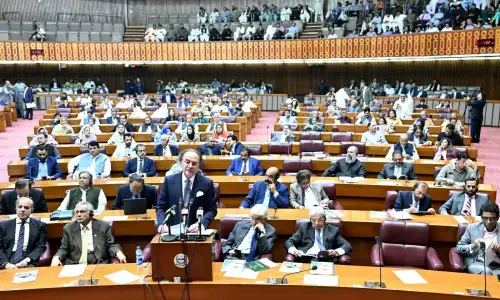
THE attitude of the opposition towards the LFO appears to be uncompromising, but the fact remains that it is because of the LFO that its members are there in parliament.
As they foresee dangers to parliament’s sovereignty, they want to check every possible danger in the way. If this is the issue, it invites the possibility of dialogues in resolving the imminent dangers to the sovereignty of parliament. Bargain demands flexibility because the extremes cannot sustain unity.
But what the opposition is trying to achieve will produce a powerful prime minister with no checks. And it was in the days of two powerful prime ministers, Zulfikar Ali Bhutto and Nawaz Sharif, that sovereignty of parliament ceased to exist.
The opposition parties are divided over the LFO. The JUI-F has stakes in the government and its leadership does not like to let the situation out of control. The Jamaat-i-Islami, whose career lies in the politics of agitation, is uncompromising even at the cost of democracy. Its leadership always idealize Talibanization. For this, if democracy is derailed, it will not hurt their interests.
The PPP is keen to exploit the situation but under the banner of the ARD. Its leaders understand the realities but are reluctant to resolve the issue. They know that political events do not just happen — they invariably results from processes that have been under way for a while.
The PML-N has to console their leader in exile. They find it the right time to settle scores with Gen Musharraf. The opposition parties which have failed to reach a consensus on the leader of the opposition are trying to achieve their vested ends in the name of sovereignty of parliament.
If politics is all about power, then our politicians are no good players of the power politics. They are divided over the issue but they believe that the iron is hot, so it is the time to strike. First, they have to secure their ground, parliament. Secondly, they have to wait for the proper place and time. It is achieved only if they perform well to ensure their further space in the corridors of power. They should try for the best but they should be ready to accept the worst.
Sovereignty is a state of mind and not an entity. It is established, achieved and ensured through conventions and traditions without being incorporated in a written constitution. For the moment, the sovereignty of parliament lies in uninterrupted democracy. There should be dialogue and debate that must lead to the end of the crisis.
SOHAIL KHALID
Toba Tek Singh
Paper mulberry trees’ issue
I WANT to convey my views on this very important issue. Being a general medical practitioner and having lived in Islamabad for last 30 years, I consider myself experienced enough to participate in this discussion.
Not everybody who comes across the pollens suffers from allergy. Susceptible individuals with inherent defect suffer from allergy. The meteorological report is misleading for a variety of reasons.
The paper mulberry tree constitutes the bulk of vegetation in Islamabad. Therefore, the percentage of pollens has to be considered in that context as well. If this tree is eliminated, this will mean elimination of more than 70 per cent greenery in Islamabad.
The allergy patient has to be prone to a particular allergen, not related to the quantity of that allergen. Only a fraction of allergen can cause allergy. So if the atmosphere contains 90 per cent pollens related to paper mulberry tree, it is quite possible that in majority of patients the underlying cause could be the remaining 10 per cent of allergens. Since nobody has conducted research on individual patients, it is difficult to pinpoint the exact culprit.
Further research is required in comparable areas, which are as green as Islamabad such as Murree, Azad Kashmir where there are no paper mulberry trees but allergy is common or even more so than in Islamabad. Till such research is carried out, it will be a crime to eliminate even a single tree.
In my opinion, each and every plant is capable of causing allergy, as are minute particles of dust, smoke, perfumes, cosmetics, etc. The allergy is directly proportional to greenery. Greener countries have more such patients than Islamabad. Nowhere in the world the trees are eliminated to treat the allergy. Imagine how our beautiful city of Islamabad will look like when deprived of 90 per cent of its trees.
In fact, the problem of allergy is self-limiting. The allergens produce antibodies in the human body, which is resistance for further aggravation. Vaccines could be the scientific solution to tackle the problem. Instead of promoting the ideas of destruction, society is obliged to find scientific solutions such as mass production of vaccines, which are within the easy reach of patients. The media has a particular responsibility in this regard.
DR M. ANWAR KHAN
Islamabad
‘Sairbeen’ programme
ON April 17, while listening to the “Sairbeen” programme of the BBC, I was shocked to hear from its correspondent, based at Hyderabad (Sindh), that the smaller turnout at the Urs of Shah Abdul Latif Bhitai was because the sowing of wheat had begun, besides bad economic conditions in Sindh.
I just don’t know if new seeds of wheat have come out through the advancement in biotechnology which are sown in April, which is otherwise a month of wheat harvesting and perhaps rice and cotton are sown in some parts of Sindh.
Further, on the same night, while commenting on the loot and arson of the archaeological treasures of Baghdad, mention was made several times of Unicef while it is Unesco which is concerned with the culture and archaeological heritage.
These may be attributed to slips of pen or tongue, but coming from the correspondents of such a reputed institution as the BBC they are difficult to swallow. Will the BBC do something about this?
DR MUHAMMAD REHAN
Nowshera
Vajpayee’s talks offer
PRIME Minister Vajpayee’s offer from Srinagar is no different from his earlier refusals to talk because he added the proviso that Pakistan should close the training camps and stop “cross- border terrorism”.
Prime Minister Jamali promptly welcomed the offer enthusiastically. However, Foreign Minister Kasuri told Reuters that if India was serious, Pakistan too was serious for substantive talks, and India would find Pakistan enthusiastic.
A couple of days back a foreign ministry spokesman confirmed that the intrusions into Indian-administered Kashmir had stopped. In the latest offer Mr Vajpayee repeated his usual demands that the training camps on the Pakistan side of the LoC be closed down and “cross-border terrorism” stopped.
Washington is going along with the allegations of India, without demanding proof from India or confronting Pakistan with whatever proof the US has. This is because of the US tilt, of late, towards India. Pakistan says there are no intrusions into occupied Kashmir and India says no and, at the same time, it is against posting of UN monitors along the LoC.
In a way the ball is in Pakistan’s court. Therefore, Pakistan should prepare an agenda for talks and send it to New Delhi immediately. If India sends an agenda of its own in the meanwhile, Islamabad should pour over it and reply promptly.
JALAL AHMED
Karachi
Roohi Bano is ill
RECENTLY Information and Broadcasting Minister Sheikh Rashid Ahmad announced a 100 per cent increase in the rates of payment to PTV artistes, writers and singers with immediate effect.
It is, of course, a good step and deserves to be appreciated not only by the artistes but all of us too. At the same time there are some artistes who are not performing anymore and they are, therefore, close-fisted. The most apt case to point out is a former radio and TV actress, Roohi Bano.
According to press reports, she is nowadays psychologically sick and finding it very hard to make both ends meet. It is a great pity that the Pride of Performance winner is living in a miserable condition and is not being looked after as she deserves to. Being unable to fall back upon anyone, she is the most deserving artiste of yesteryear who needs immediate financial and psychological help.
The minister for information and broadcasting would do well if he gets her treated till she makes a complete recovery from her illness. Furthermore, keeping in view her dilapidated financial condition, it would be quite appropriate if the minister sanctions a reasonable amount as stipend to be paid every month to the former actress until she stands at her own feet again.
A timely action and help to the former actress would go a long way in bringing an upturn in the life of an artiste whose acting once used to be par excellence.
RAFAT MAHMOOD ANSARI
Islamabad
‘Stolen car’
THIS refers to the letter entitled “Stolen car: ex-MNA’s version” (April 23) by Kunwar Khalid Yunus.
Why doesn’t Mr Yunus file a suit against Mr Ardeshir Cowasjee for defamation? I believe his party has many members who are very able lawyers, and I am sure they will be more than willing to help him clear his good name for free.
SHEHNAZ LALJEE
Karachi
World Intellectual Property Day
APRIL 26, like the previous two years, is being observed all over the world as World Intellectual Property Day, an opportunity to highlight the significance of creativity and innovation in people’s daily lives and in the betterment of society.
“Make Intellectual Property Your Business”, the theme of this year’s World Intellectual Property Day, highlights the key role of intellectual property both in achieving success for business and in enchanting daily life for us all.
With this theme, and the fact that Pakistan is gifted with the most creative of people, particularly in the fields of literature, music, science and technology, it is expected that the day will see some activity to promote the idea of intellectual property being a tool of economical development.
Making intellectual property your business is also a wider call for civil society to recognize that respect for intellectual property rights is of benefit not only to creators but to society as a whole. The intellectual property system enables innovators and creators to mint marketable inventions and works from the raw material of their artistry and ingenuity. This makes the intellectual property system a driver of technological development and ensures a force for the enrichment of our global cultural heritage and powerful tool for wealth creation for the benefit of all.
Today, universal acceptance and the strategic use of intellectual property offers an opportunity for individuals, business and countries to covert their creative resources into economic assets capable of generating wealth and contributing to a more secure future. A strong national commitment to the intellectual property system ensures the establishment of an environment within which the creative and innovative potential of a country may flourish.
Let us forge our common future today by embracing intellectual property as a way to use that creativity for the betterment of humankind.
KARIMULLAH ADENI
Attorney-at-Law,
Karachi
Post-Saddam scenario
THE three weeks of military bombardment has “liberated” the Iraqis of the despotic rule of Saddam Hussein. The aims of attacks on Iraq were many, e.g. to get hold of that country’s oil reserves, give free licence to Israel for its atrocities against the Palestine people, and keep an eye on Syria and Iran. But from the US point of view, the move was to liberate the oppressed Iraqis of the “Butcher of Baghdad” and to recover the weapons of mass destruction.
Saddam has gone but the real problem now is, who will rule Iraq, divided deeply by ethnic and religious groups? Iraq has mainly three religious and ethnic groups. The Shias make up 55 per cent of the total population of 23 million. They are mostly settled in southern part. The other group is the Sunni community making about 20 per cent of the population, mostly concentrated in central Iraq, i.e. Baghdad. The third main group is Kurds who are 20 per cent. They are non-Arab Sunni and have strong holds of Kirkuk, Mosul and Tikrit, mainly settled in northern Iraq.
To save Iraq’s integrity, it is essential to form a government representing all groups. But this is not easy. The US favours Ahmad Chalabi who has spent 45 years in exile and has no roots among the Iraqis. The US is not willing to give representation to the Shias because of their strong religious coordination with Iran. Although Arab Shias have their own policies, they have a soft corner for Iran. This community is also against the existence of Israel. It is impossible to ignore their representative.
The Kurds have their area in northern Iraq which has rich oilfields of Kirkuk and Mosul. If the US supports them, it will annoy Turkey which is opposes Kurdish autonomy.
The US is in search of moderate people from among these communities to have a better future for Iraq and for America as well. Let us see whether it succeeds or not.
MURTAZA ALI
Lahore
Boycott calls
THIS refers to Ms Tehmina Noor’s letter (April 18)l in which she describes the idea of boycotting US and British goods as unwise and fruitless.
On examination her views appear to be not only skin-deep but fallacious too. First, although global economies are integrated, their interlink is incomplete and far from being in perfect lock-step. Top four economies of world are all driven by domestic demand rather than international trade. For example, the US economy’s GDP and growth come through purchases by American consumers.
Furthermore, by boycott appeals we are trying to hit those companies that are pro-Israel and support Christian right. So the effect of boycott is on micro level rather than at the macro level and cannot possibly boomerang on us.
Finally, Pakistan’s share of global trade is a minuscule 0.75 per cent and is unlikely to be affected by a protectionist backlash by nations like the US and Britain. Even if it does so to some extent, it will be a small price to show our strength of resolve and send a strong message of disapproval and condemnation to those who make a mockery of international law and kill Muslims with impunity.
KHALID B. MANZUR
Karachi
Democracy in Pakistan
I READ with interest the letter by Mr Ghulam Kibria (April 23), wherein he has contended that democracy does not exist in Pakistan. In the strict sense of the word, he is correct.
However, to have a better understanding of the subject, democracy should not be considered in absolute terms. Democracy is not a static state of utopia which meets the expectation of all the people all the time. Democracy is an evolutionary process where a self-correcting mechanism is put in place which improves life of the public at large over a period of time.
Even in the countries where democracy has existed for some time, a process of continuing discussion and debate enables democracy to become better. In Pakistan, this process will take much longer than say in countries of Far East or of Latin America, where the essential ingredients for a prospering democracy exist.
The level of education and literacy not withstanding, these societies are free of the burden of a failed empire which went into a stupor for the longest time. The inherent conflicts and contradictions which exist in Pakistani society today are unique and have their roots in 1,000 years of history of Muslims in the subcontinent. It will take decades, if not centuries, to come close to ideals of democracy which Mr Kibria espouses.
AMIN VAHIDY
Edmonton, Canada
Death toll
“THE Pentagon will not count how many Iraqi civilians were victims of the US war against Iraq” (April 17). This reminded me of Gulf War I when the then US Chief of Staff, Colin Powell, replying to a query by a reporter about the Iraqi civilian death toll, said, “Such numbers do not interest me.”
Z.A. KAZMI
Karachi
Peanuts for pensioners
THIS is about pensioners’ plight. Dr Mahbubul Haq as finance minister introduced the system of “indexation” as in vogue in many countries. This system was adopted in view of the periodical price changes and occasional devaluation.
Finance ministers who followed Dr Haq conveniently forgot the indexation, whereas the prices of utilities, consumer goods and commodities kept on increasing every now and then. The honourable legislators were sanctioned increase in their pay and perks, and when it was the pensioners’ turn for the increase, there was no money left in the kitty.
Their services should be voluntary because they volunteer for the service of the nation and are very much sound in personal finances, whereas servicemen join the service to exist and keep the body and the soul together.
When the government does not want to help pensioners, it appoints a commission/committee and that has been the fate of pensioners every budget time. The request for increase in pension under intense pressure is looked into and some relief is granted, which is neither adequate relation nor in relation/ratio to the increase in the price.
I retired in 1964 and earned full pension of the rank of major. This was Rs450 a month at the maximum, the pay was Rs1,200 a month. This Rs450 was good enough to buy four tolas (48 grams) of gold, which now is about Rs700 a gram, i.e. Rs700x48 = Rs33,600 — the ratio of pension in 1964 to 2003 is Rs33,600.
Petrol then was Rs2.5 per gallon, i.e. 4.5 litres. Now petrol is about Rs38 a litre, i.e. Rs38x4.5 = Rs171, i.e. Rs2.5 of 1964 = Rs171 in 2003 as per the indexation. Thus pension should be increased in this ratio of prices, then and now. The ratio is Rs2.5 = Rs171.
Some weightage of this type is necessary in fixing the pension, a major retiring in 2003 probably gets Rs8,000 a month and this should be granted to old pensioners too because they are also human beings. Of course, the pensioners must qualify for it by serving the full tenure of the rank.
To add insult to injury, the government imposed a withholding tax of 10 per cent on all National Savings Schemes earning. As if this was not enough, the profit on all National Savings Schemes has drastically been reduced. The graphs of the prices are ascending and the value of rupee is descending. Let us see when this process stops, how, where and when, with what results, the way prices are skyrocketing.
The Shariat Court has already adjudicated the pension, i.e. a major who retired in 1964 gets the same pension as a major retiring in 2003. The appeal of the government is pending in the Supreme Court. Against this, arguments have been completed a long time back but the decision is withheld.
MAJOR (R) H.K. PATHAN
Karachi