0
0

ISLAMABAD, April 14: The European Union has approved a 71 million Euro (Rs4.3 billion) grant for Pakistan to help improve governance and accountability in Sindh and Northern Areas’ educational sector.
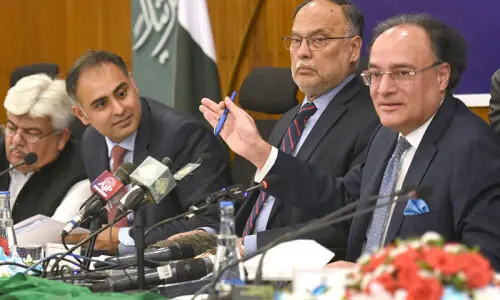
The secretary of economic affairs division, Dr Waqar Masood Khan, and head of the European Commission delegation in Pakistan, Ambassador Ilkka Uusitatlo, signed a Memorandum of Understanding to this effect here on Monday.
The grant will be used under the EU National Indicative Programme (NIP) which provides strategic framework for the EU assistance to Pakistan during 2003-05.
NIP has been endorsed by the government of Pakistan and the EU member states. It makes available a grant budget that focuses on improving Pakistan’s education sector with emphasis on good governance and accountability in the provision of educational services in Sindh and Northern Areas.
Also, the grant will be used for trade development and promotion of business and institutional links for facilitating integration of Pakistan in the world trade system, including trade sector policy formulation and institutional reforms.
From the 71 million Euro budget, 59 million Euro has been allocated for improving the education sector, 6 million for promoting EU-Pakistan trade-related activities, 5 million Euro for combating child labour and 1 million for fighting drug abuse.
NIP’s main objective is to eliminate wide-spread gender disparity in literacy and enrolment rates, and reduce the drop-out rate at primary level besides improving the competence of teachers and teaching material. NIP envisages to achieve these objectives by collaborating with provincial governments.
The Sindh education project, involving 39 million Euro, aims at supporting the provincial government in implementing a component of the Compulsory Primary Education Ordinance 2001 in all the 16 districts of the province. The goal is to help increase by 60 per cent the enrolment of boys and girls at primary level.
In Northern areas, an education project with the Aga Khan Foundation worth Euro 20 million is part of the NIP strategy to help increase the number of education centres and qualified women for development activities.
In the trade sector, NIP’s objective is to foster a trade and business environment favourable to enhancing EU-Pakistan economic relations.
Under the child labour programme, NIP seeks to progressively eliminate all forms of child labour in Pakistan by means of various interventions like empowerment of poor families, development of social safety net, strengthening of the monitoring and evaluation system and withdrawal and rehabilitation of children from hazardous and exploitative environments.