0
0

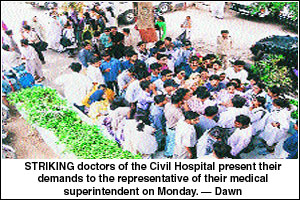 KARACHI, April 14: The house officers of the Civil Hospital Karachi called a strike on Monday morning after a series of incidents in which a colleague of theirs was severely beaten up and others were abused and threatened by the attendants of a patient.
Later in the day, the doctors resumed their duties after the hospital’s administration had assured them that adequate security would be provided to them. But, even though several policemen have been deputed to look after them, the female house officers of the hospital are reluctant to work in the ward where the ugly episode was played out on Saturday and Sunday.
An elderly woman, named Mrs Zakia Naz, was admitted recently to the medical ward number 4 of the Civil Hospital because a stroke had left half her body paralysed. On Saturday night, a house officer, Dr Shazia, prescribed a syrup for her.
When the female attendants of Mrs Naz heard about a “syrup” they simply went berserk. Saying that oral medication had been disallowed by senior consultants, they started misbehaving with Dr Shazia.
“First they called her ‘ignorant’ and ‘illiterate’. Later they started calling her names,” one of Dr Shazia’s colleagues told Dawn.
“Later, three of the attendants got hold of the poor doctor and hurled her towards a wall.” According to her, the three women punched her and pulled at her hair repeatedly. The lady doctor had to be rescued by the onlookers.
Dr Shazia didn’t turn up for work on Sunday and also on Monday. She was in no condition to resume her duties anytime soon, one of her friends said.
In the meantime, the house officers of the medical ward informed their head of department of exactly what had transpired. “The head of our department, surprisingly, kept mum and took no action. The administration’s inaction actually made the matters worse,” said one of them.
The uneasy situation, in which the doctors as well as the attendants remained irritated and tense lasted for a full 24 hours. Several doctors, including Dr Shazia, left the scene during this period.
Then at about 10pm on Sunday night the patient’s attendants, growing more restless with each passing hour because they thought the patient was not being looked after properly, decided to intervene.
According to some doctors, 40 or 50 people — raising slogans of a regional political party — raided the intensive care unit of the ward where Mrs Naz was admitted. “They didn’t beat anyone but threatened and abused every doctor they could lay their eyes on,” said one of them.
“This was too much for the doctors, especially the female ones,” one of the house officers told Dawn. The situation was so tense that the parents of several lady doctors actually drove up to the hospital and took their daughters away.
Then, on Monday morning — at about 9.30am — all the house officers of the hospital held a meeting during which it was decided that a strike would be called the same day. The strike was supposed to last until all their demands had been met.
The doctors demanded that: the people who had manhandled Dr Shazia tender an apology immediately; adequate security arrangements be made for all house officers, specially the female ones, and; a token system be introduced under which for every patient only one attendant be allowed on the hospital premises.
When the medical superintendent of the hospital, Prof Naushad Sheikh, was told that his house officers had called an indefinite strike he rushed to the hospital. There the negotiations between him and his house officers lasted for at least two hours.
At about 1pm the house officers called off their strike following repeated assurances by the hospital administration that a telephone line would be installed through which every doctor on the hospital premises would be able to call police in case there was an emergency. In addition, several policemen would be posted inside the hospital’s wards.
When approached by Dawn on Monday afternoon, Prof Naushad claimed the problem had been solved. “Look, we have ordered the installation of a separate phone line. This line will actually be an extension of the hospital’s,” he said.
“This means that after this line is installed, every doctor in case there is a need will dial 2333 and he will be able to talk to the police at the Eidgah Police Station.” He said he planned to revamp the security arrangements.
In response to a question, he admitted that the hospital’s security arrangements were not perfect. “We have only 57 positions for guards and watchmen. Out of these posts, 30 are vacant.”
Dawn also visited the medical ward number 4 where Mrs Zakia Naz is admitted. Two policemen were sitting near the entrance to the ward.
Inside the intensive care unit only two beds were occupied — one of which was Mrs Naz’s. A duty officer told Dawn that a misunderstanding had developed between Mrs Naz’s attendants and a house officer on Saturday night.
In response to a question, he said he was satisfied with the steps taken by the hospital administration. “For now we are satisfied. In case we feel that our demands are not being met we will revisit the issue.”
One of Mrs Naz’s daughters claimed that everything was back to normal. “We made a mistake on Saturday night when we refused to cooperate with the hospital staff.
“But we have apologized and everything is okay now.” She claimed that her family had no links with any political party. “We don’t know the people who came to the hospital last night.”