0
0

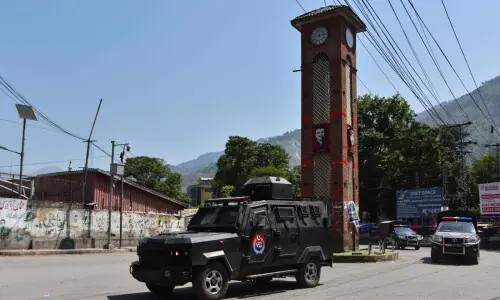
Force for Sindh-Balochistan border
THIS refers to the AIG’s proposal for forming a 1,000-man strong force to improve the law and order situation along the Sindh-Balochistan border area (April 6).
It is proposed that the force, comprising persons from the tribes of the area, will help law-enforcement agencies in differentiating between outlaws and the law-abiding local people.
In the formation of the tribal force for maintaining peace and law and order in the area, there is the other side of the picture as well. The force will be a source of much nuisance for the local population and help some people in their personal feuds and enmity under the shelter of the police.
The tribal force(s) — Jagirani Force, Chacher Force, and Sundrani Force, formed on the currently-proposed pattern by the AIG and for the same intended maintenance of peace and law and order in Kacha (Indus River belt) area of Ghotki and Jacobabad districts — have increased the miseries of the local population. They exploit people in a number of ways. Most of the people in the forces are either “wanted” in criminal cases or are the aides and assistants of the criminals and thieves of the area. They use police cover to achieve their own ends.
Although major criminal incidents have decreased, cattle theft cases have increased greatly after the formation of these forces. The forces move freely in the areas during night, commit crimes, and when intercepted by the local people, they declare themselves as people belonging to the force. The police, whose role in the law-enforcement is already questionable in the interior of Sindh, also provide them with protection.
On the same afore-mentioned pattern the tribal force is to be formed which has not produced positive results. It is suggested that the already operating law-enforcement agencies should be made strong in the tribal belt of Sindh and Balochistan by awarding them additional powers to deal with criminals. And local tribal chiefs, who perpetuate tribal feuds and animosities in most of the cases, should be engaged by the provincial and federal governments to maintain peace in the area.
The heinous crimes perpetrated in Kashmor by the tribal outlaws are alarming and have many implications. It shows how helpless the law-enforcers are in the face of the tribal outlaws who have strong political support of their tribal chiefs.
AHMED BUX GHOTO
Islamabad
‘What led to his downfall’
I READ with interest the article headlined “What let to his downfall?” by Mr Anwar Syed (March 30). He has apparently not even talked to Mr Nawaz Sharif before writing this article, as the article is based on too many presumptions and lacks objectivity, a scientific analysis and impartiality.
For example, in the same issue of Dawn, Mr Abdul Qadeer revealed that Nawaz Sharif had rejected an offer by President Clinton to deposit $100 million in the personal accounts of Nawaz Sharif and his brother if they abstained from carrying out an atomic test. If that is true then that reflects a strong character on the part of Mr Nawaz Sharif, which will be hard to match by most of our politicians and the military rulers.
As far as the tussle between Justice Sajjad Ali Shah and Mr Sharif is concerned, it was known to everyone. In a dispute between two parties, one party cannot become the judge. Justice Sajjad Ali Shad had grossly violated this very basic principle of justice. He was taking a dictation from a political party and passed a detailed judgment containing partial notes.
If Nawaz Sharif could be blamed for the attack on the Supreme Court, Justice Sajjad Ali Shah can be accused of attacking the very basic institution of justice itself.
As far as the results of the past elections are concerned, it is a fact that, while the MMA election results were by and large not touched, the PML(N) results were grossly manipulated in favour of the PML(Q). Pervez Musharraf showed his handiwork in the referendum, in which less than four per cent votes were construed to be the majority vote.
Nawaz Sharif had several shortcomings, no doubt, the worst being that he appointed Gen Musharraf as Chief of the Army Staff bypassing the senior generals. Many opportunists have since shown their true colours, and I hope Mr Sharif has realized how important it was to appoint people on merit.
Still Mr Sharif does not comprehend Benazir, and fails to realize that the PPP was fully aware of his toppling and was collaborating with the military regime and the US in the so-called plane hijacking.
Mr Sharif should become sincere to the cause of Islam and Muslims and must not make friends with those who have a known dislike for Islam and the Muslim ummah. He must shun double standards and condemn Bush’s global terrorism.
RAO ANWAR UL HAQUE
Islamabad
Diplomatic protocol
THE phone call made by President Musharraf to Gen Collin Powell after a symbolic US ban on KRL does not appear to be in line with the diplomatic protocols. It is often seen, specially since 9/11, and the start of US hostilities over Afghanistan, that the US officials are showing a highly undiplomatic and aggressive stance towards the Pakistani echelons of power.
The US ambassador, US Secretary of State, US Secretary of Defence and a host of others are seen all the time violating the honour and dignity of the Pakistani diplomatic protocols. It is time Pakistan started reasserting its rightful weight in the diplomatic circles.
Let the world, including the US, have access only to the people of their own levels in the Pakistani power, government, and diplomatic circles. Is the Pakistan ambassador to the US allowed to see President Bush any time he so wishes?
HASHIM SYED MOHAMMAD BIN QASIM
Riyadh, Saudi Arabia
Guided bombs
THE US commanders insist that the laser and GPS guided bombs being dropped on Baghdad cannot miss their target beyond a couple of metres. Hence the market place and the residential areas in the city were destroyed by the Iraqis themselves. This is an astonishing claim when we look at the scientific explanation.
The laser bombs are guided to the target by a laser beam directed at the target by an overflying aircraft or satellite. This beam, like ordinary light, gets deformed or scattered by smoke, dust, fog and other weather elements. So, the bomb loses its precise direction. This was the main reason that Iraqis put the oil filled trenches to fire around Baghdad when the US ground forces were still hundreds of kilometres away.
The GPS bombs are guided by the three dimensional geographical/topographic coordinates beamed to the missile by an overhead satellite. The problem here is that the geographic coordinates and the actual location of the target some time do not match exactly.
So, both kinds of systems are not immortal after all.
A. HAMID
Karachi
Charges on savings
THE State Bank of Pakistan has allowed all scheduled banks to impose service charges etc. on the PLS/saving accounts with confirmation with account holder. As such now the banks are asking all account holders for confirmation of payments of service charges etc.
These banks are now charging Rs200 in service charges on a six-monthly basis, along with other charges, on the minimum balance of less than Rs10,000 in all PLS/saving accounts.
It is obvious that the banks are not interested in small deposits. Hence, it is important that the CBR now allows the payment of salary to the employees up to Rs20,000 in cash.
MOHAMMAD USMAN
Karachi
Children’s hospital
I WAS shocked to see on a Metropolitan page (April 4) a beautiful hospital building which stands abandoned in Karachi and where animals roam over. Isn’t this a sad reality of our society?
We have little resources and even those are not properly handled and a lot is wasted because of lack of proper planning. This hospital is its typical example, but it is not the first time. Very often newspapers carry such news items which make one sad and upset that we begin big projects without taking into consideration all the implications.
The same thing happened with this hospital. For the last five years the building, constructed with Rs24 million, has just been abandoned. Won’t it be nice if such things are not repeated in future, and our resources used properly so that not a single paisa is wasted?
I thank you for the services you and your team is rendering to humanity.
INDRIAS REHMAT
Karachi
CPLC: change of leadership
THE citizens of Karachi have noted with a heavy heart and a degree of resignation that Mr Jameel Yusuf of the CPLC has been de-notified as its chief. The government had tried to remove him three months ago but the public outcry at that time had forced it to defer the action till another time.
Many of us can vouch for the fact that the CPLC under Mr Yusuf worked fearlessly and hard to ensure that police harassment of the public was minimized. We can only hope that the CPLC will continue in the same manner as before. The funding for this was largely from the private sector. This was in no small measure due to the respect and trust that the institution and its leadership enjoyed.
Any future leader of the CPLC will have a tough act to follow to inspire the same degree of trust and respect. The CPLC was also a very accessible forum. Citizens like Mr Yusuf build institutions in Pakistan against heavy odds and despite many hurdles put in their way by the manipulative bureaucracy and the corrupt political system.
The government needs to thank such individuals and encourage them rather than seeking to confront them and arouse controversy surrounding their activities.
Your newspaper carried a rather sweeping and cynical observation (April 1) by a government servant stating that the philanthropists who invest in public-private partnerships do not want to be involved in the institutions they help — they are simply donating money in order to get publicity! How can a public servant be allowed to utter such views without being taken to task by his superiors?
The government has failed miserably in providing civic amenities and does its best to dishearten anyone who tries to do something on their own. The Kidney Centre debacle is another case in point.
We wish to thank Mr Jameel Yusuf and the CPLC for their sterling services to Karachi’s citizens thus far and hope and pray that the institution continues to be effective.
F. MOWJEE
Karachi
Semester system
THIS refers to a report published on April 2 under the heading ‘Semester system slammed’ by Mr Zulqernain Tahir. Your reporter has condemned the semester system on the basis of a few questions in the mid-term examination of Islamic Studies.
I did my MBA from IBA, Karachi. That was for the first time I realized the difference between knowledge and formal education and it was because of the semester system. Right now my daughter is doing her MCS at PUCIT and my son is in BSc (Hons) in PU. They are both quite satisfied with their studies and so am I.
In the semester system the abilities of a student are judged through assignments, presentations and mid-term and final examinations. The final results are prepared in accordance with the student’s performance in all these as a whole. Hence a student has to study regularly and is difficult for him to miss even a single lecture.
It is also difficult to manipulate the results, because every student is aware of the others’ performance. This is also the prevailing system of education throughout the world.
On the contrary, in the annual examinations system, it is very easy to manipulate and achieve the desired results. Moreover, a student does not have to work hard to obtain a good position.
Due to this reason, certain sections of the academic staff and some student unions at the Punjab University are against the semester system. The unions with political affiliations are so powerful that even the VC and the registrar try to overlook their activities.
I would request you not to publish such one-sided and biased reports because they damage the credibility of your newspaper.
MOHAMMED ASLAM
Lahore
Trust schools
THIS is with reference to the editorial of April 6. I really appreciate your efforts in this regard.
In 1994 I matriculated from the Ghulaman-i-Abbas School. This school was not set up by the people of Lyari, but by the trustees of the Habib Group. I also want to add that the notable Hyderi Hostel is located at the same place with its own separate premises for students who opt to live there.
Through your newspaper I want to thank all the trustees, the dynamic teachers and specially Mr A. K. Khatri, who have devoted their lives to running this remarkable institution.
SHAHID ALI
Karachi
Water closure in Korangi
WE, the residents of Zaman Town, Phase II, Sector 35-A Korangi No. 4, bring it to your notice that we have been without water for the last about 15 days. There is a complete closure of water supply and not a single drop of water is being supplied to this sector of Korangi.
Nobody listens to our complaints or takes any action regarding the matter, and that too in the extreme hot weather in Karachi.
We regret to bring it to your notice that in the absence of any piped water, we the residents have no choice but to consume the sub-soil unhygienic water at a great risk to our health.
RASHID MUSHTAQ & OTHERS
Karachi
Town without fire-brigade
IT IS a pity that Tando Mohammad Khan has been without any fire-brigade for many years. It appears that if a tragedy befalls the town, help will have to be sought from the Hyderabad city, which is 35 kilometres from here.
On April 5 a dangerous situation developed when a truck loaded with straw caught fire. Nothing could be done about it except to wait for help from Hyderabad. The fire damaged electrical cables, leading to the breakdown of power supply. I request the Hyderabad Nazim to provide a fire-brigade, with a rescue team, to the area.
SADAQAT ALI SOOMRO
Tando Muhammad Khan
First step?
THE United States has imposed sanctions on trade with the KRL. Watch out, everyone. Could it be the first step towards destroying the weapons of mass destruction of Pakistan?
COL (R) RIAZ JAFRI
Rawalpindi
Problems of Qasimabad
HYDERABAD is the second largest city of Sindh after Karachi, and Qasimabad is its second most populated area after Latifabad.
Located opposite the famous Rani Bagh, it was upgraded to the status of subdivision, but it still lacks basic civic facilities.
The area has only one government high school that works in two shifts — the morning shift for girls and the evening one for boys. Two more government high schools are needed for the locality, separately for boys and girls.
Also, the situation as regards postal facilities is very bad. There is only a single-room post office, operating experimentally in HDA building. The letters received from the head post office are delivered very late. Moreover, Zakat fund distribution by the post office continues for half of the month, disrupting normal postal activities.
This forces people to visit the city centre, at great cost of their time. It is also unfortunate that there are no National Bank and Habib Bank branches here. Streetlights are no more found, in fact never installed. Roads are in bad shape, and everything else beyond the reach of the common man.
It is time the authorities did something to lessen the sufferings of the people.
NAYYAR HUSSAIN MIRJAT
Hyderabad
Repercussions of war against Iraq
AFTER the war against Iraq is over, we can visualize a ravaged and damaged Iraq, with huge shortages of food, medicines, etc. As almost all buildings will have been damaged, it will need a massive re-infrastructure programme. But at issue is restoring the confidence in people who suffer from frustration and fatalistic attitudes.
Perhaps a puppet government like the one in Afghanistan can be installed under the American umbrella. In such a situation the misery of the Iraqis will be limitless because this setup would work under a US plan and do little to minimize the miseries of the common people, as witnessed in Afghanistan.
In the meanwhile, the Saddam supporters here and there could ambush and kill people. So, it can be predicted that the pro-war situation in Iraq is even more volatile, explosive and chaotic than now.
The war could split the united bond of some atomic-capable countries, namely China, Russia, France and Germany, with the US and Britain. So, if this happens, a wave of cold war could be arguably forecast. And it is the most dangerous aftermath looming large.
After the war, a serious recession is a must across Asia in particular and the rest of the world in general. Already, the share markets of various countries in Asia are downward and its wave is sure to touch Europe and Africa very soon. The price of oil can be boomed and the developing countries will suffer much because they will have to seek aids from donors to keep themselves afloat.
In the Middle East, the political climate will get further gloomy. Israel could intensify its offensive against the Palestinians because the removal of Saddam would be considered a big loss to Arafat.
Moreover, the endeavour to establish regional supremacy would increase between the countries of the Middle East, and it is worth observing as to who would control the Middle East — the US or China.
The serious matter to be noted is how the US would respond to the North Korean threat. Moreover, an overconfident US will might further lessen its respect for the UN, and unless France, Germany, Italy, Russia and China are not ready for a big effort in this regard, the world would be in chaos.
SULAV BARUA
London, UK