0
0

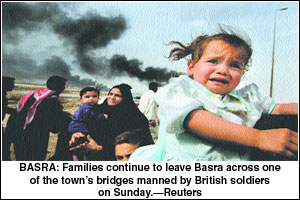 CENTRAL IRAQ, March 30: Some US troops said on Sunday they had been told a pause in land advances towards Baghdad could be extended several weeks because of overstretched supply lines from the south and stiff Iraqi resistance.
As the war entered its 11th day, soldiers said they were digging trenches, laying mines around camps and camouflaging vehicles, but that the aerial and artillery bombardment on Iraqi positions in and around Baghdad would continue unabated.
Military officials told troops with one frontline unit that the pause could last 35 to 40 days, far longer than a wait of up to six days they were warned of on Saturday.
US Gen Tommy Franks, commanding the miltary drive, rejected suggestions of a pause in fighting.
At another unit in central Iraq, troops were told they might have to wait for at least two weeks before moving forward. Food rations have been cut for some frontline US units and fuel use has been limited as supplies dry up.
But the 3rd Infantry Division, just south of Karbala, a city 110 km southwest of Baghdad, are among the furthest forward and continued on Sunday to pound Iraqi Republican Guard positions around the city with artillery.
Senior officers at the forward headquarters of the 3rd Infantry Division, US 5th Corps, said the battle for Karbala might be delayed for five or six days, but expressed surprise at suggestions an assault on Baghdad might not come for a month.
But Reuters reporters with US forces in central Iraq said field commanders were being told that a pause was needed because supply lines had been outrun and convoy routes were too vulnerable to attack from Iraqi militia sheltering in towns that the advance units of the US-led invasion have already passed.
“It looks like they are going to be in this position for at least two weeks, the sergeant says,” said one reporter.
“They’re going to send in the aircraft to do the work before the grunts (foot soldiers) go in. It’s going to be more air strikes, at least for a couple of weeks probably.”
NO OPERATIONAL PAUSE: Word of a pause in land operations first came on Saturday to allow field officers time to sort out logistics problems caused by the long supply lines from Kuwait.
US officials said on Thursday they planned to bring in another 100,000 US soldiers by the end of April to add to the 125,000 US and British troops already in Iraq.
US Joint Chiefs of Staff Gen Richard Myers said his forces could afford to take their time and were prepared to dig in as they waited close to Baghdad, which has endured some of the heaviest bombardment of the war in the past two days.
“The one thing that we have on our side and we are already using...is patience,” Myers told BBC television on Sunday.
Addressing a news conference at US Central Command in Qatar, Gen Franks rejected the idea of a pause.
“There have been some pundits who have indicated that perhaps we are in an operational pause. It is simply not the case. There is a continuity of operations,” he said.
“Combat operations are continuing. They’re continuing in the north, they’re continuing in the west, they’re continuing right around Baghdad.”
Asked about some soldiers having their rations cut, Franks said it was possible outlying units might have missed the odd meal, but there were no problems with supplies.
“We have and have had sufficient stocks all across the battlefield of food, water, fuel ammunition,” he said.
FRUSTRATION MOUNTS: Heads dropped as word was passed to the troops at one frontline unit that they might be staying far longer than they anticipated to allow reinforcements to arrive.
Many had hoped they would be home by the end of April.
“There is a realisation that we came in a little light,” one officer told his men. Some troops are within 80 kms of Baghdad, but almost 500 km from bases and supplies in Kuwait.
Iraqi Information Minister Mohammed Saeed al-Sahaf has said the long supply lines were like a snake Iraqis would chop up.
Frontline officers said the hold of Iraqi paramilitaries on the towns was preventing the people rising up against Saddam.
“The popular uprising has not happened as we predicted,” one officer told Reuters. Soldiers at another unit were told they were waiting so resistance to Saddam could gather pace.
BOMBING: Meanwhile, US and British planes and missiles kept up a relentless barrage on Baghdad on Sunday, pounding the south and east of the city and targeting a presidential palace and a training site for Fedayeen paramilitary forces.
As night fell on the 11th day of a war to overthrow Iraqi President Saddam Hussein, a huge fire raged close to central Baghdad.
It looked as though Iraqis had set alight an oil-filled trench, sending plumes of thick, black smoke billowing into the sky in a bid to hamper the US and British air strikes.
Well into the evening, fresh explosions could be heard, with planes overhead and the rattle of anti-aircraft fire.
Earlier planes flew low over the capital as explosions rumbled along the southern fringes, growing in intensity through the afternoon.
Iraqi Republican Guard troops are said to be dug in south of Baghdad ready to defend the capital against advancing coalition forces.
Iraqi officials said six civilians were killed and five wounded in an air raid on the industrial area of Zafraniya south of Baghdad on Sunday. Reuters journalists taken to the scene saw wounded people in hospital.
Telephone lines in Baghdad were badly disrupted after repeated strikes on telephone exchanges.
OVERNIGHT ATTACKS: In Washington, the US military said it had bombed the main training site for Iraqi Fedayeen paramilitary forces in eastern Baghdad, a presidential palace, an intelligence complex and surface-to-air missile sites in overnight strikes.
“The strike enhances the security of coalition air forces conducting missions over the capital city of Baghdad,” the military’s Combined Forces Air Component Command said.
Reuters journalists in Baghdad said bombs had targeted a complex inside a presidential palace used by Qusay. The complex had already been hit by several missiles in the first days of the war.
Iraq says 62 people were killed and 49 wounded in a devastating explosion in a crowded Baghdad market on Friday which it blames on a US attack. The United States is still checking whether its forces were responsible.—Reuters/AFP