0
0

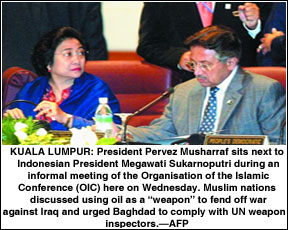 KUALA LUMPUR, Feb 26: The Muslim world is considering the use of oil as a weapon to exert pressure on the United States, but is unlikely to do so.
This was the conclusion to be drawn from Malaysian Prime Minister Mahathir Mohammad’s remarks at a briefing for the international media on Wednesday on an informal meeting of the Organization of Islamic Conference in the morning.
The Malaysian prime minister began his briefing on an upbeat note, by saying there was a consensus on the oil issue, but he made it repeatedly clear that the consensus was merely on “considering” the possibility of using oil as a weapon.
Mr Mahathir Mohammad said the OIC meeting agreed to consider using oil as a weapon as a means of exerting pressure on the United States, but there was no consensus on how this could be done. Conference sources said oil-rich nations were not fully satisfied that the Muslim world’s oil could be used as a weapon.
There were “minor differences” no doubt, the Malaysian premier said, but those differences were about how to go about it. “But most of agreed to look into it and not just dismiss the idea.” In any case, he said, “we did not go into derails.” The focus was not on oil but on the problems facing the Muslim nation.
The Malaysian prime minister said using oil was “a double-edged weapon,” and that it could have “dangerous repercussions” around the world. The first and foremost to be affected would be the OIC’s oil-less countries. Oil prices were already high, and if there was war, the price could reach $50 per barrel. This would not only destroy the economies of oil-importing OIC members but would also affect the rich countries.
America, too, would be adversely affected, because the world’s economic growth would come to a halt, and the American economy — already hit by the 9/11” — would be grappling with the recession that would set in. “We should think about it and be careful. It may hurt us more than (it may hurt) others.”
All that the OIC members had done, he said, was to consider if oil could be used as a weapon and how best its oil wealth could be used to exert pressure on the US to help avoid war. The NAM chairman cautioned that using it carelessly or without due care would hurt the Islamic world more than the US. “By and large we agreed that we should try to influence as many people as a possible. I would write to the Security Council and the European Union as NAM chairman to urge them to help avoid war against Iraq.”
The Malaysian leader, who won praise for his speech at the NAM meeting on Israeli terrorism, said the OIC members and the two non-NAM members who attended Wednesday’s meeting were “all of the same view with regard to the killing of Palestinians by Israelis ... and would like to see that Iraq is not invaded by foreign forces.” At the same time, they agreed that Iraq should “comply completely” with the UN resolutions and cooperate with the inspectors with regard to the weapons of mass destruction.
He said Iraq denied that it had any weapons of mass destruction and “the OIC members do not doubt Iraq and see no need for verification.” The OIC members agreed to make common cause with countries that were against war, especially France, Germany, Belgium and Russia. “By making common cause (with these countries) we will be able to exert some influence on the US.” The OIC in any case was meeting in Doha, Qatar, next month and all OIC members would be attending it. The OIC after all had some degree of influence with the US, and thus it should continue to play its role.
The Malaysian prime minister said the OIC had no plans to send a team of observers to the Israeli-occupied territories to report on the Jenin massacre. Israel had refused to allow the UN mission, “and there is no reason to believe that Israel will be any more considerate” this time.
Asked whether he feared that after Iraq’s destruction other Muslim countries too would be picked up one by one, he said that was true of NAM members also. “If they do not stand united, they would be one by one rendered incapable of doing anything.”
Asked whether his government would deal with the next Iraqi government if there was a regime change there, Mr Mohammad said it would depend on how things go. “If the Iraqis accept it, then we would have to respect the decision of the Iraqi people. But if there was total rejection (of the new regime), and there is civil war, then we will have to wait and see.” Basically, he said, “it was for the people of Iraq to decide what kind of government they wanted.”
He said there was no need for a second UN resolution, because the first one was quite adequate. Asked whether Muslim countries which were friendly with the US and were aid recipients had tried to influence Washington, he said: “So far, there has been no evidence. But there is consensus on Iraq and Palestine. Regime change is basically the business of the Iraqi people.”