0
0

PESHAWAR, Feb 15: A council of clerics constituted to firm up recommendations for the enforcement of Shariat in the NWFP says it has given final shape to a draft ordinance that will soon be presented to the provincial government for approval and legislation.
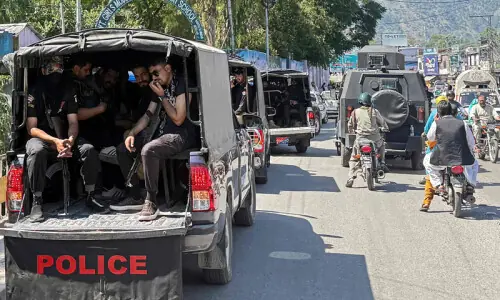
Amongst a raft of recommendations, says Maulana Gul Naseeb, the MMA government’s pointsman on the enforcement of Shariat, is a proposal to give a certain role to the police to work as the department of promotion of virtue and prevention of vice.
The Taliban in Afghanistan had a similar department that was tasked to enforce the ‘good’ and prevent what was perceived as ‘bad’ or un-Islamic by them.
Maulana Naseeb, however, hastens to add that unlike the Taliban the police will not use stick to enforce the ‘good’ and prevent the ‘bad’ and he insists that the police will not be named as such — the department of vice and virtue.
“But give it any name, the police essentially would be doing the same thing,” he maintains. “The police need to be made more effective and we have set about doing just the same.”
Maulana Naseeb is a key member of the 21-member Nifaz-i-Shariat Council that besides the clerics includes technocrats. Among them is Law Secretary Amir Gulab Khan, who took over from Salim Khan, the former law secretary, early this month. Gulab Khan is a former judge of the Malakand division that is governed under the Nizam-i-Adl Regulation.
Ironically, Saleem Khan, who had framed the Shariah Regulation in the Malakand division and is also author of the draft ordinance for the enforcement of Shariat now before the 21-member council for discussion, was removed unceremoniously.
Insiders say his draft ordinance based on the recommendations of the Council of Islamic Ideology fell short of expectations of the Nifaz-i-Shariat Council — a body that serves both as the policy-making as well as the watchdog of the MMA government led by Akram Khan Durrani.
Beside other things, the council would also want to enforce the Islamic laws in letter and in spirit that include the laws involving Qisas and Diyat, Hudood, Qanoon-i-Shahadat and Qazf.
The laws that provide for harsh punishments are part of the Pakistan Penal Code and have rarely been applied.
Talking to Dawn, Maulana Naseeb acknowledges that power to amend the PPC rests with the federal government but argues that there is a way to go about it without eliciting the Centre’s approval. He says the recommendations will be sent to Ulema in Karachi and Lahore to elicit their opinion before submitting the final draft to the provincial cabinet.
He says the council has set for itself short- and long-term objectives to Islamize society. The long-term goals, according to him, include the provision of employment, revitalization of agriculture and industrial sector and doing away with what he calls outdated laws.
The short-term objectives include the restoration of law and order and provision of justice. “The recommendations are almost ready,” he says.
But those with knowledge of the CCI’s 71 recommendations pertaining to the province maintain that the proposed amendments will have little or no bearing on people. The amendments proposed include laws as old as they were in 1798 and 1802.
Dawn has a copy of the province-related recommendations of the Council of Islamic Ideology, including such proposals as amending the Police Act 1861 that has now been replaced by the Police Order 2002, a law concerning Cotton Ginning Factories Act 1925, Hazara Forests Act 1936, Factories Act 1934,, the Control of Essential Commodities Act NWFP 1947, the NWFP Kabul River Project Act 1948, the NWFP Provision of Edibles Act 1948, the NWFP Trees and Brush Wood Protection Act 1949, the NWFP Control of Sugar Mills Act 1950, the West Pakistan Nomads Ordinance 1958, the West Pakistan Pests that harm crops Ordinance 1959, the West Pakistan Goats Ordinance 1959 and the West Pakistan Rice Ordinance 1959, etc.
A provincial minister concedes that an initial draft presented before the cabinet included such amendments, proposed by the CCI, that it looked all so ridiculous in the first place. “All this time, we have been taking about the enforcement of the recommendations of the Council of Islamic Ideology and there we were looking at proposals that concerned ducks and goats.”