



 0
0

 Wheat in Pakistan is a prime food commodity and staple food for more than one third of the world population. Currently, over 8400000 hectares of wheat are under cultivation (Pakistan statistical year book 2001).
The major area of wheat in Pakistan lies in Punjab followed by Sindh, NWFP and Balochistan. During 1998, Washington-based International Food Policy Research Institute (IFPRI) in its annual report had projected that “Pakistan’s dependence on wheat imports is likely to mount to 15 million tons per annum by 2010 from the planned 4 million tons in 1997-98”.
However, contrary to the IFPRI projection, Pakistan harvested a bumper wheat crop in 1999-2000. The official estimates put total production over 21 million tons. This production tempo was maintained next year too despite the water crisis. With bumper crop in the last two years, Pakistan produced enough wheat to meat the domestic needs as well as to export.
Currently, Pakistani wheat is being exported to Afghanistan, Iraq, Sudan, Dubai, Kenya, Somalia and many other countries. However, along with this good development, there is also a bad development taking place which may threaten the current sustainability of wheat production in the country if timely appropriate action is not taken by the concerned departments. The very bad development is injudicious use of pesticides for the minor pest of wheat crop. No doubt, wheat crop is subject to a number of insect pests but none has caused wide-spread damage hitherto to the extent of large scale control measures, especially with aerial spray in any part of the country.
However for the last couple of years, following unchecked and injudicious spray of pesticides on cotton crop have allowed resurgence of army worm on cotton crop in Ghotki district of upper Sindh. Next generation of army worm have been found causing sporadic damage of wheat crop in the area adjoining to the desert belt of Districts Sukkur Ghotki and Khairpur. Damage to early sown berseem fodder crop. This year during the last week of March while visiting wheat growing areas in Quetta valley it was observed that to control aphids (sucking pest) on tender wheat crop spraying of highly toxic pesticides, especially methamidophos was rampant.
A visit to pesticide dealers in Quetta revealed the sale of pesticide in large quantity for wheat pest control alone which was certainly a bad omen. It would be proper to mention that several species of aphids appear in wheat field crops each season. Some are relatively unimportant and for the most part are kept in check by predators and parasites. Others may occur in high numbers for a short period but do little or no damage.
As a matter of fact, natural enemies of aphids play big role in reducing their numbers. Probably the greatest and most abundant predator of aphids is the ladybird beetle. It has been estimated that one ladybird beetle can consume up to 200 aphids in one day. Both the adult and larvae of the ladybird beetle are ferocious predators on aphids.
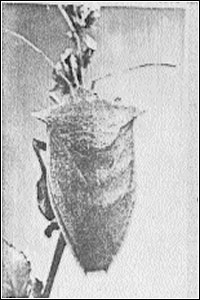
In spite of the fact that aphid pest of wheat crop did not warrant chemical control measures hitherto but during March 2002 resurrection of a deadly bug (Eurigaster integriceps) after a long slumber of over 40 years over an area of about 5000 acres in district Kohlu (Balochistan) is certainly a matter of great concern. This is because any mishandling in respect of its control may led to regular spraying of wheat crop on large scale especially with aerial spray like neighbouring country Iran where aerial spray is undertaken regularly on thousand of hectares for control of this bug of wheat crop commonly known as sun-bug or wheat-bug (Family-Pentatomidae).
The very bug is brightly coloured and have five segmented antinae. When disturbed they emit disagreeable odour. The odder comes from two glands on the thorax. The family (Pentatomidae) contains more than 5000 species. Some are exclusively carnivorous and other being exclusively plant feeders. Review of literature has indicated that this very deadly bug (Eurigastersp) was not endemic to Pakistan but got introduced from the western land frontier of the country like other notorious exotic pests viz: Codling moth, Sanjoce scale etc. However, hitherto wheat-bug is restricted to Balochistan province only posing serious threat to wheat crop in the valley.
Reportedly this very pest had destroyed almost 75 per cent of wheat crop during 1940-1943 in Balochistan. According to Dr S.A. Ghauri and Mumtaz Ali Khan in 1958 this pest again become serious and destroyed about 10000 acres of wheat crop in the valley of Balochistan. Review of literature has also indicated that origin of this pest (Eurigaster sp.) is Russia but also found in Iran, Iran, Turki and Syria and also in Pakistan now. According to the Agriculture Department Quetta during Rabi-2001-2002 season following out break of this pest District Nazim Kohlu of Balochistan requested wheat commissioner in Islamabad for arranging aerial spray who in turn requested the Department of Plant Protection and the Director General, NARC, for necessary action.
A joint survey team visited the affected area and reported that attack of wheat bug was more severe on the rain-fed wheat crop than the irrigated crop. Moreover in the rain-fed area a local wheat variety was the main victim of the bug. Nymphal population of bug on the local variety was recorded 555 per hundred sweeps whereas on owned Fakhr-e-Hind variety (smuggled wheat variety of India having long earhead but poor in yield) population of bug was only 64 per hundred sweeps. On irrigated wheat varieties like Zardana and NH97 bug infestation was not severe. However, this difference in the severity of attack was attributed to difference in the planting time by the joint survey team. Regarding control measure the survey team recommended spraying of wheat crop with different pesticides namely Chlorpyriphos, Diazinon, Malathion, Fenvelerate, etc.





























