



 0
0

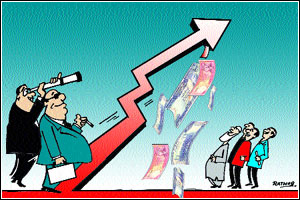 Will the corporate investors seek the assistance of the stock exchanges in Pakistan to raise new capital from the public by selling their shares to them following the phenomenal rise in the 100 share index of the Karachi Stock Exchange by 112 per cent in 2002?
This question is being asked by the small investors following the record rise in the KSE index which has exceeded the last peak of 2661 points in 1994, and outperformed other exchanges of the world, including the Dow Jones of the U.S. which fell by 16.76 per cent in 2002, The Bombay Stock Exchange index which dropped by 3.52 per cent, and even the robust Chinese Exchange which fell by 17.52 per cent.
Normally this record rise in the KSE index which stood at 2,778.15 points on Wednesday, along with the astounding performance of the Lahore and Islamabad Exchanges, should draw more of the new big investors or new investment by the old investors to the stock exchanges and through them to the public share-holders at large. But investors in Pakistan have not always been rational, nor the KSE always operated in a rational manner altogether.
The total of the new companies listed on the KSE in the last five years was only 11. They were: one in 1999, none in 1998, none in 1999, 3 in 2000, 3 in 2001 and 4 in 2002. And the number of listed companies came down from 773 in 1998 to 719 in 2002 - a fall of 54 companies. And that was the outcome of some of the companies becoming private limited companies with the approval of the regulators and others being delisted for various failures of the management of such companies, including becoming non-functional. Clearly the corporate sector has been shrinking instead of expanding.
The KSE index with its market capitalization of 10 billion dollars now may fall after sometime but the experts expect the fall at its bottom to be around 2000 points which will be far above the 1273 points at the beginning of 2002.
The new investors may now prefer to go to the banks for their capital’s interest rates have come down to almost 10 to 11 per cent to credible borrowers with a good track record. The banks want such borrowers as they have surplus funds which they have to lend to pay their depositors. They are also getting very low returns from investing in the Pakistan Investment Bonds sold by the State Bank of Pakistan at around 4.42 per cent. The government and the State Bank are pressing the banks to lend money to industrial investors for creating jobs.
The big investors can now feel it is better to borrow from banks at cheaper rates rather than go to the stock market and answer too many questions by it as well as by the Securities and Exchange Commission, who probes their intrinsic financial merit.
The design of many big investors to expose themselves to the stock exchanges and the SECP as little as possible has made some of them turn their companies into private limited companies after buying back their shares from the public at higher than their low market prices. The SECP two has preferred that to letting the common share-holders lose through the mismanagement of companies whose shares they had bought, often at high prices.
And the old big investors instead of asking their share-holders to buy their right shares have sold their Term Finance Certificates to the banks and others. They find that a simple means to raise additional capital than go through the stock market again. Finance companies, too, have resorted to TFCs in a big way- the latest being the Securities Leasing Corporation which has sold TFCs for second time for Rs.229 million of which Rs.60 million is to be sold to the public.
The banks, particularly the public sector banks, are burdened by large investment loans given for various projects to the private sector, which has not been repaid. Hence the non-performing loans are to the extent of Rs.250 billion. The new investors have hence to be encouraged to go to the general public for raising capital through the stock exchange, and the public wants to buy the shares of good companies and credible investors.
Asked whether the government proposes to take special measures to induce the investors to go to the stock exchange to raise their capital, instead of approaching the banks because of their reduced interest rates, Advisor to the P.M. on Finance Shaukat Aziz said the government has already provided for fiscal relief for small investors, including exemption from capital gains tax, which can be very large in the new circumstances of the soaring KSE index. He wants the stock exchange to make more effort to make the investors sell their shares to the public and the companies themselves to take the lead in this regard. He says, in Japan those who wished to serll shares to the public knocked at the doors of people and sold their shares.
Honest investors have a great deal to gain now by selling their shares to the public. The SECP now permits them to sell shares at prices far higher than the face value if warranted. The Lucky Cement, for example, has sold its shares at Rs. 20 instead of the face value of Rs.10/-.
The KSE index has shot up for a variety of reasons. To begin with, the index at 1273 at the end of 2001 was too low and some of the best shares were being sold at low prices because of various economic and political factors. The country was under the nuclear sanction first and then the military rule sanction. The dramatic turn-around began with 9-11 in the U.S. which brought Western political and economic support to Pakistan as a front-line state in the war against terrorism.
The macro-economic policies of the government which stabilised and revived the economy have been helpful to the KSE. The KSE itself introduced various reform measures to strengthen the exchange and check some of the many abuses in it. The successive reforms brought about by the SECP and its constant vigilance have put the operation of the exchange on a far better footing. Finally the appointment of Mr. Moin Fudda as managing director of the KSE and his vigilance have strengthened public confidence in the Exchange further.
Cleaning up the stock exchanges alone is not enough. The corporate sector as a whole has to be cleaned up despite the resistance of unscrupulous characters who are plenty in that. Too many of their children and servants should not be made directors of companies by the investors. Auditors of companies have to become far more diligent and honest. Corporate governance should improve radically and become truly transparent.
The big investors would gain a great deal through this process. Instead of exploiting or looting their companies and running down their share prices and making money immorally, they can make larger gains by keeping their companies robust, their share prices higher and their market capitilization far larger. In the process they can borrow far more from banks pledging their high priced shares instead of going to the banks to float their TFCs at high interests as the public would not buy their shares when their credit rating is low.
The SECP under Khalid Mirza has done a great deal to clean up the corporate sector and the stock exchanges, and he has to do far more in this cavernous sector with too many dupes for the few good men we have marked for their corporate excellence.





























