0
0

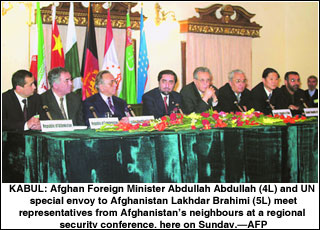 KABUL, Dec 22: Afghanistan’s neighbours signed a pact on Sunday pledging never again to interfere in the affairs of the war-ravaged country, to mark the first anniversary of President Hamid Karzai coming to power.
Foreign interference has been behind more than 20 years of devastating conflict in Afghanistan which has wrecked the country, left more than two million people dead and sent millions into exile abroad.
UN envoy Lakhdar Brahimi said he hoped the “Kabul Declaration”, signed by foreign ministers or ambassadors from China, Iran, Pakistan, Uzbekistan, Tajikistan and Turkmenistan would mark a new chapter in regional relations.
The agreement emphasises constructive and amicable relations, mutual respect for sovereignty and territorial integrity and a commitment to refrain from actions that could jeopardise peace.
Brahimi said he expected it would help both the consolidation of peace in Afghanistan and the big task of post-war reconstruction.
Brahimi said he believed the deal would put an end to recent interference from countries believed to have provided backing to Afghanistan’s violent warlords.
“I think the neighbours of Afghanistan, by signing this agreement today, have joined hands with Afghanistan to work for consolidated peace in Afghanistan and the region,” he said.
Representatives of the Group of Eight (G-8), India, Saudi Arabia, Turkey, the European Union and the Organization of the Islamic Conference also attended the Sunday’s meeting amid tight security provided by Afghan authorities and foreign peacekeepers.
UN Secretary-General Kofi Annan, in a statement read out by Brahimi, called Sunday’s agreement historic.
“Afghanistan and its neighbours have become all too aware of the dangers and the damage of foreign occupation and wars,” he said.
“I sincerely hope that the signatories will look back, years hence and remember today’s signing, not as an isolated event, but as a new beginning.”
Speaking after the signing ceremony, Afghan Foreign Minister Abdullah Abdullah told reporters the declaration represented a momentous step for Afghanistan and its neighbours, although the region still faced many challenges.
“Afghanistan has come a long way in the past 20 years,” Abdullah said.
“The 22nd of December last year, the establishment of the interim government ... was an historical event in our history.
“Since then, in different fields, a lot has happened, positive developments and achievements, at the same time major challenges. Of course the achievements are greater than the shortcomings, that we all have to admit.”
He said the defeat in Afghanistan of the Al Qaeda network marked a “major turnaround in the history of mankind”.
“Terrorism, which was a driving force in this region, was defeated. Not only that but the people of Afghanistan were given chances for their basic rights, peace and prosperity.”
Abdullah said the foreign ministers of Iran and Uzbekistan had been unable to attend the signing, due to “technical reasons”, but fully supported it.
Pakistan Foreign Minister Khurshid Mahmud Kasuri said Islamabad was now showing its commitment to non-interference by posting a massive troop presence on its frontier with Afghanistan, despite ongoing tensions with India.
“As far as Pakistan is concerned we have deployed 60,000 to 70,000 troops along the border ... at a time when we had tension on our borders with India.
“That should be evidence to the international community of the level of our commitment to non-intervention,” he added.
Speaking at the meeting earlier, Karzai said a secure, peaceful and friendly Afghanistan was a key to the success of the region.
“The recent history of my country over the past two decades clearly demonstrated this fact,” he said. “I hope that we have all learned from our past mistakes and will follow the right course from now on. Afghanistan, for its part, will not allow its territory or bilateral relations to harm another country, and we expect the same.”
Karzai said he hoped his country had ended a “dark period of its history and entered a new era.”—Reuters/AFP