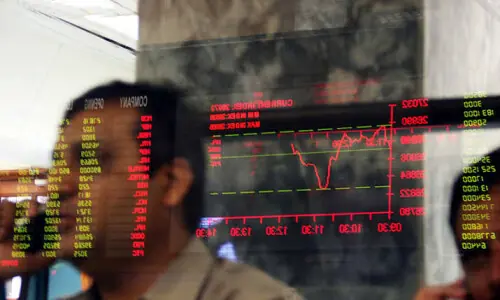
THE recent upward drive was halted on the stock market as investors took a technical breather after the election of the prime minister and the speaker of the newly-elected National Assembly and were in the process of working on the new strategy suited to the post-election objective conditions.
The big question before them was whether or not to forward or stay on the sidelines at least for during the next couple of sessions, awaiting for the post-election dust on the political scene to settle”.
As speculated, the KSE 100-share index failed to reach the 2,400-point level but finished higher by clipped gains, up 75 points and adding Rs51 billion to the market capitalization at Rs531 billion.
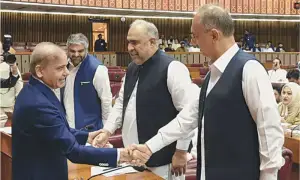
Stocks failed to sustain the pre-election buying euphoria during the last week despite the election of the pro-regime Prime Minister, Speaker and the Deputy Speaker of the National Assembly as leading investor withdrew to sidelines on the perception of a week political government.
“Terribly lower vote count in favour of the winners leading to a simple majority in the house seems to be the chief villain of the game”, one analyst commenting on the post-election scenario said, adding “some others may ride the power bandwagon in due course but it will not significantly change in the ground realities”.
Zafarullah Khan Jamali, the new Prime Minister and the speaker got 172 and 167 votes respectively to claim to be winners out of the house of 342 and 328 amid terribly divided opposition led by the PPP, the MMA and the PML-Nawaz, which together could have a field day if cared so in the national interest.
“But strange is the game of politics and only politicians know it from close circle, what is next in store is difficult to predict at this stage.
The worst-hit were shares of some leading MNCs, most of which faced hasty selling as foreign investors, perhaps, did not like the vote count. The Shell Pakistan, the Siemens Pakistan, the Unilever, the BOC Pakistan and the NestlePak were leading among them, which fell from their recent highs as the vote count was not that impressive owing to the vulnerability of the new pro-government political set-up.
The KSE 100-share index, which has risen by about four per cent after the 1.5 per cent cut in discount rate to 7.5 per cent by the central bank failed to add more to the pre-election big tally.
It finally ended around 2,346.34 points as compared to 2,271.60 points at the last weekend, on the balance up by 74.74 points, but doubts were created in its rise to the next chart level of 2,400 points.
The market should have cherished the idea of return to democracy after the three-year rule of military but it lacked the enthusiasm associated with the freedom.
The post-election political scenario is still unclear and a section of the leading analysts fears the “future sailing on political front may not be that smooth if one bases his assumption on Thursday’s National Assembly vote count”.
Some others say the peaceful election of the National Assembly Speaker and the Deputy Speaker enthused investors as it cleared the way for the formation of government at the centre after the election of the leader of the house tomorrow.
Massive activities both in the PTLC and the Hub-Power, however, tells a different story and some leading analysts claim the advent of strong foreign fund buying. Both were traded sharply higher.
“The tally of secured votes of the pro-regime candidate was certainly not that impressive as it could mean anything to the emerging strong opposition”, fears a leading stock analyst”, adding out of the 328 polled votes, the figure of 167 is too small, to command a decisive majority in the house 372”.
“If the opposition led by the PPPP and the MMA joins hands, which together polled a couple of less votes as compared to winner, the manoeuvring may tell a different story”, another commenting of the speaker election said.
The consensus among the leading analysts was that the future sailing on the political front may not be that smooth if the leader of the house could not get a decisive vote in Thursday’s election.
And that factor worried investors too, who are being told of the continuation of the current robust rally in coming weeks. “It is too risky at this time to go beyond the limits at least until the political indicators from Islamabad are positive”, one broker said adding” despite the fact that major leading parties, the PPPP and the MMA are still poles apart and the pro-government party could have an easy win again”.
But on the other hand economic indicators are pretty encouraging in the backdrop of visiting Treasury Secretary statement that the US economic aid to Pakistan will continue.
The market is also witnessing steady inflow from the money market to stock market owing to continued weakness of the dollar and attractive return on investment in stocks.
Leading gainers were led by the Nestle MilkPak, the Pakistan Oilfields, the Unilever Pakistan, the Siemens Pakistan and the Wyeth Pakistan, the National Refinery, the Shell Pakistan, the Attock Refinery, the Pak-Suzuki Motors, and the Treet Pakistan followed by the Millat Tractors, the Clariant Pakistan, the Fauji Fertiliser, the Tri-Pack Films and several others.
Losers were led by the Grays of Cambridge, the General Tyre, the Packages, the Dawood Hercules, the Ferozsons Lab, the BOC Pakistan, the Lakson Tobacco, the Premier Sugar and the Pak-Reinsurance Co.
Trading volume was maintained at the last week’s level of over 1 billion shares, bulk of which went to credit of the Hub-Power, which was massively traded earlier in the week followed by the PTCL, the PSO, the Sui Northern Co.
Other actives were led by the ICI Pakistan, the Adamjee Insurance, the Dewan Salman, the National Bank, the MCB, the FFC-Jordan Fertiliser, the Fauji Fertiliser, the Engro Chemical, and several others.
FORWARD COUNTER: Speculative issues on the forward counter also followed the lead of th ready section where bulk of the alternate bouts of buying and selling remained confined to the Hub-Power and the PTCL followed by the PSO, the ICI Pakistan and the Sui Northern Gas. On-balance closing was steady.—Muhammad Aslam