0
0

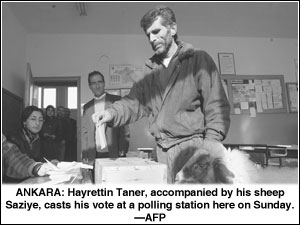 ANKARA: Turkey edged towards constitutional crisis on Friday as its highest court ruled that it may yet outlaw the moderate Islamic party which has led the opinion polls in the run-up to general election.
A final decision on whether to close down the Justice and Development party (AKP) will not be taken for at least several weeks, leaving millions of voters uncertain whether their ballots may later be in effect declared invalid by the slow-moving legal process.
The other day the constitutional court in Ankara said it would, in a fortnight’s time, re-examine the case for closing the AKP.
The chief prosecutor, Sabih Kanadoglu, claims the party breaches regulations governing how political parties are run. The AKP has been asked to submit a defence. Previously, Islamic parties have been banned on the basis of their constitutions.
Even before the AKP had launched its first general election campaign, the public prosecutor had moved against the party leader, Reccep Tayyip Erdogan, a former mayor of Istanbul. In September, the Supreme Court ruled that he could not stand as a candidate because he had been imprisoned briefly in 1999 for “incitement to religious hatred”.
That punishment was imposed after he recited, at a public meeting, an old poem which compared minarets to bayonets, the domes of mosques to helmets, and the Muslim faithful to soldiers. The crime for which he was sentenced no longer exists but because he was jailed under a specific article of the penal code, the judge maintained he could never hold public office.
Erdogan accepts that the party he founded has its roots in Islamic concerns about social welfare, but insists it is no more religiously obsessed than any Christian Democrat party in western Europe.
He condemned the court rulings as a “heavy blow to Turkish democracy”.
His reformulated version of political Islam is none the less sending tremors through the capital’s establishment. The party is way ahead of rivals in the opinion polls — which give it up to 30 per cent of the vote — and, unless banned, is likely to form the next government.
The latest legal manoeuvre has added to suspicions that the army is increasingly anxious about the outcome of the vote. The armed forces interpret their constitutional role as safeguarding the secular state established by Kemal Ataturk in the 1920s.
Behind the government and the national assembly — a nest of corrupt politicians, according to many Turks — power resides with the military-dominated National Security Council, which consists of four senior ministers, the chief of the general staff and commanders of the army, navy, air force and police.
Five years ago, the military forced an Islamist-led government to step down. The generals feared religious changes to schools would undermine society; it was a bloodless coup, and the tanks never left the barracks. Successive Islamist parties were banned, only to re-emerge under different names.
The last few days of campaigning have been dominated by the question of who will become the next prime minister.
Erdogan is disqualified because he cannot be an MP. He says his party board will select a new leader, possibly Abdullah Gul, an economics professor and deputy party chairman. On Thursday, however, the president, Ahmet Necdet Sezer, intervened by announcing he would designate the next prime minister after the elections.
Erdogan has been desperately downplaying his Islamic roots while courting voters disenchanted with the outgoing ruling coalition.
Green is the traditional colour of Islam, the colour adopted by Islamist parties across the Middle East. But the only splash of green outside the AKP’s election headquarters is a lawn dotted with gurgling fountains.
“Everything is for Turkey”, announces one slogan; “Constant brightnessess”, promises another.
The party’s flags are pastel blue, yellow and white. In Turkish, the party’s main initials, AK, spell a two-letter word which can mean white, clean or unblemished. No mention of green.
“AKP will be an honest government,” Erdogan told one interviewer. “Poverty will be overcome. You can have a secular government, it doesn’t conflict with Islam; Islam is a religion.”
Asked whether the army might remove his party from power, he replied: “What do you mean? They are my army, how would I not work with them?”
If the AKP wins office it is likely to proceed with caution. Inside party headquarters, a marble and smoked-glass office block lent by a sympathetic businessman, officials deny they will pursue an Islamist programme.
The vexed question of women’s headscarves — which cannot be worn in public buildings or universities under Turkey’s rigid secular laws — will not be top of the agenda, one woman insists.
The AKP is firmly in favour of joining the EU. It also supports the close military alliance with the US, and welcomes America’s attempts to persuade Brussels to give Turkey a date for EU entry. Any eventual decision to ban the AKP is likely to damage Turkey’s hopes of being given a definite date.—Dawn/The Guardian News Service.