



 0
0

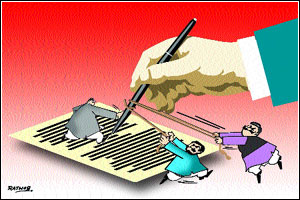 As the country re-enters the murky waters of the ‘made-to-order’ democratic set-up, the bureaucratic hierarchy in ministries is busy giving final touches to their reports that they would present to the new ministers on the very first day that they assume office.
The purpose of such an exercise is simple: To let the incumbent know the limits within which he would be expected to operate— at least in the short term. This important task has been given to the ministries by the transition committee that was set up by the government to ensure continuity of its policies.
The high-powered committee was formed by the government, about a month ago, to oversee the transition process. The committee is headed by Cabinet Secretary Javed Masud and includes Secretary Finance Naveed Ehsan and other senior civil servants including Dr Mutavakil Qazi, Anwar Mahmud and Dr Ashfaque Ahmed Khan.
A senior government official—-dripping with pride for having won a favourable IMF-World Bank nod in Washington recently and very confident over the direction of economic policies pursued over the last three years by the Musharraf’s government— affirmed that the government is sparing no effort to ensure that the hard-earned respect in the world financial circles is not lost after elections. To this end, he felt, it was necessary that not only the thrust of economic policies remains unchanged but even projects already in hand were brought to successful completion by the elected representatives.
Information gathered from Islamabad confirmed that all ministries have been given a guideline by the government to prepare a report about their respective area, highlighting major policy decisions, list of projects being launched and the progress of those projects with targeted date of completion. “Federal secretaries have been directed by the transition committee to brief their ministers as soon as they assume office so that they know from the word go exactly what is happening in economic field and what are the challenges before them in their area of operations”, an official impressed with the wisdom of the decision elaborated on phone.
But a great number of people who do not see eye to eye with the government in its pursuit of macro-economic stablisation as a panacea of peoples’ economic problems, find the policy of macro-economic stabilization (opted and actively followed on the advice of the IMF) as anti-people and regressive in the sense that it entails high adjustment cost that is not equitably shared— with economically vulnerable sections bearing the brunt. Also, they believe, such policies have led to the stifling of the productive economic agents, leading to depressed growth. They advocate change in these policies to create a conducive environment where public and private sector might be encouraged to assume the role that is their due to provide impetus that the economy so badly needs.
Members of current economic think tank, however, fail to see any problem with the content of stabilization policies. “Had these policies been inappropriate, we could not possibly have achieved what we have. We brought down the revenue deficit to 2.1 from 2.7 per cent, and primary budget-GDP ratio to 5.5 from 6.1 per cent, converted current account -GDP deficit into a surplus, external and foreign exchange liabilities have come down from $38 billion to $36 billion and we accumulated forex reserves to more than $7 billion, up from the paltry $1.6 billion that we inherited three years back “, a top ranking manager of the country’s economy said.
Continuing to count the bounties bestowed by the three-year-old team of financial managers, he added: “Our greatest achievement is that we changed the economic image of the country. Pakistan’s economy, which was mocked at by the international donors as a ‘one-tranche economy’, has come to be respected for its stability and continuity”, he said, adding that earlier the IMF had to suspend their programmes after the very first review for not achieving the agreed targets or for not implementing the policies committed by the government at the time of negotiations. We were pushed around and ridiculed. Now donors and IFIs can ridicule us no more. We honoured our commitments and have succeeded in attaining a position where we need to woo no one and can meet world business leaders with our heads held high”, the official said.
When the attention of this financial wizard of the present government was drawn to the darker side of the stabilization programme; namely that it aggravated the problems of inequity and poverty wherever it had been adopted by governments, the world over, Pakistan being no exception— the official vociferously defended those policies. He argued that gains would follow pains if continuity was not allowed to be disturbed. He was asked to cite one success story anywhere in the world where the donor-dictated stabilization strategy had delivered after uninterrupted pursuance since 1988. Agitated, but unrelenting, the economic wizard blamed the ineffective implementation and not the policy itself. He contended that the desired results were missed because: a) commitment on the part of the respective governments was lacking, b) they did not have capacity to implement the programme or c) projections were haywire. But such unequivocal defence of the donor-specified macro economic policies, looked like putting up a brave face even when some of the unsavoury realities were accepted by the donors themselves. Even the agency does not defend its policies with such vigour. Horst Kohler, the IMF managing director, looks more modest. He was recently quoted by the influential “Financial Times” to have conceded in Tokyo: “IMF does not have all the answers. Recent experience should make us even more humble. The fact that it was not possible to avoid current difficulties in Latin America suggests that we still have a lot to learn”.
Sadly, in our part of the world, the IMF loyalists seem not to be prepared at all to even think that there could be an alternative. Intentions and even integrity of people who find fault with current mix of economic policies is put to question. In a situation like this, the country might have to wait till the time donors under pressure from their own public agree to start the process of rethinking and evolve a new mix of economic policies to better suit the ground situation in the developing world.
While it was important to assess the situation in its perspective, it would also not be right to rob the present economic managers of the credit that is their due. It is a fact that in the past, successive governments shelved various projects half way not on merit but for political reasons. If steps are taken to avoid such a practice in the future, what could be better for the country and its people. The cost of all such abruptly discontinued projects in the public sector was borne by the people of the country.
The effort and resources were allowed to crash for some ulterior political gains. Such an attitude could never be construed to be economically justifiable. A nation so poor as ours cannot afford the costly populists gimmicks of political elite of the country. Economy is a serious business and it should be treated as such. It looks to be a prudent policy that ministries have been asked to prepare plans to keep the new elected heads posted about the policy and initiatives so far taken also so as to save the nation of unnecessary rude shocks. However, it is equally important that elected representatives be granted enough space to ponder over other more equitable economic policies, without compromising the achieved gains.





























