0
0

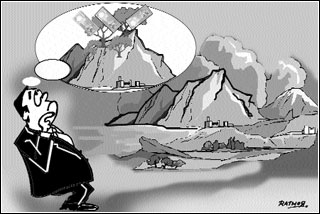 THE NATURE has been bounteous to the North and its munificence is evident everywhere in this region: be it the gigantic water towers, sky-scrapping peaks, abundant mineral wealth, or azure lakes.
To top it all is the potential of its soil, which according to the latest researches, offers immense prospects of ‘mountain agriculture’ that could bring about an amazingly socio-economic transformation.
However pessimistic views are available saying that the Northern Areas offer little for agricultural economy because of aridity as well as the scarcity of land. True, that per capita land-holding in the area is quite negligible as compared to elsewhere in the plains but these scarce landholdings also offer prospects reckoned to be far more than those in the latter. This gets buttressed in the successful experimentation of potato in these areas which has over the preceding one decade yielded stunning results.
What is noteworthy is the pest-free potato production for supply to farmers to substitute potato-seed import that has long been going on for a long time.It has come to the fore that potato-cultivation is a success story in the uplands ranging from 9000 feet and above for the pest-free production. This underscores the importance of giving a genuine boost to ‘mountain agriculture’ in the Northern Areas, not simply for benefiting the respective communities of the region but to sustain the agricultural economy in the rest of the country.
Although efforts remain underway for weaning farmers in rural areas of the North on to cultivating potato in substitution for traditional cropping, efforts are required to achieve maximum potato-cultivation targets in the region.
This should be, in addition to maximising and popularising mountain farming technology in the region at subsidised rates and by offering incentives to ‘subsistence farming’. The yard-stick of loaning by the Agricultural Development Bank of Pakistan remains the same as is in vogue in the rest of the country.
This indeed, is an imprudent step to equate the land here with that of the plains. For instance, the minimum land hypothecation needed for a tractor loan here is put at around 40 kanals which is unjust. Instead, it is required to be further reduced to enable mountain-farmers to have access to such a loan facility in an unhindered manner. These farmers are also required to be offered incentives for mechanisation as well.
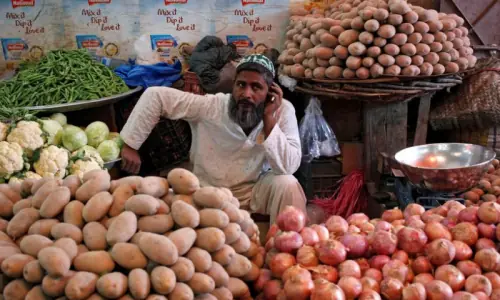
Again referring to the potato cultivation, it is to be pointed out that by now it has assumed the status of a ‘cash crop’ in this region with an average farmer earning around Rs 100,000 per annum provided an unhindered marketing takes place. Potato cultivation,initially got popularised in the ‘Upper Hunza Valley’. The tangible results achieved there attracted other communities to take to the same cropping instead of the traditional ones. The result is that potato cultivation is gaining popularity in all the tracts like Bagrote, Haramoosh, Astore, Ghizar, Diamir and the whole of Baltistan with fruitful results.
The construction of ‘three tourists’ roads’ across the Northern Areas would undoubtedly bring about more accessibility to marketing and more people would benefit from their agrarian produce. Though potato cultivation is rife in the lowlands here but it is not that much pest-free. Once one gets used to the potato of the uplands, he would certainly develop a taste for the same.
According to the statistics for the year 2001-02, potato produce touched 670 ton mark. The income generated thus was staggering a billion and a half, while the income accruing during the year 1999 was merely Rs 2.8 million. Researchers hold the view that the potato produce is singularly pest-free one in the world for being used as seed and a switch-over to mountain-farming technology would redouble the produce.
Meanwhile a number of ‘storage houuses’ at places like Gilgit, Skardu, Ghizer, Chilas and Gojal have been established and agriculture complexes are being built at Skardu, Ghizer and Chilas which would help boosting the mountain farming in the region.
According to an estimate, potato cultivation across the country is carried over an area of 100,000 hectare (2.0 million kanals) for which 3.0 million tons of seed is needed. Since the potato produce in the plains is often pest-laden, the government was constrained to spend Rs2 billion in foreign exchange on the import of potato seed from Holland every year. This was regardless of the fact that the imported potato were not absolutely pest-free either.
There can be no denying the fact that livestock breeding and the mountain agriculture inexorably work in tandem in the life of the mountain-folk. Given this, paying heeds to one while discarding the other cannot bring about a socio-economic change.