0
0

 TEL AVIV, Sept 22: The aim of Israel’s siege of Yasser Arafat’s headquarters in Ramallah is to force out the Palestinian leader, Israeli Deputy Defence Minister Weizman Shiri said on Sunday.
The siege forced enraged Palestinians to take to the street on Sunday and four protesters were killed in clashes with Israeli troops.
“We have no intention of physically eliminating Arafat or to forcefully occupy the Muwatalli (Arafat’s HQ), but to push him to decide to where he will leave,” Shiri said on the Arab-language service of Israel’s public television.
It was the first time an Israeli official said the aim of the army’s operation launched on Thursday was to drive out Arafat.
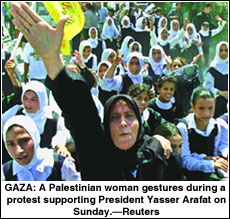
DEMONSTRATIONS: Palestinians flooded the streets of Ramallah and every other major town in the West Bank and Gaza Strip before dawn on Sunday, after the Israeli army threatened a huge explosion near Arafat’s office, urging everyone inside and nearby residents to evacuate.
Hamas and an armed offshoot of Arafat’s Fatah called for an intensification of the two-year-old Palestinian uprising in support of the beleaguered Arafat.
The early morning faceoffs turned bloody in several spots in the West Bank, with tensions running higher in Ramallah, where two Palestinians were shot dead by Israeli soldiers.
Another was killed in the Balata refugee camp, in Nablus, where at least 2,000 protested, and a fourth Palestinian was shot dead by Israeli troops in Tulkarem.
Hundreds of protesters in the Ramallah area massed at checkpoints, hoping to muscle their way to Arafat’s compound, to chants of “Abu Ammar (the Palestinian leader’s nom de guerre), we will sacrifice our blood and soul for you”.—AFP