0
0

Constitutional amendments
FOR a good deal of time there were rumours of the expected moves of the government for effecting amendments to the Constitution and now the government proposals have come out. Unfortunately, right from Constitutional Amendment No. 1 till the last one the amendments were not brought in the interest of good governance but to meet the requirements of the government in power at that time, to enable it to do what it wanted to do but which it could not do because it was illegal and unconstitutional. As a result, those amendments proved pernicious and a stumbling block to good governance.
If at all amendments to the Constitution must be made, then there is only one amendment that should be made — to scrap and annul all the amendments right from the first amendment to the fourteenth so that the 1973 Constitution is restored. The provision declaring Qadianis as non-Muslims may also be deleted. Anyone who calls himself a Muslim should be considered a Muslim and the question as to whether he in fact is or is not should be left to God.
The amendment brought about in the penal code through the Qisas and Diyat Ordinance has played havoc with the dispensation of criminal justice. Till then we had only two types of injuries, simple and grievous, but this has created nearly 40 types of injuries. With all my experience in the judicial service, I could not till the end master the details of these injuries which were given Arabic names and which were very difficult to differentiate from one another as they were in many cases overlapping.
It will be a great service to the nation and to Islam if these abnormalities are removed from the Constitution and the criminal law. This in itself will be a great achievement for the present government. The government may then float proposals for constitutional amendments and let them remain afloat until it bows out of office, leaving the job of either effecting those constitutional changes or rejecting them to the next democratically-elected parliament and the government which it forms.
Only then can the real worth of the amendments be thrashed out in an open discussion. On the contrary, if the present government itself drafts the amendments and itself enforces them, an impression may be created that the government has effected the amendments not in the interest of the nation and in the interest of good governance but for the sake of keeping itself in power.
As for the power to amend the Constitution, given to the present government by the Supreme Court, let it be realized that one of the fundamental principles of law is that no one can give a thing to another which does not, in the first instance, vest in him. The Supreme Court, being a creature of the Constitution itself, cannot itself amend the Constitution and, therefore, it cannot confer the power of amendment upon the government or upon any other authority. The Constitution can only be amended in the manner provided in the Constitution itself.
A CITIZEN
Karachi
His heart beat for the poor
ON June 25, the light of our family was extinguished for ever. My beloved nephew Omar Asghar Khan was found dead, leaving behind a grieving family. This is an irreparable and devastating loss for his young wife and three children, as well as for his parents, siblings and the entire family. Not only have we lost a charismatic and gentle family man, but Pakistan has lost an innovative, emphatic and hard-working citizen. Omar’s concern for the downtrodden was genuine.
On the night of June 25, almost 12 hours after Omar was found dead, his body was brought to his childhood home in Abbottabad. The coffin with a glass top was laid in the front room and people from all walks of life entered the house in large numbers. All night and the following day, men and women arrived, the constant flow of tears reflecting their broken hearts.
The majority of these mourners were very poor, their faces ridden with suffering and hardship. They arrived on foot, in carts and buses.
As I spoke to a group of impoverished women, I learned that they had come from a small village near Mansehra, where there were no roads, water or electricity. They said Omar Asghar Khan would come to them in his old worn pick-up. He helped bring water to the village and worked alongside everyone, resting only when the villagers stopped.
Omar would sleep in their mud-homes on a rope-bed, he would eat the same bread as the villagers, often insisting not to be given special treatment. As one woman said: “He got wells dug, latrines and roads made, he changed our lives. We are poor and for us he was a saint.”
Omar Asghar Khan did not own a house. He lived with his father after resigning from his ministership. He drove an old Toyota pick-up. Omar was a unique person, completely unmaterialistic. Although he could have had what he wanted, he was a great patriot who lived for serving the poor and needy. He did not think of acquiring wealth for himself or his family, and as a minister, he was a man of great integrity, firmly opposed to nepotism.
Although our beloved Omar has now departed, his dedication and work will never be forgotten.
ZARINA AYAZ
Islamabad
OMAR Asghar Khan came to eminence when he was forced to resign as a lecturer at the Punjab University because of his ‘crime’ to give voice to the suppressed kiln workers.
Later, he founded the Sungi Development Foundation to save the green pastures of the northern area, and to raise voice against the ruthless cutting of trees in the area by the jungle mafia.
His death has left a vacuum in the hearts of many.
M. SALEEM SHEIKH
Multan
Teacher training
SINDH occupies the position of a pioneer in the field of teacher training, as the first institution of its kind, Normal Training College, was established in Karachi in 1854, which was later shifted to Hyderabad in 1864 and is now working as Government Elementary College of Education (Men), Hyderabad.
At present, there are 23 elementary colleges of education offering pre-service training and 14 other institutions that offer in-service teacher training programmes for primary school teachers. One more training centre, the PITE, has been recently established at Nawabshah.
More stress has been laid on the professional development of primary school teachers (PSTs) and junior school teachers (JSTs) who teach classes I to VIII.
The government of Sindh made substantial financial allocation of Rs10 million for the training of PSTs/JSTs during 2001-2002. This will undoubtedly improve the quality of education.
The Bureau of Curriculum and Extension Wing Sindh at Jamshoro, being the organization responsible for the improvement of quality education at various levels in the province, developed a plan of one-month extensive orientation of 3,091 PSTs and JSTs in the subjects of Science, Mathematics, English, Urdu, Sindhi, Social Studies, Islamiat and Computer Literacy. During the conduct of these courses, scholars and social scientists were invited to give lecturers on a variety of topics such as human rights, elimination of all forms of discrimination against women, rights of the child, honour killings, population planning and environmental pollution. These lectures will surely help the teachers and through them the students.
DR MEHBOOB ALI SHAIKH
Jamshoro
Kashmir dispute: a suggestion
THIS refers to Engr Shaukat Ali’s letter (June 29), in which he has suggested holding a plebiscite in Azad Kashmir by Pakistan, monitored by observers of the UN, Amnesty International and other important organizations and countries. I feel that this would not meet the requirements of a free and fair plebiscite nor would it fulfil the conditions mentioned in the UN’s resolutions on the subject.
It should be noted that the Kashmir issue is an unfinished part of the agenda of partition of the subcontinent. The solution to the Kashmir dispute is that the whole state should be given under the trusteeship of the United Nations for at least 20 to 25 years and after that the 12.5 million Kashmiris be given their fundamental right of self-determination. They will have three options: (i) accession to Pakistan, (ii) accession to India or (iii) independence.
According to the “trusteeship scheme”, the troops of both India and Pakistan will be asked to quit the state and an international peace force will take over its control.
SAALIM SALAM ANSARI
Karachi
Impatient honking
IN Karachi, those who live in apartments have to face a peculiar problem because of the growing habit of visitors blowing the horns of their cars to seek the attention of the person or the family they want to call.
For apartment dwellers, this is nothing but torture because neither the visitors have the patience to wait after blowing their horns once, nor do the respondents act quickly enough to come out in their balconies and respond.
The most horrible horns are blown early in the morning by the drivers of school vans who come to pick up school children. These people do not realize that somebody could be sick or somebody could be busy preparing for the examinations.
Would the concerned authorities look into the matter?
NEHAL ALVI
Karachi
No facilities at Kalri Lake
THESE days the Kalri Lake is gaining popularity as a picnic spot. But, regrettably, though the authorities are charging a high entry fee, essential facilities are not available there. For example, there is no public lavatory and visitors, particularly women, have to face hardships on this account.
I request the concerned authority to provide this facility and also construct cemented umbrellas besides making arrangements for the supply of drinking water.
KHALID HASHMI
Karachi
Experimental sciences
THIS is with reference to Prof Roedad Ahmad Khan’s article titled ‘The degenerating experimental sciences’, which was really thought-provoking and calls for immediate attention from the authorities concerned (Of Education, June 23).
The learned writer has convincingly depicted the true picture of the poor quality of the practical aspect of natural sciences (physics, chemistry, biology, etc) at school, college and university levels. I strongly support the views expressed by Mr Khan as my life-long experience in the teaching profession has been the same.
It is a fact that up to the matriculation level, only lip service is paid to the practical aspect of science subjects in general. Both the students and teachers mainly concentrate on the theoretical aspect and that, too, on rote-learning to get maximum marks in examinations. Even the practical examiners, being a part of the system, give credit to the students mainly on the criterion of viva-voce. Resultantly, with a few exceptions the practical aspect of the subject and creativity of most students remain poor up to the university level.
During my whole career as a college teacher, I could not find a single student of the first year class who could tell me why Vernier Callipers, an instrument used in physics, was called as such although it is taught in physics theory and practical in the matriculation class. This indicates that in our system of education, the hows and whys of the subject are not discussed.
Some reasons for the poor quality of the practical aspect of the science subjects are:
1. Ineffective teacher-training in science subjects.
2. Lack of interest, willingness and motivation on the part of the teachers due to financial constraints and low social status.
3. Pressure from the management and demand of the parents for high marks for their wards without worrying about the quality of education.
4. Over-crowding in classrooms in most public schools. In some cases, there are more or less 100 students in one class.
5. Sub-standard, half-baked and hurriedly-written textbooks, which are full of mistakes, inadequacies, deficiencies and other anomalies.
PROF ATAUL HAQ SUBHANI
Faisalabad
City government’s performance
THE city government talks too much and does too little. Every day we read loud announcements in newspapers regarding projects like the Karachi Circular Railway, large buses and what not, but nothing ever materializes.
The city government has failed even in performing its basic duties such as providing sanitation, carrying out repairs of roads and footpaths, maintenance of street lights, removal of encroachments etc.
Heaps of garbage have been lying in every locality for months now producing intolerable stink and becoming the breeding place of mosquitoes and bugs.
One example is the garbage heap opposite Clifton Arcade on the service lane of Khayaban-i-Roomi and another along the storm water drain, opposite Kehkashan Town Houses, under Union Council No. 10, Saddar Town.
Most of the encroachments have not been removed and those removed have been re-occupied within hours as there is no follow up or there are vested interests within the city government itself, who patronize the culprits.
Will the Nazims find time to attend to these basic requirements?
SARFARAZ
Karachi
Unscreened blood
THIS is with reference to a news item (June 14) that in Sindh only 30 per cent of the estimated 35,000 blood transfusions in a year are screened and that too through the courtesy of an NGO.
It was really shocking to read this when the possibility of HIV positive blood being present among that given by the professional donors is always there. The Sindh Blood Transfusion Authority (SBTA) completes its five years of existence this June. But can we say that it has been able to provide safe blood to the people of this province?
Reportedly, around one hundred blood banks operate in Sindh at present but the same have not been registered. Why have they been allowed to play with people’s lives?
I hope that the concerned authorities would take notice of this very important matter and would ensure that everyone gets safe blood.
AQIL AHMED ZUBAIRI
Karachi
Book-lovers’ plight
I LIKE reading a lot and I would like to buy books more often than I do. However, there is a problem. The books that are sold are so expensive that I cannot afford to spend so much.
For example I visited a well-known book store recently and while cruising through their books I found one on the recent history of Pakistan that interested me. But when I turned the book over to see the price, I was astonished to see that it cost around Rs800.
The inside pages were not properly printed either as they looked as if they had been merely photocopied. There were other books as well that had appalling prices, touching the sky. If books are so expensive, how can people be encouraged to read them.
Magazines, too, have become very expensive and it becomes very difficult for ordinary people, and especially students, to buy them. I can understand that imported books are expensive because of our exchange rate. But why are locally printed books more expensive than those coming from our neighbouring countries.
There are not many libraries either and the ones that are present charge a dear amount to join in as a member. I wish the concerned authorities would do something about this.
XARI JALIL
Karachi
Using religion for politics
“ULEMA are warned against using religion for political purposes,” so said the Interior Minister (June 26).
The point to be clarified is whether it includes the laying of wreaths by our VIPs on the graves of saints, which is frequently shown in PTV’s news, to gain political mileage among the masses.
Z.A. KAZMI
Karachi
Income tax on savings scheme
THIS is with reference to the news reports about income tax on profits on Defence Savings Certificates and Special Savings Certificates and tax returns.
The investors of National Savings Centres Schemes of Defence Savings Certificates and Special Savings Certificates should be fully aware in all respects of the following:
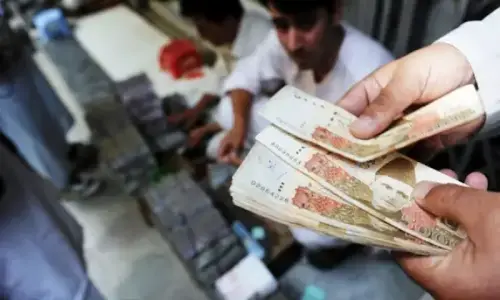
* For certificates issued from July 1, 2001, onwards, if the total investment value exceeds Rs300,000 the withholding tax is applicable at 10 per cent on profit earned.
* From July 1, 2002, onwards, if the total investment value exceeds Rs150,000 withholding tax is applicable at 10 per cent on profit earned.
* Tax deducted at source at 10 per cent of profit is not a final discharge of tax liability.
* Investors of National Savings Schemes whose annual income exceeds Rs60,000 are required to file a normal income tax return.
* Final tax computation will be based on normal tax rate table for the relevant tax year.
* For low investment values of National Savings Schemes, refunds are created, taxpayers are entitled to claim adjustment for tax withheld against their final tax liability.
* Excess computed tax (refunds) withheld is only adjustable against other tax liability of the taxpayer in the relevant tax year and not refundable.
* For higher investment values of National Savings Schemes, income slides into higher tax slab brackets, resulting in additional tax payable along with the tax returns, further causes to reduce the net yield of profits, after payment of final tax along with income tax returns.
National savings schemes investors must maintain records of withholding tax deduction certificates, Zakat deduction certificates, photocopies of matured certificates before surrendering for encashment, and bank statements.
In the past, profits earned from investments in National Savings Centres Schemes were exempted from income tax, but from July 1, 2001, onwards incomes of NSC Schemes have become taxable.
It has been observed that investors of NSC Schemes are ignorant of the fact that under certain conditions they are required to file income tax returns.
Further, neither the Central Board of Revenue nor the National Savings Centres are informing the NSC Schemes investors as to what they are required to do in respect of taxation. It is a basic responsibility of both the concerned authorities to educate the NSC Schemes investors on taxation.
SHAHID RASHID
Karachi