



 0
0

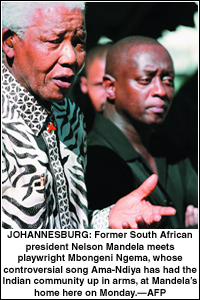 JOHANNESBURG, June 17: Nelson Mandela raised the alarm on Monday about a song portraying South Africa’s Indians as oppressors of black people, saying it pandered to the same prejudices that underpinned the former apartheid system.
The statesman who spent 27 years in apartheid jails for fighting against white supremacy, met songwriter Mbongeni Ngema and said he was worried by the emotions the lyrics had stirred.
“Unfortunately the manner in which (Ngema) has raised the problem simply panders to the worst prejudices inculcated upon us by the past.
“Already some of the responses and reactions bring out the danger of being guided purely by emotion,” Mandela said in a statement read outside his Johannesburg home, with Ngema standing beside him.
The singer and impresario from the port city of Durban has been at the centre of a storm for the past month over the lyrics of “Ama-Ndiya” (Indians).
Both the Film and Publications Board and the Broadcasting Complaints Commission are weighing calls for the song to be banned as racist. But reactions from many black South Africans — to judge by radio phone-ins, letters to newspapers and street talk — have been approving.
Mandela, who was freed from jail in 1990 and was president from 1994 until 1999, criticised the song earlier this month, but the debate about it has grown ever more heated.
He said he called Monday’s meeting because Ngema was someone who had resisted apartheid through his art and who must continue to act responsibly.
“The Indian community has in many respects been a pioneer and an inspiration to all of us,” Mandela said, recalling the number of South African Indians who were in prison with him.
“WORDS MAY HAVE GONE TOO FAR”: Durban has one of the largest ethnic Indian populations of any city outside India, but nationally Indians and Asians account for only 2.6 per cent of South Africa’s 44 million people.
“Indians have conquered Durban. We are poor because all things have been taken by Indians. They are oppressing us,” one verse of “Ama-Ndiya” says.
Ngema has strongly defended his song’s message but said the nuances in his Zulu lyrics were lost in the English translation.
On Monday as he stood next to 83-year-old Mandela, Ngema insisted his goal had been to start an honest debate about relations between blacks and Indians.—Reuters


























