0
0

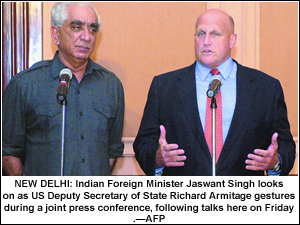 NEW DELHI, June 7: US Deputy Secretary of State Richard Armitage extracted crucial assurances of peace from senior Indian officials on Friday that may help ease a menacing nuclear standoff between New Delhi and Islamabad.
After his meeting with Prime Minister Atal Behari Vajpayee, the last on his day-long schedule in New Delhi, he told reporters: “I did have discussions both here and in Islamabad about the possibilities and modalities of monitoring the LoC, but no decision has been taken as yet to the best of my knowledge.”
In reply to a question, Armitage said: “President (Pervez) Musharraf has made it clear to me that he intends to do everything he can to avoid a war consistent with the honour and dignity of Pakistan. I didn’t say he had promised anything.”
Consistent with his image of a no-nonsense negotiator Armitage declined to discuss details of his talks earlier with Home Minister Lal Krishan Advani, Defence Minister George Fernandes, National Security Adviser Brajesh Mishra, External Affairs Minister Jaswant Singh and leader of the opposition Sonia Gandhi.
An Indian spokesperson said the US official had brought information with him that President Pervez Musharraf was looking at a long-term solution to the issue of cross-border infiltration in Kashmir.
“President Musharraf has made it clear to the Americans that ceasing infiltration across the Line of Control needs to be an action that is permanent,” foreign ministry spokeswoman Nirupama Rao said in a routine briefing.
“We expect over the next few days to see concrete steps taken by Pakistan to end infiltration,” she said. “If and when we are satisfied Musharraf’s assurances have been implemented, then we will take appropriate action,” Rao said. She did not elaborate.
Armitage, stating that he had briefed the Indian leadership about the tone, tenor and full content of his discussions with Gen Musharraf, said this included the commitment of the Pakistani president to the US to stop “cross-border infiltration” permanently.
Describing his discussions with Vajpayee and other Indian leaders as very good, Armitage said India also intends to avoid a war but they do want terrorism to stop. “And, in this regard, we share that view,” he said.
LOC MONITORING: A proposal doing the rounds in the media, to monitor the volatile LoC with the help of helicopter-borne military observers from the United States and Britain was not acceptable to New Delhi, according to both the Indian and the US sides.
Rao said India’s proposal for joint a patrolling with Pakistan on border was the “only practical” and “necessary” mechanism to check infiltration.
Making it clear that India and Pakistan have to resolve their problems bilaterally, she said: “This is the government’s considered position and there is no dilution to our approach to the issue.”
She was responding to questions on reports in British media that Washington is to propose a US-British military monitoring force for Kashmir and also remarks attributed to British Defence Secretary Geoff Hoon regarding an international monitoring force to patrol LoC.
JASWANT: Earlier, Jaswant Singh said India was committed to peace and termed its proposal for joint patrolling with Pakistan along the Line of Control as “evolutionary” suggesting that one should work towards it to solve the problem of infiltration.
Speaking to reporters after his talks with Armitage, Singh said Prime Minister Atal Behari Vajpayee had suggested the joint patrolling to check infiltration from across the border.
“It is not as if joint patrolling will be established tomorrow. It is an answer to a problem. It is evolutionary and that is why one should work towards it,” Singh said in reply to a question.
Reiterating India’s commitment to establish peace in the region, he said: “We are very much committed to moving on the path to peace because to peace there is no alternative.”
Singh thanked US President George W. Bush for sending Armitage to the region to try to cool down tensions which have soared over India’s assertion that Pakistan is sponsoring cross-border terrorism.
“I must take this opportunity to put on record our deep sense of appreciation for the spirit that has persuaded President Bush to send him here,” Singh said. “We are beholden to the president.”
He repeated, without elaborating, that Indian Prime Minister Atal Behari Vajpayee had committed India to taking reciprocal steps once it can confirm that Islamabad has reined in Islamic militancy. Armitage told reporters he had been told by Bush to “come here in search of peace”.
“I am delighted to have frank and free discussion,” said Armitage, who on Thursday managed to secure a similar peace pledge from Pakistani President Pervez Musharraf in Islamabad.
Forming the backdrop to the Armitage visit was the helping hand of Russian President Vladimir Putin whose meetings with Gen Musharraf and Vajpayee in Almaty appeared to have nudged both countries towards a more reasonable demeanour.
“While public attention in India remains focussed on US emissary Richard Armitage’s talks with Gen Pervez Musharraf (on Thursday) and his impending arrival in New Delhi, the stage is being prepared in Brussels for what international peacemakers want to be the final push to start the process of defusing South Asia’ military crisis,” India’s usually reliable Telegraph newspaper said in a dispatch from Washington.
At the end of a day of hectic talks by national security adviser Brajesh Mishra with Russian ministers in Moscow on Wednesday, Sergei Ivanov, the Kremlin’s defence minister, arrived in the Belgian capital on Thursday.
“Ivanov will brief US defence secretary Donald Rumsfeld on the progress made by Russian President Vladimir Putin in Almaty in dealing with the India-Pakistan crisis and the follow-up to Putin’s efforts during talks between Mishra and Russian ministers.”
“Rumsfeld will be further briefed by Armitage either in person or through a secure telephone line about his discussions in Islamabad and New Delhi before the defence secretary travels to South Asia,” the newspaper said quoted officials in his delegation.
EVACUATION: Even before the Armitage visit was over, the Japanese government on Friday said that it would charter a special flight to evacuate Japanese nationals who have been unable to get seats on commercial aircraft from India.
Fearing war between Pakistan and India, Japan is encouraging most of its nationals to leave India and Pakistan. According to the foreign ministry, there are about 1,450 Japanese nationals in India and 680 in Pakistan.