0
0

ISLAMABAD, May 29: The federal government has taken a number of important decisions about the devolution of power, including putting in place the “New Local Government Finance System” from July 1, 2002.
This has also been decided that National Reconstruction Bureau (NRB) and Finance Division would mutually sort out the procedure for the transfer of 2.5 per cent additional General Sales Tax (GST) to the provinces.
It was explained that the 2.5 per cent addition to the GST, made to compensate for the defunct Octrai Zila Tax (OZT), will now be distributed among the provinces through straight transfers, through the National Finance Commission (NFC).
The provinces will distribute the whole of this amount among the local governments according to the Provincial Finance Commission Award. It was expected that enough funds would be generated through the additional GST.
These decisions were taken during the 6th meeting of the Chief Executive’s Committee on Devolution (CECD) held on May 4, with President Gen Pervez Musharraf in the chair. The meeting was also attended by all the four governors, ministers for finance, foreign affairs, information, interior, states and frontier region, local government, law and justice, chairman NRB, Governor State Bank, provincial local governments’ minister, vice-chief of the army staff, corps commanders of Lahore, Karachi, Peshawar and Quetta, DG ISI and other senior officials of the provinces.
According to the minutes of the meeting which were made available to Dawn, all the local governments are slated to be fully established on the ground with proper office accommodation, transport and other logistics support. However, the meeting called for avoiding expenditure on brick and mortar, unless absolutely essential, and suggested use of the existing buildings.
On the law enforcement, the meeting decided that the final draft of the Police Ordinance, 2002, will be sent to the cabinet by June 30 for approval and police rules would also be promulgated simultaneously. The meeting was informed that work was also continuing on the Prosecution Ordinance, both in the NRB and the Interior Division.
It was decided that all local government institutions, especially the Local Government Commissions and Public Safety Commissions must start functioning by June 30, 2002. The meeting also decided that re-organisation of the Police Force, including separation of investigation, and the establishment of Prosecution Service should be completed by the stipulated deadline. “The NRB should share the Prosecution Ordinance, developed by it, with the Interior Division which has almost finalised its version of the same.”
It was further decided that the system of financial allocations/transfers to local governments to be made irreversible but provincial governments be given more representation in the Provincial Finance Commissions.
The current ban on the purchase of vehicles for Local Governments will be relaxed and the Governors will be authorised to sanction purchase of locally manufactured vehicles for local governments on essential requirement basis.
The meeting was of the view that tehsils/towns needed to be brought into focus to ensure that Tehsil Municipal Administrations (TMAs) start functioning effectively by June 30, 2002.
While accommodating the various elected representatives and district functionaries, the ultimate aim should be to put them under one roof. Special care should be taken to provide proper working facilities for women councillors.
An allocation of Rs4 billion Devolution Transition Fund is to be included in the budget for fiscal year 2002-2003, depending on resource availability. The meeting called for examining a system to pay remuneration to the councillors. However, this should be done by the Local Governments out of their own resources.
The Local Governments, the meeting suggested, should substantially improve the rate of utilization of Devolution Transition Fund allocated to them. Friction-free intra-district financial transfers be ensured with a view to harmonising relations between tiers of Local Governments.
Instead of 50 per cent, as decided earlier, only 25 per cent of development funds at all levels of Local Governments should be kept reserved for financing viable projects submitted by Citizen Community Boards. Mushawarat (consultation) Committee should be made functional without further loss of time.
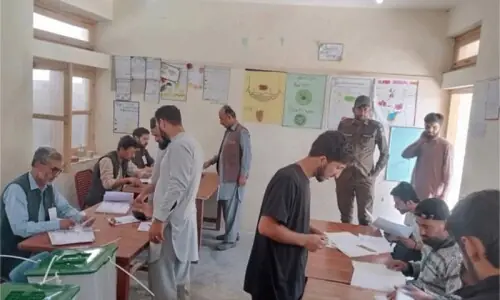
In his opening remarks, the president spoke of the success of the mass contact campaign leading up to the referendum and the heavy turnout of voters on referendum day. “The Referendum amply proved the efficacy of the Local Government system as the elected Nazims and Councillors convincingly displayed their organisational ability and played a crucial role in mobilising the voters,” the copy of the minutes reads.
He said he interacted with the elected representatives in all parts of the country and found them to be highly motivated, knowledgeable and exuberant — qualities which augured well for the future success of the system.
The president noted that little time was left for the full implementation of the newly-introduced Local Government System. Although most of the work had already been done, some important decisions still remained to be taken, making it imperative to move fast to put every thing in place by June 30 despite resource constraints, he said.
Gen Musharraf, in particular, referred to four areas that needed quick action. The first was the establishment of Local Governments firmly on ground by providing office accommodation and other logistic facilities and creating harmony between Tehsils and Districts, which, he said, was not fully visible in all cases. The second point related to financial devolution which the president described as the key to effective running of the system. The third point highlighted by the president was the requirement to correct the notion that the provinces were being sidelined in the system. Lastly, he emphasised the need to institutionalise and entrench the system so that it could not be reversed in the future as it represented one of the most important achievements of his government.
The president said the system of financial allocations to local governments will have to be made irreversible but, at the same time, the provinces’ powers should not to be eroded. This, he said, could be ensured by giving the representation to the provincial governments in the Finance Commissions.
Some of the issues raised during the presentation led to detailed discussion in the meeting. Most intensely discussed was the role of the provincial governments in the Local Government system. The provinces felt that they had only marginal authority to oversee the functioning of the Local Governments.