0
0

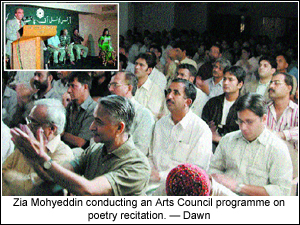 KARACHI, April 3: Veteran theatre artist Zia Mohyeddin conducted a workshop on “How to read poetry” at the Arts Council on Wednesday at which he not only commented on poetry recitation by experienced artists but also highlighted the finer points of the poems read out by them.
Mr Mohyeddin said that few people realized that phonetic stresses could change the meaning of a couplet completely. In the context, he cited a few couplets by Ghalib.
Ahmed Shah, Mehvish Zaidi, Mohammad Ayub, Ayesha Alam, Arshad Mahmood, Sajid Hassan and Talat Hussain took part in the session.
Mr Mohyeddin said that while poem reading was an accepted norm in the West, here it was not very popular at Mushairas where ghazal still ruled the roost. “At Mushairas, daad is showered upon poets when they recite a good ghazal. But in the case of a poem, especially free verse, daad will disrupt the poetic flow of the poem.”
At first, Mehvish Zaidi read out a speech by Ophelia in Hamlet. When she finished her recitation, Mr Mohyeddin said that if Ms Zaidi had been aware of a few things, she might have done the job a little differently. “First, it is the only soliloquy that Shakespeare has given to Ophelia. Second, when a stage performer expresses grief, he has to ensure that the last person sitting in the last row of the auditorium also hears the lines.”
Ayesha Alam recited a few lines from Romeo and Juliet. Mr Mohyeddin conceded that she had done the job admirably well. “It is one of the most beautiful speeches of Juliet. I am sure people remember this balcony scene. I just want to point out one thing: In English poetry — as in Urdu poetry — if the verse is broken, the metre is lost.”
Mehvish Zaidi recited John Donne’s poem “Death be not proud”. Mr Mohyeddin said the last lines of the poem — “death thou shall die” — were so powerful that they haunted us. “John Donne is a metaphysical poet. In this poem, he is mocking death. And the person who recites these lines must try to bring out this mockery.”
All of a sudden, the sound of a mobile phone reverberated through the Arts Council hall. Mr Mohyeddin was so vexed that he said sarcastically: “Thank you very much, this upholder of modern technology who forgot to switch off his mobile. We know who you are and where you are.”
Mohammad Ayub recited Sarood-i-Shabana by Faiz. Ahmed Shah and Sajid Hassan recited the same poem. “The strong point of this poem is its ability to evoke images. For instance, Kehkashan ki neem wa ghatein, chandni ki dukhhi hui awaz and ghaney darakhtoen pay jo kuchh so raha hey.
Mohammad Ayub recited a poem by Meeraji. Sajid Hassan recited the same poem. Mr Mohyeddin drew the attention of the audience towards what he called a horrifying image: Lahad aisi jaisey bhokey ka lalachi munh. Arshad Mahmood recited Meeraji’s another poem called Bulandiyan. Talat Hussain recited the same poem. He also recited a poem by Noon Meem Rashid, titled Andha Kabaria.
In the end, Mr Mohyeddin recited a poem by Rashid called Aag key pass.