0
0

KARACHI, Feb 20: In Sindh, more than 11 million men and women are jobless, sitting idle for want of work, and over 15 million are living below the poverty level.
In a detailed presentation, at the Sindh Development Forum before the foreign donors held early last week, the Sindh Finance Minister Dr Abdul Hafeez Sheikh quoted official figures which shows that unemployment ratio in Sindh has jumped up to 33 per cent during the decade of nineties as against 25 per cent in eighties. More than 50 per cent of the officially counted 30 million population in the province lives below poverty level in the province.
Rural Sindh, spread over a dozen districts has been hit most hard by the drought in last four years. More than 8 million population is reported to have been pushed down below the poverty level in rural Sindh.
A study sponsored by the Asian Development Bank showed that 82 per cent population in five districts out of 20 of the Sindh province, live on less than one dollar a day income.
Urban Sindh, mainly concentrated in Karachi, Hyderabad, Sukkur, Nawabshah, Shikarpur, Larkana and some other towns, accommodating almost 50 per cent of the provincial population, the situation is far from satisfactory. Industrial production is down and services sector has shrunk sharply. The industrial production growth in 2000-2001 was negative in Sindh.
Despite official claims that a few new industrial units have been set up in Kotri, the industrial production in Sindh remains far behind the national industrial production growth ratio in last six months. The national industrial growth ratio too, is down from what was recorded in last year.
Legalisation of more than 260 buildings declared ‘illegal construction’ way back in 1996 is the only action taken by the Sindh government recently that has activated the developers and constructors. A slight increase in remittances from abroad after last October has pushed up real estate value in a few urban areas of Karachi. But this economic activity is restricted to the affluent sections of the population with no trickle down effect to the lower income groups.
Urban areas of Sindh continue to receive the population influx from Punjab and the NWFP leading to proliferation of slums in Karachi, Hyderabad and Sukkur. It is aggravating the social and physical infrastructure facilities pushing up crime rate now beyond the control of the law enforcing agencies.
No accurate figures are available but those linked closely with the government, industry and trade estimate roughly three million men and women, mostly between 15 and 45 years of age, educated and with technical awareness are looking for jobs in the urban areas of the province.
Overall literacy in Sindh is estimated at 46 per cent. Literacy rate is 65 per cent in the urban areas and district central in Karachi boasts the highest literacy percentage in the country ironically with equally matching highest unemployment rate.
A cut in Sindh’s irrigation water share during last four years, federal government’s delay in announcing certain decisions of crop procurement went to the benefit of growers in Punjab at the cost of farmers in Sindh and setting in of a virtual de- industrialisation in urban areas has literally pauperised the province.
Sindh’s share in irrigation water was cut down by 6 per cent in kharif and 17 per cent in 1999-2000. In the year 2000-2001 Sindh received 25 per cent less than its share of water in kharif and 43 per cent in rabi. In the current fiscal year 2001-2002 the release of water was cut down by 28 per cent in kharif and 54 per cent in the rabi.
A cut in water releases has caused sea intrusion over 1.2 million acres of once fertilized Indus Delta from where the population has been forced to leave and find new shelters. Ghorabari, Shah Bunder, Ketti Bunder are hardly 60 miles off Karachi and were once thriving towns with markets. These places are now deserted and offer a haunted scenes.
Water shortages have forced the irrigation engineers to resort to rotation system in canal supplies to the fields. There is a fear that if the 1991 water accord is compromized, the water shortages will hit the urban areas forcing closure of industries and supply of drinking water on rotation basis to the households.
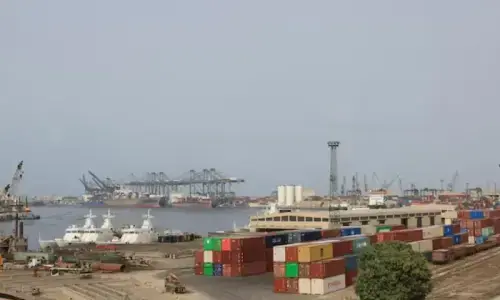
Foreign donors representing World Bank, Asian Development Bank and representatives of foreign aid giving countries were informed that over 90 per cent of Pakistan’s international trade transits through Karachi. It means goods worth about 17 billion dollars pass through Karachi out of total 19 billion dollars every year.
Sindh once boasted of having 39 per cent of the total industrial capacities of the country. It is now reduced to 34 per cent. Still Sindh contributes 43 per cent in large scale and 25 per cent in small scale manufacturing.
But with no one in the provincial and federal government to raise the voice of the pauperised section of the population of Sindh, there is no end to the miseries of more than 15 million men and women who are living below poverty level.