NEW DELHI, Dec 22: India described on Saturday its move to recall High Commissioner Vijay Nambiar from Islamabad as only the first step in a series of penal moves it planned against Pakistan, and officials said these could include the scrapping of the Indus Water Treaty and suspension of overflight facilities to Pakistani civilian planes.
Saying that Prime Minister Atal Behari Vajpayee had hinted at harsh measures against Pakistan in parliament recently, Home Minister Lal Krishan Advani told a TV channel: “Recalling the envoy was only the first in a series of steps we propose to take in this matter.”
He was quoted by The Hindustan Times as explaining the decision to recall Nambiar thus: “We said all options were open and we weighed the situation, took public perception into account and then took the decision, after the (cabinet committee on security) was briefed by the service chiefs and our intelligence agencies... All members were unanimous that Pakistan had to pay the price.”
Interestingly US Ambassador Robert Blackwill has been quoted as telling some BJP MPs at a dinner he hosted for them that they should follow Vajpayee’s approach to the crisis, understood to be a moderate in the otherwise hawkish BJP.
Advani denied that the government was divided. “We had to take action, which we have done. I want to make it clear that there are no hawks or doves in the government. We are all one. This constant refrain of differences between Atalji and me is simply not true,” he told The Hindustan Times.
Pro-government defence analyst Brahma Chellaney was among several advocates of harsh penalties on Pakistan.
He wrote in the Hindustan Times: “India’s first actions amount to nothing more than a slap on the Pakistani wrist, but the signal they send out internationally is unmistakable: New Delhi means business. A further downgrading of diplomatic relations is likely.”
India’s graduated approach, through a measured exercize of options, seeks to penalize Pakistan not through immediate application of force but through controlled non-military retribution in the form of gradual, modulated steps up the punishment ladder, analysts said.
Such is the degree of hostility towards Pakistan that no party barring the Left Front has come out to advocate moderation. BJP spokesman J.P. Mathur even slammed Islamabad’s decision to keep its high commissioner in Delhi as an example of “ungraceful diplomacy.” Communist Party of India and two other left groups said the government had taken Friday’s decision without informing the opposition, a move that could recoil on its diplomatically.
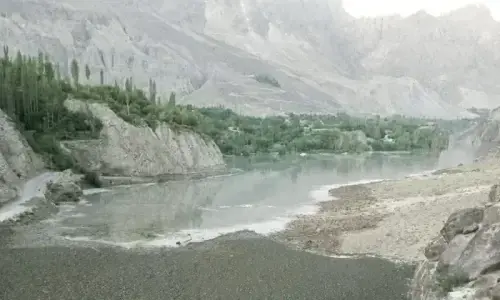
Foreign Secretary S.K. Singh, who has been an envoy to Pakistan, said Vajpayee was opposed to the idea of hot pursuit of militants inside Pakistan. But, he added: “He has other options in mind. For instance, ending the Indus Valley Water Treaty and starving Sindh and Punjab, scaling down of the mission,” Singh said. The Indus Water Treaty of 1960 governs the distribution of water from the Indus river and its tributaries between India and Pakistan.
“And when Pakistan has digested this, we can stop over flights. We don’t need their airspace, they need ours,” Singh was quoted by the newspapertoday online daily as saying. There was also a suggestion that India take the case of the terrorist assault on the Parliament House to the United Nations.
“India will try to prepare a watertight case against Pakistan’s involvement and take it to the United Nations,” said Ajai Sahni, executive director of the New Delhi-based Institute for Conflict Management, a counter-terrorism research body. “If the case is admitted in the United Nations, under the anti-terrorism Resolution 1373, Pakistan will be bound to follow the UN’s instructions. Delegitimizing terrorism would be India’s top priority,” he said.
The final word on the current tense standoff went to Foreign Minister Jaswant Singh who told reporters in Kabul that India’s patience was not infinite. He described the decision to withdraw Nambiar as a signal to Pakistan to recognize the enormity of the crime.
“The step was only a signal, a message to Pakistan so that it recognizes the enormity of the situation,” Singh said when asked about New Delhi’s decision to recall Nambiar.
“India has been patient and waiting since Dec 13 for some kind of recognition from the Pakistan government about the enormity of the situation. Nothing of that sort came. The issue was deliberated by the Cabinet Committee on Security (CCS) at great lengths and it was decided to pull out India’s High Commissioner to Pakistan,” Singh said. He ducked a question when asked whether India was considering a military option to deal with the situation saying “I am not in Kabul to discuss such options.”
Meanwhile the Press Trust of India reported intensified surveillance by the security forces along the border with Pakistan.
“We have launched intensified surveillance and monitoring operations in different areas of Kargil, Jammu, Poonch and Kashmir sectors in order to tackle any type of situation emerging on the border, particularly in Jammu-Poonch Sector,” said a PTI report from Jammu, quoting sources. Even in remote areas the security apparatus has been beefed.
According to Border Security Force sources, the Army is taking up positions along the border in Rajasthan too, in a bid to thwart any adventure by Pakistan, even as BSF jawans are keeping a close watch on the movements of Pakistan Rangers across the border.
Cemented bunkers on the east bank of the Ganga Canal in Rajasthan, constructed before the 1971 Indo-Pakistan war, have been cleaned up and troops have taken up positions. Troop movement was also observed in many of the villages in the state as the Air Force installed mobile radars at several places. According to a PTI report, the Ganganagar district has witnessing enhanced movements of defence goods for the last three days.