0
0

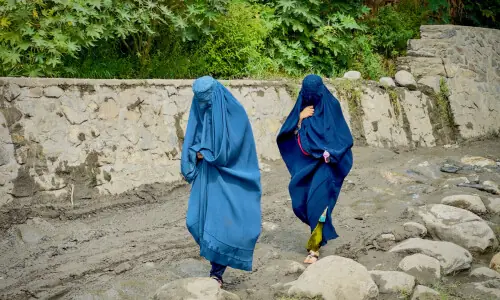
LOS ANGELES: The striking images of women emerging from beneath their burkas and men shaving their beards in celebration of their newfound freedom from the Taliban remind us that the notion of appearance is much more profound than we ordinarily think.
By casting off the heavy shrouds and facial hair that had for so long held their faces hostage, Kabul’s people told the world, “We are free.” Seeing their exhilaration was like watching the fall of the Berlin Wall 12 years ago this month. But more than just a victory over an oppressive regime, their rejection of burkas and beards was a symbol of personal and political freedom.
Western dress is by no means superior to Muslim dress. Plenty of women wear chaddars and head scarves willingly, but the tent-like burka was exclusive in how it was used in Taliban-controlled Afghanistan, according to Katherine Spillar, executive vice president of the Feminist Majority Foundation.
Before the Taliban took power, women in Afghanistan were professionals and students, and they wore contemporary clothing. ”Kabul was known as the Paris of the East. In the 1960s, women wore miniskirts,” Spillar said. “Burkas were forced on them, and they were totally restrictive garments.”
Choice is precious. Some Afghan men admitted that they did not mind having facial hair. Still, after the Northern Alliance gained control of Kabul, they wanted to shave because they had for so long been deprived the ability to define their own identities.
Changing one’s appearance can be an intimate form of rebellion, and clothing and hairstyles have long been a medium for expression. “Political ideas have always been reflected in dress,” according to Ruth P. Rubinstein, an associate sociology professor at New York’s Fashion Institute of Technology.
Peter the Great imposed his modernist ideology in part by forcing Russian men to pay taxes on their long beards if they chose to keep them instead of adopting his updated, cleanshaven look. During the French Revolution, one of the first things the third estate did after seizing control of the government was to outlaw the extravagant wigs, gowns and jewels that had defined the aristocratic and out-of-touch ancien regime.
In the United States, clothing and hairstyles figured prominently in the Civil Rights movement. Political radicalism could almost be gauged by the length of a man’s hair and sideburns. Wearing an afro (and later, braids) was a way to affirm black power. Hair was such a statement in the 1960s that it sparked a musical.
In the 1970s, women rebelled against a patriarchal society. In England, the punk look became a way for jobless youths to express their rage. They wore slashed T-shirts with violent images on the chests, and safety pins pierced through their noses and ears.
If clothing and hairstyles are a visual language for expressing politics, social status and creativity, the definitions are constantly evolving. The Mao jacket, popularized by the Chinese leader because it was classless, was embraced by dandies in the late 1960s and now has become a staple shape in menswear. Likewise, campus radicals wore camouflage Army jackets and pants even as they protested the Vietnam War.
Muslim dress has long been romanticized on runways from New York to Paris. For fall (before he went out of business), Miguel Adrover sent models down the runway in turbans and Middle Eastern-inspired djellabas. The collection, he said, was not about “skin” but “the heart and soul of a woman.” —Dawn/LAT-WP News Service (c) Los Angeles Times.