ICC bears similarity to United Nations: SWINGING DRIVES
SHOAIB Akhtar’s bowling action has become a permanent feature of international cricket, not dissimilar to a television serial. He gets reported for ‘chucking’ and is then cleared. Then he gets reported again and cleared again. What the hell is going on? Is there any special reason why he is being targeted. A high-tech study at the Western Australian University had concluded that his bowling arm was naturally kinked at birth and did not fully straighten during delivery. X-rays of this were duly shown on television.
Perhaps, the time has come for Shoaib to take matters in hand himself and not rely on the ICC whose writ is apparently not binding on a gang of umpires and match referees. He should take legal action. Lt-Gen Tauqir Zia has indicated that the PCB would back him if he decides to go to court. Imran Khan has also backed Shoaib. I think the matter should be resolved once and for all.
Cricket is Shoaib’s livelihood and he shouldn’t be kicked in the stomach by umpires who routinely make mistakes but the consequences of these mistakes are now career-threatening.
I have written this before and still maintain that the ICC bears a similarity to the United Nations. The United Nations is invoked when it suits the Big Powers and ignored when it does not suit them.
The ICC remained silent when India cancelled its tour of Pakistan. It remained silent too when New Zealand refused to tour Pakistan citing security concerns, influenced no doubt by highly selective pictures of protests that Western television channels showed them as a part of hyping up the war in Afghanistan. The ICC should have sent its own representative to see what was the reality on the ground. The ICC is an independent body and should not become the cat’s paw of someone else’s foreign policy.
Justice Karamat Bhandari who is holding a judicial inquiry into allegations made by Ali Bacher that Pakistan’s match against Bangladesh in the 1999 World Cup was “fixed” has written to Bacher to appear before it but has not received a reply from him. Why has Bacher not chosen to reply? He was pretty cock-a-hoop when he made the allegation. Has he had second thoughts? Or was it an attempt to deflect attention away from South Africa’s own problems with match-fixing? I still maintain that people who are not able to substantiate their allegations should not be allowed to get away scot-free.
A team that makes 378 in its first innings should not lose a Test match by nine wickets and with a day and one session to spare. Yet that is precisely what India managed to do in the first Test match against South Africa.
Was it a case of South Africa playing exceptionally well or India playing exceptionally badly? I think it was a combination of both. India was unlucky with injuries and the absence of Harbhajan Singh was crucial.
Normally, it is fast bowlers who hunt in pairs but spinners also do. The South Africans are vulnerable against spin but Anil Kumble couldn’t do it all on his own.
But it was India’s batting in the second innings that folded up on a seaming track that Shaun Pollock exploited fiendishly. I must confess to being surprised that Rahul Dravid opened the innings for India. After Sachin Tendulkar, Dravid is India’s best batsman. Why was he made a sacrificial lamb? In the final of the triangular, he kept wickets! Suddenly, he has been converted into a utility player.
India relied on a pace attack but the two left-arm fast bowlers had had a long lay-off and I rather suspect were not hundred per cent fit. It says something that it was the old war-horse Javagal Srinath who looked the best of the bunch. Tendulkar’s hundred was one of the best that he has made. He was pugnacious and quite brilliant.
Saurav Ganguly must learn how to handle the ball aimed at his rib-cage otherwise his utility as a batsman in Test cricket against teams that have quality pace attacks is limited. It is a defect that is curable and he should work with his coach to sort it out. As with Pakistan and Sri Lanka, some serious thought should be given to preparation of wickets at home. I don’t see any advantage in preparing flat-tracks.
The best thing that has happened to one-day cricket is the one-bouncer per over that is now allowed. The one-day game used to favour the batsman so heavily that bowlers became trundles and functioned as glorified ball-boys. The introduction of the bouncer has transformed the game. The next change that is over-due is the wide. Presently anything pitched outside the leg-stump is a wide. The umpires virtually have no discretion. If a batsman is able to reach the ball, it should not be a wide. And while the going is good, the front-foot no-ball rule should also be changed and we should go back to the old, back-foot rule. I think every bowler in the world would welcome it. So too would umpires, I would imagine, those, at least, who are not too busy finding fault with Shoaib’s bowling action.
The war in Afghanistan is taking toll of many sporting events. They are being cancelled on the theory of better safe than sorry. I can’t help feeling that we are being over-cautious. After expressing some initial fears, England has after all agreed to tour India and the West Indies are in Sri Lanka and Zimbabwe is in Bangladesh. But to crown it all, the Sri Lanka Under-19 is in Pakistan. The best way to fight terrorism is to go about our normal lives and sports provides the greatest reassurance of the lot.
Bahadur Shah Zafar remembered
IT was quite surprising to see the Chaghtai Adabi Forum, Karachi, commemorate the 139th death anniversary of the last Mughal king-poet, Bahadur Shah Zafar, in a school building in Sir Syed Town last week.
A seemingly Chaghtai, Mirza Ehtashamuddin Beg, clad in a typical Mughal dress of the first half of the 19th century, declared at the outset that the family of the last Mughal emperor had decided to commemorate the death anniversaries of Bahadur Shah Zafar and other poets of the family, such as Shah Alam Sani Aftab and Zebunnissa Makhfi, regularly.
Mirza Ehtashamuddin Chaghtai read out a paper which was plaintive in tone. He said that the government had not, as yet, fulfilled its pledge to bring the remains of Zafar to Pakistan and give it a proper burial in Lahore, alongside emperor Jehangir.
Now on to Bahadur Shah Zafar as a poet. I believe that he is one of the most neglected of Urdu poets. He has left behind four parts of his kulliat running into some 3,000 pages. He should be classed as an important poet of the Urdu language if we are to go by T. S. Eliot’s obiter dicta that the reading public has to pay tribute to a poet who has served the language, if not literature.
Zafar has also written poems in Punjabi. His holis and bhajans contain a wealth of indigenous allusions. Mirza Ehtashamuddin has rightly lamented that Mohammed Husain Azad is unduly hard on Zafar when he says in his Tazkirah, Aab-i-Hayat, that Ustad Zauq was the ghost writer for Zafar. This could not be the case. One of his four Diwans had appeared when Zauq was not his Ustad (mentor).
He had also written two books — one on poetry and the other on mysticism — during this period. The book on poetry was titled Lughat aur Islah-i-Sukhan. Except for Azad, almost all Tazkirah writers and critics have accepted the craftsmanship of Zafar. The list of his advocates is pretty long. It includes Munshi Karimuddin, Ahmed Husain Sahar, Mustafa Khan Shaifta, Mirza Qadir Bakhsh and Abdul Ghafoor Nassakh, Maulana Hali, Mirza Hairat Dehlavi, Lala Sri Ram Dehlavi, Maulvi Abdul Haq, Nawab Naseer Husain Khayal, Ram Babu Saxena, Hasrat Mohani, Niaz Fatehpuri and Firaq Gorakhpuri.
Sir Ross Masud, grandson of Sir Syed Ahmad Khan, has rightly criticized those who think that Zafar’s “prison-poetry” was written by a team of anonymous poets. On the authority of his father, Syed Mohammed Mahmud, who rose to be the first Muslim judge of high court in the subcontinent, says that he remembered all of Zafar’s prison poems by heart. He says that not only Syed Mahmud but also Sir Syed regarded Zafar’s prison-poetry as a genuine contribution of the last king. Syed Mahmud remembered every line of Zafar’s poems which were written in Rangoon, and accepted them as genuinely written by the deposed king. It is said that an English officer was kind to him and provided him with pen and paper to write down his poetic thoughts.
Shanul Haq Haqqi says in his book Nawadir-i-Zafar that there is no reason to exclude Zafar’s prison-poetry as it is the chip of the same block. Either one should accept all of his Diwans as Zafar’s genuine contribution to Urdu poetry or reject his claim to be the poet of those Diwans. The controversy must end now and Zafar be credited with having used the symbols of Gulistan and Chaman for India.
It is also wrong to suggest that Bahadur Shah Zafar was not the leader of the Revolt. He had, quite early in his career as the symbolist king, refused to waive the court etiquette for Lord Auckland, the governor-general who succeeded Lord Amherst. There is no use discussing the tragic events of September 1857. The way Hodson murdered Zafar’s sons — Mirza Mughal, Khizar Sultan and Abu Bakr — was condemned even by British historian Bosworth-Smith who called it “stupid, cold-blooded threefold murder because the princes were unresisting prisoners in his hands.” This tragedy was also responsible for the poetry which Zafar wrote after 1857. It is spontaneous and moving as it is dipped in unparalleled anguish. One cannot escape feeling the pinch:
Gai Yak Ba Yak Jo Hawa Palat Nahin Dil Ko Mere Qarar Hai
Karon Is Sitam Ka Mein Kiya Bayan Mera Gham Se Seena Figar Hai
Na Tha Shahar Dehli Tha Ek Chaman Kahoon Kis Tarah Ka Tha Yaan Amn,
Jo Khitab Tha Woh Mita Diya Faqat Ab Tu Ujra Dayar Hai
Zafar’s poetry of the prison was compiled by Azizur Rahman Dehlavi in his Ilm-i-Majlisi series, and Mufti Intizamullah Shahani also published a part of it. It is a matter of regret that except for Khalilur Rahman Aazmi, Shanul Haq Haqqi and Shahid Ahmed Khan of the Jamia Millia very few critics have paid attention to Zafar.
The Chaghtai Adabi Forum has done a right thing to attract our attention to the life and poetry of Zafar who died on November 7, 1862, in Rangoon.
Our own Char Minar
THE majestic edifices raised during the reign of Emperor Shahjehan stand testimony to the Mughals’ love for art. These include, among many others, the Taj Mahal in Agra, the Jamia Masjid in Delhi and the Shalimar Gardens in Lahore. Another proud relic of this family is the Chauburji monument. It is a masterpiece of architectural dexterity, and shows a dominant Persian influence on sub-continental architecture. Its distinguishing features are the minarets which expand from the top, not present anywhere in the sub-continent. Some, however, believe that there were domes upon these minarets which collapsed with the passage of time. The view is not widely shared.
Away from the hustle and bustle of city life, two miles south of the Lahore Fort, was built a walled garden in AD 1646. The monument of Chauburji was the gateway to princess Zaibun Nisa Makhfi’s garden. According to REM Wheeler’s book, 5000 Years of Pakistan, “The story goes that the garden was laid out under the supervision of the princess’ favourite female attendant, Mian Bai; that it thus became known as Mian Bai’s garden and was on that account given to Mian Bai by (her) royal mistress.”
The kings and princess in those days used to travel with scores of attendants and troops. But they would hold themselves back with only a few servants at such gardens so that the troops might go ahead to prepare for their next encampment. Similarly, when the emperor would visit any city, the troops would be there in advance.
The entire building exhibits a beautiful show of tiled floral panels. There is a great variety of colours, but blue is predominant which has a cooling effect during summer.
The name Chauburji has been derived from the four octagonal minarets occupying the four corners of the monument. During a severe earthquake, the north-western minaret collapsed in 1843, and cracks appeared in the central arch.
Although most of the inscriptions have been lost, on the upper-most part of the construction Ayat-ul-Kursi can be seen in Arabic script in blue and worked in porcelain. Others include two couplets written in Persian above the arch:
“This garden, in the pattern of the garden of Paradise, has been founded (missing line)... The garden has been bestowed on Mian Bai. By the bounty of Zebinda Begum, the lady of the age.”
Kanhayya Lal, in his Tarikh-i-Lahore says that Zebinda Begum and Zaibunnisa Begum are the names of a single individual.
This was the period of building activity in Lahore. Major buildings of the Mughal period like the Shalimar Gardens, Wazir Khan’s mosque, Mai Lado’s mosque, and Dai Anga’s tomb and mosque were constructed during this period. The construction is typically Punjabi in character with an exaggerated use of bricks and glazed tiles.
The idea of having minaret-like projections is thought to have been introduced first in the tomb of Ismail the Samanid, built in about the 10th century AD. Major changes in the global political situation in the 12th and 13th centuries resulted in a large influx of artists and architects to the sub-continent. The result was an overwhelming ingression of the Seljuk style of construction and decoration. Consequently, in the Ajmer mosque and the Khirki mosque and in Akbar’s tomb, we find four minarets just like Chauburji. “But the real prototype of Chauburji is the Char Minar of Hyderabad Deccan constructed in 1591 by Muhammad Quli as a triumphal arch at the junction of four roads, leading to the four quarters of the old city. Octagonal minarets were later used along the corners of Jehangir’s tomb itself. This became a motif and was incorporated in the Taj where the minarets flank the corners of the platform” wrote Dr Ajaz Anwar in an article published in The Pakistan Times in April, 1985. He adds: “the Char Minar, though it comes closest to Chauburji, has a striking contrast and a sense of negation between the very simple lower portion and the heavily decorated upper portion. In the tomb of Akbar, the white marble and variegated stone: give the feeling of having been added later... Chauburji, because of the colour of the brick adorned with glazed tiles having the look of flowering creepers, retains a distinctive unity.”
Chauburji was declared a protected monument under the Archaeological Act as revised in 1975. Though it has been repaired and somewhat protected, the signs of negligence are still present. The building is serving as a store-house. The rooms are locked. The ground staff shows complete ignorance about the use of these rooms and says that their keys are with the Auqaf Department.
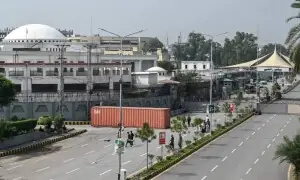
During the interim prime ministership of Mr Moeen Qureshi, a circular road was built around the monument. This has not only eased the flow of traffic but has also given Chauburji a central place. The surrounding shops were demolished and an attempt was made to restore its lost glory. Unfortunately, the restoration and conservation work seems to have been below the required standards. A restoration mason, when asked about this inconsistency, replied that the material originally used was not available now. “They would use colours extracted from vegetables and would use natural adhesives. These things require time and skill. Today we lack both. We have cement and other strong materials, but somehow the work that we do today is far less durable than the one done centuries ago.” — DANYAL SALEEM GILANI
Water shortage: effects and remedies: COMMENT
FINALLY, the government has annulled the 1994 ministerial water apportionment formula which had proved to be the main source of hurdle in resolving the water sharing dispute among provinces, specially Sindh and Punjab. Although it appears that the issue stands resolved now, there remains much to be done to make the resolution effective as there still persists differences over the interpretation of two clauses in the Water Accord of 1991, which will require another attempt to straighten the things.
The water sharing formula has remained a source of bickerings between Sindh and Punjab since long. On certain occasions the matter would get so warmed up or serious that the prime minister had to intervene to overcome the problem. Generally the decisions would be made with due regard to the needs and rights of the provinces, but doubts would crop up at the stage of implementation when the two main beneficiaries would find themselves at variance with each and make complaints. The problem still persists for one or the other reason. The present dispute also emanates from the basic question of how to share the water.
While the Punjab Water Council has announced a three-phased closure of the main Mangla water works for 30 days, lasting up to Jan 31, 2002, Sindh has announced a four-tier programme to conserve water during the ongoing Rabi season, in addition to the allegations that Punjab is consuming more water than was allocated for the season.
Experts calculate that this time the average shortfall would be about 51 per cent. Sindh fears it may not be able to get more than 39 per cent of water it requires during the Rabi season. The situation can be gauged from the fact that at present Sindh should get 40,000 cusecs but it is getting 22,000 cusecs at a time of the wheat sowing. This makes the issue more critical, and growers have begun expressing concern over the farm targets.
Whatever the intake and outflows at the dams, the fact remains that both provinces have to share the shortfall. But there has been a longstanding mistrust between the two on the sharing formula. This ensued from a clause in the ministerial formula of 1994, which was adopted during the Nawaz Sharif government, reportedly to benefit Punjab. In fact, the Water Accord of 1991 had already a similar clause, 14 A, which says that in case of water shortage all provinces will equally share the shortfall. To make it ineffective, the ministerial formula was adopted in 1994 with the addition of another clause in which the 1977-82 period was taken as average to work out the water sharing.
According to Sindh, this clause slashed its rightful share. Thus it became a bone of contention between the two provinces, with Sindh demanding its annulment. The present government took notice of the matter and issued two letters to the Indus River System Authority (Irsa) to undo the formula but it could not be complied with, on one or the other pretext. On Monday the Irsa chairman issued a formal notification to undo the 1994 formula and restore the 1991 Water Accord.
In view of the estimates that this Rabi season will face more shortage of water, the president’s secretariat has asked the water engineering wing of the GHQ to seek a report from the ministry of water and power and has asked the Irsa to present a report on the issue and sort out the problem at a meeting convened for Wednesday at Islamabad. Obviously the meeting, to be attended by experts and high officials of the four provinces, will take into account the situation and evolve a strategy to face the shortage.
How the effects of the shortage are going to be reduced is a mind-boggling question which requires a multi-faceted solution, without any political or parochial reservations. This is the third consecutive year that the country has been facing water shortage, specially Sindh which has undergone drought-like conditions, affecting its produce and general environment in the deltaic economy. In the past too there had been serious political bickerings that at times had led to street demonstrations. On one such occasion a man was killed in police firing. To avoid such a situation, one hopes some sound strategy would be evolved this time.
Here the question is not about what a province’s demand is. We know the ground reality, i.e. the water shortage will prevail till April-May 2002 and till then we have to make the best use of the water available in our reservoirs, underground resources and conservation. But the main hurdle is proper distribution. We have the formula which has been worked out after a long and extensive exercise by the experts and approved by all beneficiaries.
In the past Sindh had been complaining about Punjab drawing more water than its share. Even on Oct 25, it made a similar complaint that Punjab drew more water for the Chashma-Jhelum Link Canal. Complaints like this could again torpedo a formula. The only solution lies in the proper, judicious and neutral monitoring of the water outflows at all points.
Similarly, the underground water resources need to be revamped. Sindh has over 3,500 tubewells which are meant for lowering the underground water-table but can be used for irrigation purposes. A more liberal attitude towards this issue can also help meet the shortfall to some extent.
The provincial governments will also have to be more vigilant to stop water theft by influential landlords in collusion with the corrupt bureaucrats. But more important will be a neutral monitoring mechanism at the water works to help ensure an end to the distrust among the provinces.