0
0

Private sector remains discouraged
SO far, we have proved to be very emotional people. We tend to act in haste without examining all the pros and cons of problems and at times we have tended to run with hares and hunt with hounds. There was a period when both private and public sectors were working in close coordination and harmony with each other.
In fact, during this period, public sector entered into joint ventures with the private sector, in order to tempt them into new industrial ventures.
In case of difficulties, the private sector undertakings were taken over by the public sector and after removing the difficulties these were handed back to the private sector. Some, in the private sector, at that time were reported to have avoided payment of taxes, repayment of bank loans, etc.
Here and there, there were also complaints of artificial shortages of essential commodities for making more money.
An economist of repute at that time, carried out a study with all good intentions and disclosed that the entire wealth of the country had accumulated in the hands of just 20 or 22 families.
This created considerable commotion in the country and a newly formed political party included in its election manifesto, nationalization of important industries. This party won the election in the then West Pakistan with thumping success and on assumption of power, embarked on a massive programme of nationalization, not only of industries but also of banks, education and some other sectors of the economy.
This shook the confidence of the private sector completely. The hard work and money invested by it over the years was taken away from it by one stroke of pen. This discouraged the private sector so much that even after the lapse of 20 to 25 years it has hesitated in putting its own capitol at risk and some businessmen will like that, when setting up industrial undertakings, the investment in machinery, construction of building, etc, should all come from bank loans, kickbacks, etc.
According to media reports, the information is that some four to five thousand industrial units in the private sector stand closed. Those who own these undertakings do not appear to be worried, as their own capitol is not involved.
For no fault of others, but of our own, we have landed ourselves in all sorts of problems. In order to break the logjam of our problems, extraordinary steps are needed.
We should look at the progress achieved by Germany and Japan, although their economies were ravaged during the second world war. We also need to look at the achievements of China, which attained independence two years after us, but is now on the way of becoming the second biggest economic power. All this progress has been achieved by sheer dint of hard work, observance of law and dedication to honesty of purpose.
It is considered that it is never too late to mend. It is expected that by now we have learned our lessons. This calls for a hard look at the policies that we are pursuing at present. It is felt that a motivated public sector under a dynamic leadership can, at this juncture, play a vital role in inspiring confidence in the private sector and in taking it along to move the economy forward.
The importance of the private sector cannot, be emphasized to much as the private sector is capable of taking quick and correct decisions when its own capitol gets involved. We would, there like the private sector to move forward, making it possible for the public sector to shed its activities as may be required.
This is not to say that we should close our eyes to advice and criticism from others. We should, in fact, make all our operations open and transparent and any advice, which is considered beneficial, should be welcomed and accepted.
MOHAMMAD ANWAR KHAN,
Karachi.
Osama and US policies
THE US has embarked upon a big military operation to topple the Taliban government in Afghanistan and apprehend Osama bin Laden.
It would be interesting to know that Osama bin Laden and Sheikh Abdul Rehman worked in close association with the Americans during the Soviet invasion of Afghanistan. They were asked to recruit “Mujahideen” from all over the Muslim world, train them and then push them against Soviet forces.
At that time, the Americans were keen to inspire the Muslim youth, including the students of Deeni Madaris, for a Jihad to teach a lesson to the Soviet Union. As a result of active participation of Mujahideen in the war, the Soviet forces had to withdraw after facing a crushing defeat in Afghanistan. Then the American leadership was highly pleased with Sheikh Abdul Rehman and Osama bin Laden and commended their efforts for waging Jihad against the Soviet forces.
But the whole scenario changed in 1990, when the Gulf War commenced and the Americans attacked Iraq and their troops landed in Saudi Arabia. Osama bin Laden asked them to withdraw their forces from the holy land at the end of the Gulf War. But they turned a deaf ear to his repeated requests. This was a turning point in their relationship and Osama had to divert his efforts towards a religious war against his past sponsors.
Later, the Americans implicated Sheikh Abdul Rehman and Osama in an earlier bomb blast at the World Trade Centre and convicted Sheikh Rehman for that attack. Since then, Osama bin Laden has been at large and the American leadership has stepped up efforts to apprehend him. He ultimately landed in Afghanistan as a guest of the Taliban regime.
The catastrophe of September 11 enraged the Americans who once again accused Osama bin Laden and Al-Qaeda for organizing the attacks on WTC and the Pentagon and asked the Taliban government to hand him over to them. The Taliban authorities asked for the proof of involvement of Osama in terrorist operations in New York and Washington. The US government instead of providing the desired proof to the Taliban government, took an affront to their stand and started a war.
The waging of war in Afghanistan has shaken the entire world, as it will have far-reaching effects in the future. The lessons of history teach us that war spreads fire and extreme hatred instead of achieving peace and stability. Furthermore, it invents new methods of terrorism instead of ending terrorism.
LT-COL (R) MUKHTAR AHMED
Karachi
Jaswant Singh’s interview
THIS letter is in reference to Indian Foreign Minister Jaswant Singh’s interview on CNN on October 2 which was so cleverly dovetailed (courtesy CNN and India TV) with the hijacking of an Indian airliner in 1999 and making ridiculous efforts to establish similarities with the horrendous incidents of September 11 in the US in which thousands of innocent lives were lost through acts of terrorism condemned by one and all the world over.
Today we are standing at a crucial crossroads of history. It is a time when the entire civilized world is faced with the grim prospects of our beautiful planet being pushed to the brink of a possible holocaust.
At this crucial juncture does it behove of a political leader of the world’s so-called largest democracy to attempt making petty political propaganda gains? When he tries to portray the freedom struggle by the masses in Kashmir as cross-border terrorism being launched by Pakistan, he should also recall the Indian role in erstwhile East Pakistan in 1970-1971 and thank his stars that Pakistan is still making serious efforts to resolve all outstanding differences including Kashmir through dialogue and not by use of arms.
Mr. Jaswant Singh, under the present chaotic conditions, let us work together and help overcome the present crisis rather than compound it by petty propaganda gains. The world community can see through the game and hence this exercise in futility is only stoking the fire of mutual hatred and mistrust among the illiterate masses on both sides of the border.
Once the present crisis is over, let us seriously continue to work towards resolving our differences through peaceful means. Any other course will only spell disaster.
BRIG (RETD) ANWAR MUNIR-UD-DIN
Lahore
Need for statesmanship
Had the Americans and its allies shown statesmanship and allowed the rule of law to prevail by demanding the UN to act, instead of the unilateral bombing of an already bombed out Afghanistan, they would have earned the respect of the moderates, the undecided and the silent majority. Unfortunately bombs and biscuits do not mix and jargon phrases do not help the dead and the dying.
Unfortunately, over the years, the American government, the UN, the “silent majority” of the prosperous and developed nations and even the Muslim Ulema, through their complacency, have ignored the suffering of the millions of innocent Muslims and other victims of ethnic violence. Through no fault of theirs, these displaced citizens of the world have been forgotten and have become helpless pawns in a deadly political chess game. They die due to starvation and disease or rot in refugee camps, while we prosper and flourish.
President Bush, the British PM, Mr Tony Blair, the G7 countries and the UN have to declare a crusade against these refugee camps also, where poverty, illiteracy, unemployment and frustration is their wretched way of life. And it is where an army of disgruntled and angry youth, willing to kill and be killed, have been born. And it is in this cesspool where men like Bin Laden recruit their “followers”, through whom they have succeeded in hijacking the world by disrupting the global economy and destroying the sense of security of many nations. America and its allies will not make any progress in fighting terrorism until they begin to appreciate the reasons why terrorists target US interests and address the root causes, not the symptoms.
Unless these refugee camps are eliminated and a just world and economic order established, the world will never be rid of the terrorists and their camps. For every terrorist killed or camp destroyed, another 10 terrorists will be born and the cycle of terror will continue to haunt us in the air, the seas, the streets and in our daily lives.
A.H. MAKER
The Helpline Trust,
Karachi
Passport renewals
THE Pakistan Consulate in Dubai is not refusing to entertain applications for passport renewals without production of foreign exchange remittance receipt, as stated by Mr Ali Ahmad (Oct 13).
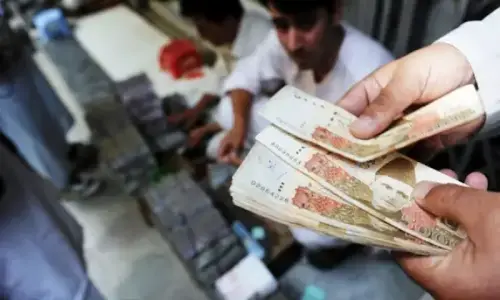
Remittance through the Hawala or Hundi system is illegal and the State Bank of Pakistan rules in this regard are very clear which make it mandatory upon all Pakistani citizens to remit their money back home through legal channels. The Central Bank of UAE has also issued fresh instructions to discourage illegal money transactions.
At the request of the Pakistani community, a separate banking counter has been set-up at the Pakistan Embassy, Abu Dhabi to facilitate home remittances. A similar facility is also being made available at Pakistan Consulate Dubai very shortly. Remittances could also be sent through any other legal channels.
It is the national duty of all Pakistani expatriates to join in nation building and contribute in boosting the national economy. It is in this spirit that the Pakistanis are being motivated to send their remittances to their family members in Pakistan through legal channels.
While availing consular services, the Pakistanis are being requested to produce a copy of any receipt of the amount remitted to their kith and kin during the last six months. In case anyone does not have a receipt at the time of submission of papers, he/she is requested to produce the same at the time of collection.
This is also necessary to verify bonafide Pakistani expatriates from a large number of non-Pakistani nationals in possession of Pakistani passport and ID card.
LIAQUAT ALI KHAN
Press Councillor, Pakistan Embassy Abu Dhabi,
U.A.E
Eliminating terrorism
EVER since the horrendous acts of terrorism of September 11 — which have been universally condemned, and quite rightly so — the one constant refrain in the speeches of President George W. Bush has been that America is out to seek not “revenge”, but “justice” for the perpetrators of this heinous crime.
Another important point that he has made is that his administration is determined root out “all forms of terrorism”.
Both these observations are of the utmost importance, and if pursued earnestly and diligently, will go a long, long way in eliminating this curse of terrorism in our midst.
It is generally recognised that all acts of terrorism (with the possible exception of those which are committed by mentally deranged persons), are the outer manifestation, or “symptoms” of a deep-seated malaise, or “disease”.
Through force of arms or military might you can obliterate terrorism per se, i.e., the symptom, but the disease will remain, and in due course of time, it will erupt again in the form more symptoms, i.e., more acts of terrorism.
In today’s troubled world, this disease is to be found in the Middle East, or, translated in political terminology, in the pain and suffering of the poor, helpless Arab people of Palestine who, through no fault of their own, have been ruthlessly dispossessed of their homes and lands. The “disease” is also located in the state of Jammu and Kashmir, where India has stationed more than 700,000 troops to crush the freedom struggle of the Kashmiris by unleashing “state terrorism” of the worst kind.
Therefore, when the leaders of America speak of “justice”, let them do “justice” in Palestine and in Jammu and Kashmir.
And this they can only do by being fair-minded, by rising above political expediency, and above the politics of double-standards.
By doing so, they will not only eliminate the “disease” of terrorism, but also make the world safe for democracy, decency, and freedom around the world.
SALAHUDDIN K. LEGHARI
Lahore