0
0

While Z.A. Bhutto was busy handling vital issues, Sindh was passing through an unpleasant situation like Punjab. Cracks were appearing in the party ranks mostly on the issues of party offices and government positions. Groups became apparent. Ghulam Mustafa Jatoi, a feudal of Nawabshah in central Sindh, accompanied by Syeds of the same district, Talpurs of Tando Mohammad Khan, Khairpur and Mirpurkhas, had gained some strength and had been rewarded for that. Syed Qaim Ali Shah, a lawyer of Khairpur, presently Sindh Chief Minister, was the president of Sindh People’s Party and was trying to convince Bhutto that his services could also be used for some government position.
Mir Rasool Bakhsh Talpur became a popular governor as he removed the usual protocol and allowed every visitor to see him without undergoing the formalities of security checks. All a visitor needed was to get his name registered at the main gate. Talpur was a very hard-working person rising from the lowest rung of politics. This also created jealousy among his fellow partymen.
This followed an unfortunate event. When arms and ammunition were seized from the Iraqi Embassy on February 10, 1973, Mir Ali Ahmad Talpur, a cousin of Mir Rasool Bakhsh Talpur, was accused of involvement. In the wake of this, the Balochistan government led by Mir Ghaus Baklhsh Bizenjo was disnmissed, and three days later Mufti Mahmood’s government in Khyber Pakhtunkhwa also resigned. Mir Rasool Bakhsh Talpur, the Sindh governor also resigned in protest. He then stayed as an independent politician who worked with sincerity for the betterment of the people. Both the brothers remained steadfast and did not show any inclination to rejoin the People’s Party though there were attempts by certain sincere party leaders. When the Pakistan National Alliance (PNA) was formed and the fateful 1977 elections held, both the brothers worked for the alliance. They were arrested and sent to jail for “creating disturbance” but were released after military dictator Ziaul Haq seized power in July 1977.
This was a blow to the People’s Party. The unhappy Mumtaz-Jatoi relation also affected the party’s performance. When Ghulam Mustafa Jatoi was appointed Sindh Chief Minister, Jam Sadiq Ali, hailing from Sanghar’s influential family, was appointed provincial minister for housing and local bodies. He was a very sharp person. He had worked with Bhutto during Ayub Khan’s rule and joined Pakistan Muslim League (Convention) on Ayub’s insistence. Since he did not like Mumtaz Bhutto, he came too close to Jatoi who had formed his own group bringing Mirs of Tando Mohammad Khan and Syeds of Nawabshah district besides many MPAs; but the role Jam Sadiq Ali played was not favourable for the party.
Bhutto succeeded in manipulating the situation in Khyber Pakhtunkhwa and set a coalition government of his choice. But in a few days it became clear that the Chief Minister, Inayatullah Gandapur, and Governor Aslam Khatak were reportedly trying to talk to Wali Khan in a bid to form a new government which had the support of all the parties. This infuriated Bhutto and in May 1974 Aslam Khatak was shown the door. This broke the axis Bhutto suspected of having evolved. He then turned to Chief Minister Gandapur and Hayat Mohammad Sherpao, a friend and close confidant of Bhutto, was appointed the chief minister. Bhutto had expected that Sherpao would take control of the provincial affairs and create a place for People’s Party. Bhutto had rightly hoped but the association was short-lived as Sherpao was assassinated.
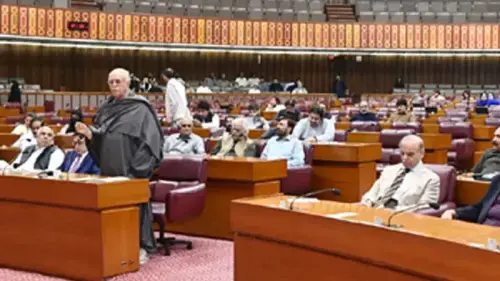
Sensing the disturbance in the country and still far from his objectives, Bhutto sought the extension of the state of emergency and suspension of certain fundamental rights. The joint session of both the houses of parliament was convened in March 1974. The Law Minister Abdul Hafeez Pirzada presented two reasons for continuing the draconian laws — one, India was retaining emergency laws since 1971; and second Pakistan needed it as a source of empowering the government to face the possible fallout of the Middle East war. Members voiced concern against both the laws and complained that the Defence of Pakistan Rules (DPR) were being used against political opponents.
The members’ voice was joined by the people outside the assembly, but to no avail. The newspapers were under heavy system of ‘advice’ by which instructions were issued by the government to follow a certain policy and even then they were threatened by reprisals. The fact is that a number of newspapers saw closure, including 32 Sindhi and some Urdu newspapers, with a single order. Even an Urdu weekly Adakar, a literary magazine Sohni and monthly Sindhi film magazine Filmi Duniya were banned. To calm the criticism from intelligentsia, a powerless commission was formed to look into the matter which proved futile.
Despite the voices raised by the parliamentarians and people’s spokesmen against the extension of the two laws, People’s Party government passed two resolutions extending emergency and suspension of fundamental rights for six months. This proved dangerous for the democracy which was still to take firm root.
shaikhaziz38@gmail.com