0
0

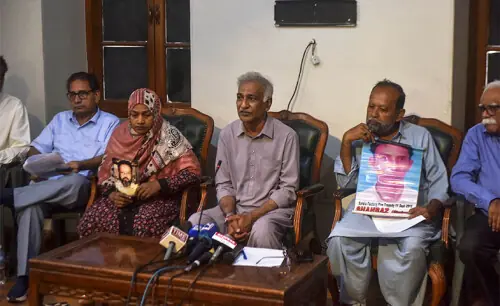
HYDERABAD, Jan 9: The dam-building industry has become a highly lucrative business for builders, investors, politicians and consultants who aggressively lobby for water reservoirs with little if any concern for the ecological degradation the dams wreak on tail-end areas, says Pakistan Fisherfolk Forum chairman Mohammad Ali Shah.
The dam construction had become part of global politics with a strong lobbying group. Only 21 of a total of 292 rivers of the world, including the Indus, reached their tail-ends while the rest had become dead because their flows had been blocked upstream with dams, said Mr Shah.
He was speaking at a national water conference organised by his NGO here on Wednesday. Pakistan People’s Party leader Taj Haider and Sindh Taraqqi-pasand Party chairman Dr Qadir Magsi were also among the speakers.
Mr Shah said that about 50,000 large dams blocked flows of most big river systems around the globe, which was equal to 15 per cent of the world’s annual freshwater run-off.
He said the delta communities had the first right to river water and the government should ensure they were supplied water through the river. Rise in sea level caused by dams might soon engulf entire districts of Thatta and Badin, he warned, adding the dams also changed water temperature which caused destruction of ecology.
He said the blockade of rivers had had serious impact on communities living in tail-end areas and along coasts. “Similarly, when we see Sindh, specially the Indus delta the dam industry is again bent upon destroying lives and livelihoods of hundreds of people living in Thatta and Badin districts,” Mr Shah said.
PPP leader Taj Haider said quoting from A.N.G. Abbasi’s assessment report prepared for the Musharraf government that Bhasha dam was being built despite the fact that there was no more water available in the river systems of the country.
“There is no operational criterion for Chashma-Jehlum Link Canal and Taunsa barrage. There should be consensus on criteria (for operating the controversial canal) to allay fears of small provinces,” he said.
He said that growers had changed priorities for sowing crops and replaced production of grain with cash crops which might cause food insecurity.
Because of that Pakistan had to import food products from other countries, he said.
“We should adopt a multi-dimensional approach to utilise floodwater in an efficient manner,” he said, adding that increasing waterloggedness posed another serious challenge, which had affected 65 per cent of fertile land in Sindh.
STP chairman Dr Qadir Magsi rejected arguments put forward by successive governments for building dams and barrages, which had caused degradation of fertile land, forests and marine life. All Sindhi nationalist parties were on the same page with regard to dams and water share of the province, he said.
Awami Jamhoori Party leader Abrar Qazi, general secretary of Sindh United Party Dr Dodo Maheri, PML-N leader Ayub Shar and representatives of Strengthening Participatory Organisation Mustafa Baloch and others said that before the development of an irrigation system on the Indus, the river water flowed in its entirety through Sindh’s plains down to the Arabian Sea, branching out into 17 channels called creeks and forming the seventh largest delta of the world.
An annual flow of over 180 million acre feet (MAF) carrying a silt load of about 440 million tons passed through Indus into the Arabian Sea, they said.
They declared that water was a fundamental element of life on earth and thus access to water was a basic human right that must be protected for all people in all places.
The conference adopted a declaration, which said strong dam industry, in confluence with local and national governments, had been engaged all around the world to build dams and destroy rivers.
An estimated 40 to 80 million people had been displaced by dams around the world so far and at present perhaps two million people were displaced by large dams every year.
Dam had contributed to depletion of mangrove forests, leaving deltaic region vulnerable to greater damage from floods and cyclones.
Thousands of people living in Indus delta had migrated from the area, said the declaration.
The conference demanded a halt to work on greater Thal canal and compensation for the gross damage so far caused in the Indus delta as a result of water cuts for decades.
It said the UN agencies should take notice of human rights issues emanating from destruction of the Indus delta in order to make the state responsible for conservation of bio-diversity.
Human rights organisations should raise the issue of degradation of Indus delta at various forums and political parties should raise the issue not only on national level but also within an environmental and human rights perspective so as to win support of international stakeholders and UN bodies, it said.