0
0

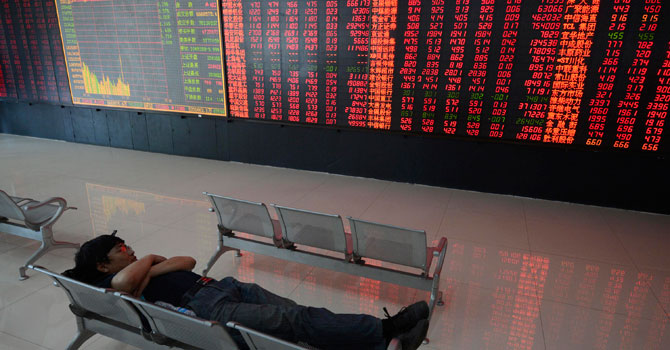
HONG KONG: Asian markets sank Wednesday on growing concerns that Spain could be forced into seeking a bailout while China dashed previous hopes it will introduce fresh stimulus measures to boost its economy.
The euro also set new two-year lows against the dollar as attention turned away from positive news from Greece at the weekend that had provided some lift earlier this week.
Tokyo fell 0.28 per cent, or 23.89 points, to 8,633.19, Seoul was 0.27 per cent, or 5.05 points, lower at 1,844.86 and Sydney shed 0.49 per cent, or 20.2 points, to 4,092.2.
In the afternoon Hong Kong tumbled 1.95 per cent and Shanghai slipped 0.26 per cent.
The losses reversed two days of gains after opinion polls in Greece on Sunday pointed to a victory for the pro-austerity conservatives in June 17 elections, easing concerns the country could end up leaving the euro bloc.
But Madrid's economic woes are now in focus as its borrowing rates approached the 7.0 per cent mark considered unsustainable for governments to service their debts.
Economists fear that if yields stay so high the government will have to seek an international bailout -- following Greece, Ireland and Portugal -- despite assurances from Prime Minister Mariano Rajoy that it would not need to.
Adding to traders' woes was a European Central Bank warning that it would oppose any plan by Spain to tap its lending facilities in order to recapitalise the country's ailing Bankia, which has asked for $24 billion in state aid.
Spain already this month paid $5.6 billion to the lender to take it into government control and the latest plea from its board comes as the nation's own finances are stretched to breaking point.
While officials say they are only considering the ECB as a last resort, the Frankfurt-based bank's governing council is set against it, the Wall Street Journal said.
“There is this ongoing concern about the Spanish banking system and what kind of bailout it could need,” Tim Waterer, senior trader at CMC Markets in Sydney, told Dow Jones Newswires.
Spain's woes weighed on the single currency, which in early trade fell to $1.2458 -- another low not seen since July 2010.
The troubled unit bought $1.2467 and 99.08 yen in Tokyo in the afternoon, down from $1.2503 and 99.39 yen in New York on Tuesday.
The dollar was stable at 79.46 yen, compared with 79.49 yen.
Regional markets, particularly Hong Kong and Shanghai, also slipped after an editorial by China's state run Xinhua news agency saying Beijing would not embark on a stimulus drive like that seen during the 2008 financial crisis.
The news countered a Tuesday report in the state-run Shanghai Securities News that measures would be introduced to jumpstart demand for automobiles, fuelling hopes for similar moves in other sectors.
Traders were unmoved by a Wall Street rally that saw the Dow up 1.01 per cent, the S&P 500 gain 1.11 per cent and the Nasdaq climb 1.18 per cent.
On oil markets New York's main contract, West Texas Intermediate crude for delivery in July was down 42 cents to $90.34 per barrel while Brent North Sea crude for July shed 30 cents to $106.38 in the afternoon.
Gold was at $1,549.56 an ounce at 0600 GMT, compared with $1,573.60 late Tuesday.
In other markets:
-- Taipei fell 1.10 per cent, or 80.49 points, to 7,261.80.
HTC shed 1.85 per cent to Tw$424.0 while TSMC was 0.73 per cent lower at Tw$81.7.
-- Wellington closed flat, edging up 0.09 per cent, or 3.05 points, to 3,481.34.
Fletcher Building rose 0.16 per cent to NZ$6.26, Chorus was up 1.25 per cent at NZ$3.25 and Telecom fell 1.16 per cent to NZ$2.55.