0
0


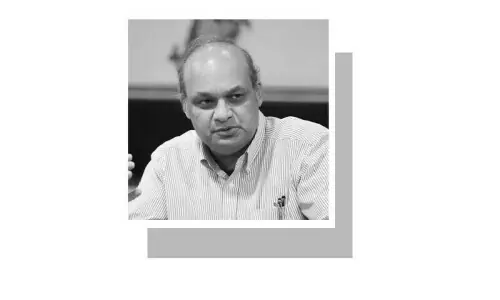
“I like to travel light,” he says as a smile lights up his face. “A change of clothes, these biscuits for eating on the way and some papers,” he shifts the small hand-carry and a shopping bag to make place so that I can sit down next to him.
There is no person I am more delighted to see in the otherwise crowded departure lounge of the domestic airport. Writer and poet Asad Muhammad Khan makes a delightful person to travel with and from the experience of going with him to Islamabad, Lahore and Delhi, I know that his fascinating conversation makes time and distance fly.
Even a small journey becomes a story by itself, so not to worry about delays, inaudible flight announcements, long queues, producing photo IDs and other such things. All these are small details in Asad Bhai’s narrative which we cannot turn away from like the ‘wedding guest’ in Coleridge’s Ancient Mariner.
The passenger next to him gracefully changes his seat seeing my eagerness to continue the ongoing conversation during the flight; Khan settles down and buckles the seat belt while telling me about the possibilities of the story. He has been reading a fairy tale belonging to his granddaughter who studies in class five. “She lets me borrow books from her collection and I was fascinated with this particular tale,” he remarks with a twinkle in his eyes.
“More than 32 different characters in about a 100 pages and she could identify and explain most of them to me. It is amazing how such characters have become accessible for children—Nymphs, centaurs, dwarves and unicorns. I was in my 20s and an avid reader of English literature before I learnt about these creatures which stir the imagination,” he says and the conversation flows on to myths, concept of time, the burraq and the phoenix, old Karachi and then he tells me about an old humorous poet from Bhopal who had taken Quqnus as his takhalus and used to get a stipend from the nawab. This could almost be a story from this chronicler of enigmatic men in difficult, inexplicable situations.
“Main Vindhya chal ki atmaan,” the Bhopal-born Khan shot to fame with his melodious poem which remained his hallmark for many years. He did his matriculation from Bhopal and obtained a diploma from the JJ School of Arts in what was then Bombay. Around the age of 17, he came to Lahore and eventually to Karachi and can now look back at a long, arduous journey. He recalls Karachi University in the scattered buildings of the old city campus and how Professor Maya Jameel had to send somebody downstairs to make the wood-seller stop using the saw as she was beginning her lecture.
This soon changed to the desolate, dusty new campus many miles away from the city. He did his MA previous but could not complete the degree. His elder brother, who was in the army, died suddenly following appendicitis and an emergency surgery. “It was an era of crisis and I had to fend for myself. I had started working in the Karachi Port Trust which I was balancing with my studies. I also started writing for Radio Pakistan,” he fondly recalls that he would get Rs15 for a skit but was encouraged by the writers working there, including Saleem Ahmed and Aziz Hamid Madani.
He became known as lyric poet and later on, several of his songs were great hits. These included Anokha ladla and Diya jalai rakhna hai. “Athar Nafees and Iftikhar Arif persuaded me to write for television,” he says. From songs, he moved on to plays and serials, winning a second round of fame. His TV hits are still remembered fondly by people who don’t know much about his literary work. At the same time, he wrote fiction for the popular press. “I always kept the commercial work away from my literary work and did not let it have an adverse effect. I have stopped this kind of work. My children are settled and I don’t need to take on such tasks,” he can look back with satisfaction.
Khaan-e-Khanaan is how Shamsur Rahman Faruqi addresses him while scores of younger writers affectionately and respectfully address him as Asad Bhai. “I turned towards fiction late in my life,” he picks up the thread of conversation during our return flight. “The first story I wrote was Basuaday ki Mariam. I read it out to Athar Nafees and he started sobbing while I, too, was in tears. Anwar Maqsood heard me read it and had learnt whole paragraphs by heart. After this, I wrote Mai dada. Ahmed Nadeem Qasimi took these stories for his magazine Funoon, and I began writing regularly for it,” he says.
A forceful narrative was combined with vivid experimentation, but many stories stand out due to the beautifully crafted personal anger. A harvest of anger, the name given to a selection of his stories in English translation, seems to be an appropriate description of his mood. This includes the baker’s dozen of stories featuring the Emperor Sher Shah Suri.
“He captivated me when I was young. As a child I recall visiting the Rai Sen fort to which he had laid siege. When I began researching his life for a teleplay, I came across the wonderful book written by Professor Hassan Khan, who was the head of the history department at the Peshawar University. His book contained much original research. I found some details there which I could develop and imagine further,” he explains why he found this period fascinating.
“He ruled for about four-and-a-half-years, but look at what he accomplished. The Grand Trunk Road, which you and I cannot go places without travelling on in this day and age. He introduced improvements in the bureaucracy and a coin which had the kalma on one side and the devangri script on the other. I have used this detail in the story Rupali,” he says, and then adds mischievously, “Do not forget that he was a son of the soil and a Pathan like me!”
From Sher Shah Suri he moves on to himself and tells me that while he used to work till two o’clock at night, he gets tired easily these days but would like to dredge his memory for more stories when the ‘fasten your seat belts’ sign is switched on and we start getting ready for the landing. With Asad Bhai there is always the promise: there will be more stories another day.