0
0

KARACHI, May 19: As the deal between US and Pakistan for the resumption of Nato/Isaf supplies is imminent a large quantity of containers and military hardware including vehicles may soon start moving out of Karachi port and Port Qasim.
Port sources disclosed on Saturday that if Pakistan decided to allow Nato/Isaf supplies to resume and use its Ground Lines of Communication (GLOCs), the Karachi port alone would earn a hefty amount of Rs2 billion on account of different port charges.
Pakistan closed its borders to the shipments after a US air raid in November along the Afghan border left 24 Pakistani soldiers dead. Prior to the closure around 70 per cent of Nato’s supplies in Afghanistan travelled over land from Karachi.
At present 7,834 containers and vehicles have been stranded at Karachi and Bin Qasim ports for the last six months. Out of these, 5,834 containers and vehicles are in Karachi port area and 2000 boxes at Port Qasim.
Official sources said at present 3,851 heavy military vehicles are stranded at the Karachi port for the last six months. However, it is interesting that around 350 Humvee vehicles widely used by US forces in the Afghan war are also detained at the port.
Official sources said 1,112 containers were stacked at East Wharf of the Karachi Port. Besides, 850 boxes are stacked at Karachi International Container Terminal (KICT) and 20 containers at Pakistan International Container Terminal (PICT).
According to estimates made by Karachi port authorities early last month, the bill for port charges with regard to stranded Nato/Isaf cargo have almost reached Rs1.8 billion. However, if it is updated by adding charges of wharfage and demurrage for another month, it would exceed Rs2 billion, sources said.
In reply to a question, a spokesman said after the stipulated “free period”, the port starts imposing different time-based charges. He further said that for a 20 feet container, the port charges Rs1,400 per day and for a 40 feet box Rs2,800 per day.
For vehicles, the port charges are calculated on the basis of space, measured in cubic metres, occupied. On an average, the amount ranges between Rs3000 and 4000 per day per unit.
Port and Shipping sources confirmed that around 2,000 containers were also stacked at the Port Qasim. However, the quantity of oil belonging to Nato/Isaf stored in storage areas of these ports could not be verified.
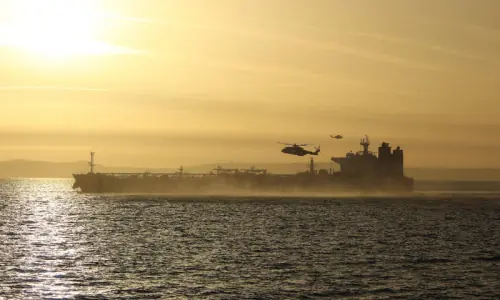
Ever since the ground supply route for coalition forces in Afghanistan was closed, eight vessels loaded with military hardware and vehicles touched the two Pakistani ports. These vessels were President Truman, APL Pearl, Liberty Pride, Freedom, Alliance Beaumont, Maersk Wisconsin, Sealand Michigan, Maersk Kentucky and Maersk Utah.
According to the manifest, these ships carried military hardware such as vehicles, aircraft parts, parachutes, troop clothing and equipment, motors and parts, alcohol (not for human consumption), training material, chemicals and computers.