0
0

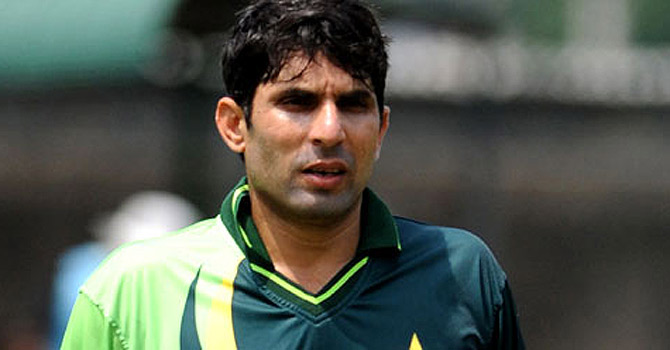
THE announcement of separate Pakistan squads for all three formats at the National Cricket Academy in Lahore on Thursday was preceded by a significant development when Mohammad Hafeez was officially unveiled to the media by the Pakistan Cricket Board (PCB) Chairman Zaka Ashraf for the Twenty20 leg of the upcoming Sri Lanka tour.
The decision to relieve Misbah-ul-Haq had already been taken by the PCB top hierarchy the night before, following his own modest performance in recent games that Pakistan have played in the shortest format. But the PCB, in a shrewd move, have opted against making a clean break as far as giving Hafeez a longer reign as the national Twenty20 skipper is concerned. The PCB chief, in his media conference, made a clear statement that Hafeez’s promotion was just for the two fixtures in Hambantota while leaving options wide open for the ICC World Twenty20 which Sri Lanka would host in late September.
Obviously, this key factor has dissuaded Misbah from making any announcement on his international future as a Twenty20 player despite not being picked for the Sri Lanka matches. During the official media briefing Misbah extended ‘full’ support to Hafeez, who also happens to be his close friend. However, later on he reportedly expressed ‘disappointment’ at losing the T20 captaincy after eight months in the job and declared that he was still available for future selection even though he is already well past sell-by date as a cricketer since he turns 38 on May 28.
Of course, there are no two views about Misbah’s qualities as Test captain. He was asked to take over the reins at a critical juncture, barely a couple of months after the spot-fixing saga that rocked Pakistan cricket in August 2010, and how well he responded to the challenge is now history. In his quiet way, Misbah has also commanded utmost respect of not just his team-mates but also the majority of those who matter a great deal in our cricket. But with the passage of time, his employers at the PCB must keep on reminding Misbah that his days as an international cricketer are certainly numbered, and that he should himself pick the moment when and where to hang up his boots.
Historically, the last days of a Pakistan cricketer usually end in humiliation. Clear examples of this are Hanif Mohammad, Zaheer Abbas, Majid Khan, Asif Iqbal, Javed Miandad, Wasim Akram, Waqar Younis and Inzamam-ul-Haq, and one can safely assume that Mohammad Yousuf also now falls into this category.
Coming to the selection of the three squads, the national selection committee headed by Iqbal Qasim has done a reasonable job in most of the cases. As the usual norm in any sport, there are some selections which a few, if not many, have the right to question. One glaring example is the Twenty20 squad which definitely has two players too many and too few specialists in the batting department, while there are far more spinners and bits-and-pieces individuals for a two-match series. The balance is somehow not right as far as the composition of the 16-man party is concerned.
Iqbal, to his great credit, calmly handled the barrage of questions fired at him during the media briefing. However, the first impression one gathered while watching the live telecast of Thursday’s proceedings was that some of the queries were either irrelevant or seemed planted.
The affable chairman of selectors defended the inclusions of the already tested pair of Mohammad Sami (one of only four names to figure in all three squads) and Faisal Iqbal and those of the uncapped paceman Rahat Ali and the enigmatic Imran Farhat.
On the other hand, the selectors should be applauded for recognising the run-making consistency of Mohammad Ayub Dogar and Afaq Raheem by naming them in the Test squad.
Ayub, the 32-year-old right-handed batsman from Sialkot, has not failed to cross the 1,000 mark in the last three first-class seasons after accumulating 909 runs in the previous one. Afaq, the Mirpur-born opening batsman who plays for Islamabad, also has been deservingly rewarded for being domestic season’s highest run-getter (1,420) in all first-class matches.
Sami – the pivotal force behind Port Qasim Authority earning first-class status recently – has been fully compensated for an outstanding season in which he claimed more than 100 wickets in all forms, including a career-best tally of 56 first-class victims. He was also at his best in the inaugural Bangladesh Premier League. Arguably one of the fittest cricketers around, Sami’s inclusion adds loads of experience to the bowling attack spearheaded by fellow fast bowler Umar Gul and the wily off-spinning genius Saeed Ajmal.
Faisal, like Sami, has earned his laurels on the basis of his recent first-class form of scoring more than 1000 runs. He would be also under pressure to perform if gets the chance in the Test series.
Farhat is extremely fortunate to retain his spot as a borderline selection as the third opener in the ODI squad. His patchy track record, to be honest, doesn’t make him a deserving candidate in presence of others who are languishing on the sidelines. Whatever plea the selectors take, it won’t be a surprise if outside interference played an influential role here.
In the days to come, there will be criticism from different quarters over the selections, something not strange in this region. Selecting teams is no mean achievement since it is humanly impossible to attenuate everyone at the end of it all.