13
13

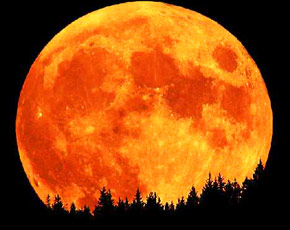 From werewolves to induced lunacy to epileptic seizures, a full moon can cause any of these. “Are you ready for tonight’s supermoon? Ready to throw caution to the wind and be a lunatic for a night?” a friend asked.
We were walking along the Potomac, outside Washington. The river was restless. It was dark and scary. The sky was cloudy, so the moon did not illuminate the forest as predicted.
The evening burned out quietly on the horizon. Like the river, we were restless too but we did not know why. Was it the moon or our hidden lunacy? Something was hurting us but we did not know what.
The half-lit forest did not help us overcome our fears. We heard a howl? Saw a werewolf?
Dreams and nightmares. Pains and tortures. Fears. We needed to overcome all. But were reluctant to do so. The night too was reluctant. So was the moon. What offerings did we have for love’s altar? For the god of fear? For the night goddess? What could we offer? We who get drunk on borrowed wine!
Desires, we have plenty. Means to fulfill them, we have few. We are not among those who burn with passion. We are not among those who go to the gallows, their heads held high.
We have no friend, no enemy. No hand is holding a dagger pointed at our hearts. No hand is stretched up to pray for us. No friendly embrace. No ambush.
What we saw hanging on the horizon was a begging bowl. We are not blind. But we keep our eyes closed. Eyes are treacherous.
They betray. They can’t lie. You can see all our fears, all our sufferings in our eyes. You can see how weak we are. That’s why we keep them closed. We have already seen so much. We don’t want to see anymore.
It is not easy to live with your past. But it is also not possible to live without a past. We have a past but we do not want to talk about it. We do not want to listen. We do not want to see.
Most of us would prefer to live a normal life, but how? There are few among us who have not witnessed violence. If not in real life, on television screens.
We are insane because we have seen people being killed for no reason. We have seen people being beaten with batons and flogged in public. There are prisons where hanging is a monthly ritual.
This violence, both individuals and collective, has been going on for years. Many among us can’t recall any other experience more vividly than wars, suicide-bombings, hangings, floggings, and the killings that we are forced to witness. Although most of us are silent spectators, we are deeply affected by what we see. It stays with us and haunts us for the rest of our lives.
There are some who grew up in better days and when they have time, they talk about love, trust and romance. But such tales are so few that they do not have much of an impact on us.
Our generation also had its moments of glory. We shared jokes and talked about sporting events. But all such experiences were overshadowed by the collective violence that happened around us.
Even now when we speak of a personal event, we relate it to an act of collective violence. “Ali met his future wife a few days after the big hanging,” one says; or another, “Hassan went abroad for studies days after the public flogging.”
At colleges, we spent more time watching protests and rallies than studying. Although the majority did not participate, it was affected nonetheless. Rallies often led to clashes with police. Such clashes then led to the closure of the college, sometimes for months.
Because of these disturbances, some of us did our two-year courses in four years. This made a large number of people over-aged for good jobs or for admissions to professional colleges. Since most of us were not from rich families, such delays in jobs and admissions meant additional problems for all.
In our society, important family events are often linked to the employment of the eldest son or daughter. So, for us, not getting a job on time meant delaying a sister’s wedding or postponing another son or daughter’s education. It forces parents to work after their retirement as well. We all had to face such problems because of the collective violence our cities always seem to be suffering from.
But even worse is the impact this violence has had on our personalities. I am not an expert and I have done no case studies, so I don’t know how much this violence is responsible for shaping the society in which we live today. But I feel that if today we live in violent societies, where there is very little individual or collective tolerance, it is because of what we went through in the past. In a way we suffered twice. First when we witnessed all these hangings, floggings and killings, and later when we had to face their consequences.
We have governments. But instead of helping us lessen our burden, the governments add to our problems. Police head the list of the troublemakers. Our rulers — both despotic and elected — use the police to perpetuate their rule and eliminate their critics. They encourage police to arrest, beat, kidnap and even kill their rivals.
This has made the police so powerful that now they know no limits. In many places, dozens of people are killed every year in extra-judicial murders by the police. But these murders have little impact on the rulers. They are happy as long as it is their opponent who is killed.
There are few among us who will go to police for protection. In fact, most people feel unprotected when police are around. This has encouraged vigilantism.
Most political, ethnic and religious groups have formed their own vigilante gangs to fight both police and rival gangs. Like everybody else in this business, they also believe that offense is the best defense. So they often attack their rival groups to remove real or perceived threats to their interests. This means that the gang fights never abate. Often innocent people are killed in these clashes.
In recent years, violence against women and religious minorities has also increased. Women are the most vulnerable. They are beaten up at home. They face sexual harassment when they go out, and are often victimised because they are unable to defend themselves. The society projects them as weak and vulnerable. Women are encouraged to stay at home. Those who venture out are seen as asking for trouble.
All this violence made us unstable and insecure. We often over-react, get irritated and tense. We worry more than we should. Even when we are enjoying a situation, we worry that it would soon end, and it makes us uneasy.
Sometimes we try to imagine how our personalities would have developed had we grown up in a less violent environment. We wonder how it would feel to live in a place that does not need vigilante gangs for protection, where borders are peaceful, and where political parties do not engage in gun battles for power.
 The author is a correspondent for Dawn, based in Washington, DC.