ISLAMABAD, April 30: Zakir Majid Baloch was picked up from Mastung three years ago. He was on his way to a university where he was enrolled as an MA English student. Zakir had always wanted to go to Balochistan University in Quetta but it was impossible for him to get admission there. According to his sister Farzana Majid, his political activities in the Baloch Student Organization-Azad made him an unpopular pick for most academic institutions. It was most likely also the reason for his kidnapping: Farzana believes that the security agencies picked him up on June 8, 2009, to punish him for his activities.
“I just want my brother to come home. His political activities might be the reason that he was picked up but it is certainly not a legitimate one,” she explains.
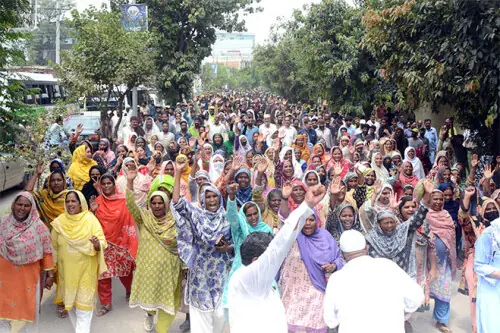
Farzana is part of a delegation of family members that arrived in Islamabad on Sunday to set up a camp in front of the National Press Club. The families are organised under the Baloch Voice for Missing Persons (BVMP), a self-proclaimed apolitical lobby group with one sole purpose: to recover their loved ones.
According to the BVMP, 14,400 individuals have gone missing, and an additional 400 tortured, bullet-ridden bodies - sometimes charred beyond recognition - have showed up close to the homes of family members. A Human Rights Watch report from July 2011 presents a lower estimate of “several hundreds” missing since 2005, while a June 2011 report from the Human Rights Commission of Pakistan (HRCP) has documented 140 individuals as missing.
“Naturally, we take the BVMP estimates into consideration. And there is no doubt that many more have gone missing than those on our list, or on the list that has been submitted to the Supreme Court and the High Court in Balochistan,” says the HRCP Secretary General, I.A. Rehman.
“There is no doubt that atrocities are being committed in Balochistan, and that the security agencies are behind them,” says Abdul Qadeer.
Disillusioned
Abdul Qadeer Rekhi Baloch still remembers the day that the big men came and threatened to kill his son. “Samad Badini, the grandson of Senator Waleem Mohammad, asked me to close the camp. He said he was delivering a message from the Inter Services Intelligence (ISI) and Military Intelligence (MI). When I refused, he said these exact words: It will not be good for you, if you don’t,” Abdul Qadeer explained.
According to Qadeer, Badini returned the next day with a “non-local”, and offered to return Qadeer’s son, Jalil Rekhi, for 20 lakh (2 million) rupees.
“I told them that all missing persons are Jalil Rekhi’s in my eyes. If you can offer to release all of those who have gone missing, we can talk,” Qadeer continued.
“I was told that I can wait for my son’s dead body,” Qadeer finished. His son’s body was dumped in November of last year. Jalil Rekhi was the Information Secretary for the Baloch Republican Party (BRP), one of the separatist political forces currently active in Balochistan.
“We are disillusioned by the Pakistani government. What do you expect? We have been asking the state to return our sons for years, and this is what we get in return?” Qadeer concluded.
‘A history of betrayal’
“This is not the first time that the Pakistani state has attacked the Baloch. There is a tendency to see this issue in a vacuum, as if it is happening without any historical precedence.
Everyone seems to have forgotten the way many of us were forced to be a part of Pakistan originally, the military operations carried out against our people with the help of Iran from 1973 onwards, and the ongoing violence for the last 5-6 years,” Farzana explained.
“How does this country expect us to remain wedded to the idea of Pakistan, when it continuously attacks us?” Farzana concluded.
When asked why the BVMP continues to set up camp in front of the press clubs in Islamabad, Karachi and Quetta, Farzana explained the organisation’s reasons.
“We do not want to be accused of avoiding Pakistan, of not attempting to inform or approach the government. But my brother has been missing for three years, and the government has done nothing.”
Farzana was disappointed when the provincial government and the security agencies failed to produce her brother in mid-April.
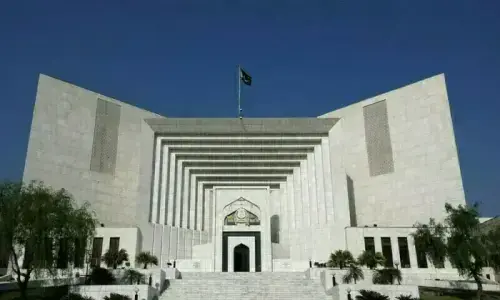
A three-judge bench in the Supreme Court (SC) headed by Chief Justice Iftikhar Mohammad Chaudhry had ordered the government to produce her brother along with Dr Deen Mohammad and Hafiz Syedur Rehman.
“The chief justice is back in Balochistan, but it is unclear whether we will see any results from this process. Our past experience indicates that we will be kept waiting,” Abdul Qadeer said.
“There are all sorts of accusations levelled against these people. But the bottom line is that they have been waiting for justice for such a long time,” said I.A. Rehman.