0
0

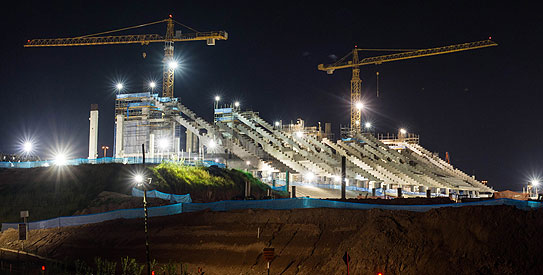
The good news is that despite late starts and strikes, work on the 12 stadiums being built or renovated for the 2014 World Cup is largely on schedule.
The bad news is that they are already three times over budget and are being built with taxpayers' money despite initial promises that private enterprise would foot the bill.
Although all the stadiums should be ready for the kick-off in 26 months' time, with sports minister Aldo Rebelo saying that some will be ready by the end of this year, there will be a heavy price for Brazil's beleaguered taxpayers to pay.
The stadiums are much more expensive than similar arenas built elsewhere and at least four of them, and perhaps as many as eight, will be white elephants, unlikely ever to turn a profit.
"I don't understand why a stadium in Brazil needs to cost 500 million reais ($275 million) when there are examples of stadiums built elsewhere in the world with 40,000 or 50,000 seats that cost less than half that," said Amir Somoggi, Sports Management Consulting Director at BDO Brazil, an auditing firm.
The ballooning price tag of the World Cup preparations is yet another example of the "Brazil cost", an exasperating mix of high taxes, stifling bureaucracy and crumbling infrastructure that make Brazil a notoriously expensive and difficult place to do business.
Those elements are perhaps most evident at Itaquera in Sao Paulo, where Brazilian construction giant Odebrecht is building a brand new arena to host the prestigious opening match.
The stadium, which will belong to Sao Paulo's biggest club Corinthians once the tournament is over, will seat 48,000 fans and cost at least 820 million reais ($450.5 million).
But that doesn't include the construction and removal of the 20,000 additional seats that FIFA, requires for the opening game.
Odebrecht and Corinthians officials still do not know how much the temporary seating will cost.
"Our contract is to build a 48,000-seat stadium and prepare the ground for the additional seating," said Frederico Barbosa, the engineer in charge of the project.
"The cost of that is still being discussed."
There are other issues surrounding Itaquera, as with most World Cup grounds. It is far from the city centre and the road links and surrounding infrastructure are poor.
The design also has its detractors. Although it is one of the most expensive of the 12 venues, areas behind the goals are uncovered, a problem in a country with torrential rains and blistering heat.
And it is one of only two not to seek certification by the Green Building Council, according to GBC officials in Brazil.
But it does have nearby rail and metro links, unlike many of the other stadiums for the Cup, and construction is on time.
"We've been surprised how well things have gone, to get this far after just nine months is great," said Barbosa.
CORINTHIANS VS SAO PAULO
The opening match was supposed to take place at Morumbi, the 73,000-seat stadium owned by Sao Paulo FC, arch-rivals of Corinthians.
Sao Paulo drew up plans to modernize the ground but FIFA and local organizers rejected them. Instead, FIFA and the Brazilian Football Confederation urged Corinthians to build a brand new facility.
Corinthians, however, said it did not need 65,000 seats. After much discussion, the club agreed to build a 48,000-seat arena and add temporary seating for the opening match.
The cost was set at 350 million reais ($192 million) but could reach three times that once the temporary grandstands are factored in.
Half the money will come in from the BNDES, Brazil's state development bank, at subsidized interest rates. The rest will come from private investors who are allowed to write off the cost in tax breaks. That financing model is common to the nine grounds that are publicly owned.
"I can't believe that the Corinthians stadium will be more modern or more efficient than the Allianz Arena, a ground that was the most expensive in the Germany World Cup and an obra prima in sports architecture," said Somoggi, referring to the Munich stadium.
SOARING COSTS
Overall, the estimated cost of stadiums has more than tripled since Brazil were awarded the tournament in 2007.
The current official estimate of 6.7 billion reais ($3.68 billion) is well above the 1.4 billion euros ($1.87 billion) Germany spent on its 12 stadiums for the 2006 World Cup and more than twice the $1.48 billion South Africa spent on 10 arenas just two years ago.
The modernisation of the legendary Maracanã stadium in Rio de Janeiro, where the World Cup Final will be held, will exceed 1 billion reais ($550 million) when added to other reforms carried out over the last few years.
This overhaul is the third in just over a decade and costs soared after engineers mistakenly decided the stadium would not need a new roof.
In Cuiaba, a city with little footballing tradition, authorities are spending 520 million reais ($285.7 million) on a stadium for just four group games.
The Amazonian city of Manaus is shelling out more than 533 million reais ($293 million) on a new arena even though its best club is in the fourth division of the Brazilian championship.
"If it was just based on football criteria then the games wouldn't even be on TV here as our standards of professional football leave a lot to be desired," said Carlos Cavalcanti, the organizer of a state football tournament in Manaus.
"The fact that people want to visit Amazonia is the main factor."
Critics say the government, under pressure to accelerate public works project for the Cup, is inadvertently catering to big business at the expense of the Brazilian taxpayer.
Authorities are already handing out contracts without putting them out to tender because time is tight.
"This is all just a chance for the big construction firms to get their hands in the till," said Christopher Gaffney, a visiting professor at the graduate school of architecture and urban planning at Fluminense Federal University in Rio.
"Society is not going to benefit in any way."
Organizers dismiss those concerns, Rebelo saying that a report by a government agency declaring that four of the 12 stadiums are likely to be white elephants "wasn't worth commenting on".
The delays mean the stadiums will not all be ready for the Confederations Cup, the tournament held as a curtain raiser in 2013.
But they should be ready for the main event a year later, even if it means going well over budget.