0
0

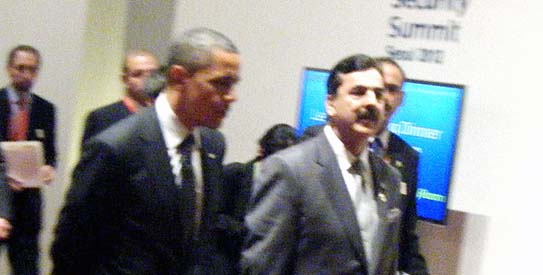
SEOUL: Prime Minister Yousuf Raza Gilani on Monday emphasised ‘national responsibility’ for strengthening nuclear security as he renewed demand for access to civilian nuclear energy and made a strong pitch for Pakistan’s membership of atomic cartels, in particular the Nuclear Suppliers Group.
“National measures are the most important part of our efforts to enhance nuclear security. If nations do not move, nothing would move. If nations move feebly, nuclear risks increase many times,” Mr Gilani said at a dinner attended by world leaders participating in the Nuclear Security Summit. The two-day summit will chalk out plans for reducing the threat of nuclear terrorism by curbing illicit trafficking and improving the security of nuclear installations.
A communiqué will be issued at the end of the summit on Tuesday. The communiqué is expected to lay down principles on nuclear security and to propose measures for achieving goals.
Mr Gilani further underlined the significance of cooperation between states for improving security, saying “nations need to move together and learn from each other”.
Analysts saw in his focus on ‘national responsibility’ a clear message for outsiders to refrain from worrying about the security of other countries’ facilities and instead trust their efforts for keeping them safe and secure.
Pakistan’s own nuclear programme has been under continuous criticism, with various quarters regularly pointing out what they see as vulnerabilities of its facilities and material.
However, the prime minister brushed aside the concerns and reiterated his government’s commitment to maintaining nuclear security standards.
Mr Gilani listed a host of measures his government had taken to improve the security regime of its nuclear facilities, including capacity building of personnel, international cooperation, deployment of special nuclear material portals, conducting of stress tests of nuclear power plants, implementation of a “nuclear security action plan” and commissioning of an emergency response mechanism.
Compliance with UNSC Resolution 1540, support for the work of Global Initiative to Combat Nuclear Terrorism and IAEA approval of safeguards for two Pakistani nuclear power plants, he noted, reinforced Islamabad’s credentials as a responsible nuclear state.
The prime minister referred to the revived peace dialogue with India in the context of bringing security and stability to the region.
“In South Asia, Pakistan is pursuing strategic restraint and confidence building through dialogue. This process, over time, should guarantee security and stability in the region.”
Mr Gilani offered to train nuclear experts from other countries at Pakistan’s Centre of Excellence set up by the Strategic Plans Division (SPD).
The offer for using the institute as a “regional andinternational training hub” was to signal the level of expertise achieved by the country in training security personnel. The institute offers courses in nuclear security, physical protection and personnel reliability.
ENERGY CRUNCH: Mr Gilani also sought access to civilian nuclear energy in order to tide over the energy crunch back home. “To meet our growing energy needs, the National Command Authority has approved a plan, Nuclear Power Programme 2050. We urge the international community to give Pakistan access to nuclear technology for peaceful uses on a non-discriminatory basis.”
Pakistan has so far been denied nuclear energy technology on the pretext of its perceived poor track record on nuclear non-proliferation.
The prime minister, summing up the review of the country’s progress towards enhanced nuclear security, pointed out that Islamabad had fulfilled the criteria for membership in the Nuclear Suppliers Group and other export control regimes.
Although Pakistan has not formally asked for membership of NSG and other similar groups, the move to highlight its qualifications for joining these international arrangements coincided with India stepping up its campaign for admission to these multilateral regimes.
Indian Prime Minister Manmohan Singh on Monday sought South Korea’s support for his country’s membership in NSG, the Missile Technology Control Regime, the Australia Group and the Wassenaar Arrangement.
The US, France and Russia have already indicated that they would support India’s bid for membership of these groupings.
According to observers, after Pakistan’s plea for membership of export control regimes, the Indian bid, already facing resistance from within NSG for being a non-NPT country, could get further complicated.