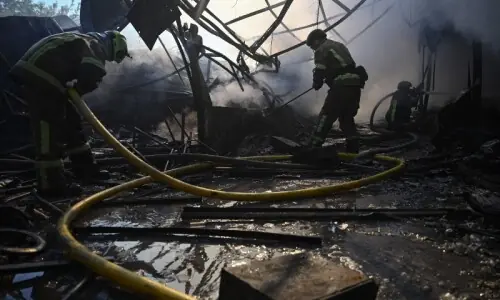
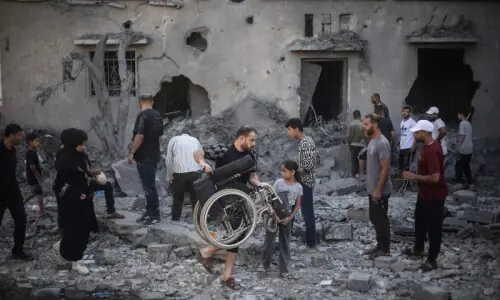
LONDON: There is no limit, it seems, to the blood price Arabs have to pay for their “spring”. After the carnage in Egypt, Yemen, Bahrain and Libya, Syria’s 11-month-old uprising grows ever more gruesome. Four days of bombardment of rebel-controlled districts in the Syrian city of Homs have yielded horrific images and reports from the embattled Bab al-Amr opposition stronghold: of mosques full of corpses, streets strewn with body parts, residential areas reduced to rubble.
Television footage broadcast in the Arab world is still more graphic, and the impact convulsive. Whatever the arguments about the number of dead on either side, the scale of human suffering is unmistakable — and comes after almost a year of continuous bloodletting, torture and sectarian revenge attacks.
So when Russia and China vetoed Saturday’s western-sponsored UN resolution condemning Bashar al-Assad’s regime, requiring his troops to return to barracks and backing an Arab League plan for him to be replaced, US and British leaders and their allies, echoed by the western media, felt able to denounce it as a “disgusting” and “shameful” act of betrayal of Syrians.
But that assumes externally imposed regime change, which is what the resolution entailed, would either work, have legitimacy or actually stop the killing. By decreeing a “political process” with a predetermined outcome, the withdrawal of the Syrian army from the streets with no parallel demand on armed rebel groups, and full implementation within 21 days — with a provision for “further measures” in the event of “non-compliance” — it also paved the way for foreign military intervention.
It’s been widely claimed that the double veto has given Assad the green light to intensify repression and made full-scale civil war more likely. But by ruling out UN-backed intervention, it could just as well be argued that it puts pressure on the main opposition group, the western-backed Syrian National Council, to negotiate — given that its whole strategy has been based on creating the conditions for a Libyan-style no-fly zone.
Russia and China have used Syria to challenge the west’s attempt to corral the Arab uprisings for its own interests. The veto has strengthened Russia’s hand with the Assad regime, while Russian officials have privately assured opposition leaders that the quarrel is with the US, not them. And Barack Obama has now pledged to “try to resolve this without recourse to outside military intervention”.
But that’s a long way from ruling it out. Already US, British and French leaders are busy setting up a new coalition of the willing with their autocratic Saudi and Gulf allies, satirically named “friends of democratic Syria”, to build up the opposition and drive Assad from power.
Intervention is in fact already taking place. The Saudis and Qataris are reported to be funding and arming the opposition. The Free Syrian Army has a safe haven in Turkey. Western special forces are said to be giving military support on the ground. And if that fails, the UN can be bypassed by invoking the “responsibility to protect” civilians, along Libyan lines.
But none of that will stop the killing. It will escalate it. That is the clear lesson of last year’s Nato intervention in Libya. When it began, the death toll was 1,000 to 2,000. By the time Muammar Gaddafi was captured and lynched seven months later, it was estimated at more than 10 times that figure. The legacy of foreign intervention in Libya has also been mass ethnic cleansing, torture and detention without trial, continuing armed conflict, and a western-orchestrated administration so unaccountable it resisted revealing its members’ names.
Russia and China have now signalled there will be no more UN-sanctioned Libyas. But for the US, Britain and their allies to indulge in moral posturing over Syria or pose as friends of its people is preposterous. It’s not just their responsibility for hundreds of thousands of deaths in Iraq and Afghanistan or, say, their support for the Bahrain dictatorship — even as it violently suppresses its own uprising while sponsoring the UN resolution for democratic transition in Syria. For 45 years, they have underwritten Israel’s occupation of the Syrian Golan Heights, yet now promise to guarantee Syria’s “territorial integrity”.
By arrangement with the Guardian