0
0

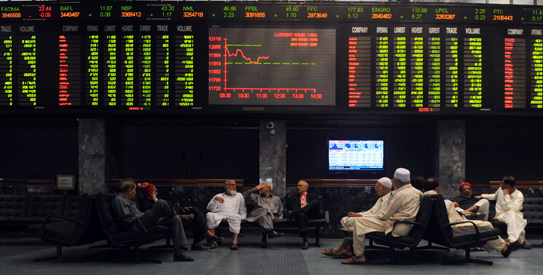
KARACHI: Pakistani stocks ended lower on Wednesday as investors chose to cash in after the market rallied to a more than six-month high for two consecutive days, dealers said.
The Karachi Stock Exchange (KSE) benchmark 100-share index fell 0.17 per cent or 21.37 points, at 12,263.25 points.
The KSE-index closed at 12,284.62 points on Tuesday, its highest close since July 26, 2011.
Volume rose to 243.29 million shares, compared with 162.11 million traded on Tuesday.
“After gaining (a total) of around 3 per cent in the last two trading sessions, investors opted to book profits, especially in oil and banking stocks,” said Samar Iqbal, a dealer at Topline Securities Ltd.
Bank Alfalah closed 1.64 per cent lower at 12.60 rupees, National Bank of Pakistan shed 0.86 per cent to end at 46.19 rupees and Oil and Gas Development Co Ltd fell 1.34 per cent to 156.50 rupees.
In the currency market, the rupee ended flat at 90.62/67 to the dollar, unchanged from Tuesday’s close, although dealers expect pressure to continue on the local unit due to increased import payments.
Dealers said they were also cautious after the International Monetary Fund advised Pakistan to take immediate steps to tackle growing budget pressures and raise interest rates to contain inflation.
The IMF on Monday projected a widening of Pakistan’s fiscal deficit in the 2011/12 fiscal year to 7 per cent of gross domestic product, compared with the government’s revised budget target of 4.7 per cent.
The rupee touched a record low of 91.28 to the dollar on Jan 9, pressured by worries about higher payments for oil imports and the country’s overall economic health, especially a weakening current account.
The current account recorded a provisional deficit of $2.154 billion in the first six months of the 2011/12 fiscal year, compared with a surplus of $8 million in the same period last year, according to data from the State Bank of Pakistan.
The deficit is likely to widen further in coming months because of debt repayments and a lack of external aid.
In the money market, overnight rates ended at their top level of 11.90 per cent, compared with the previous day’s close of between 11.25 per cent and 11.75 per cent, because of a lack of liquidity in the interbank market.