0
0

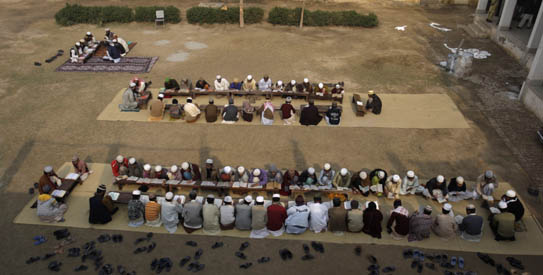
OKARA: Sultan Mehmood Gujar was a solid supporter of militants and even donated money to them, until he attended an innovative 40-day lecture series by a moderate cleric aimed at countering violent extremism.
The course, given to the public at an Islamic school in a hotbed of militancy in Pakistan, had a profound effect on the 46-year-old property dealer, convincing him the militants were wrong to claim they were waging holy war, or jihad, justified by the Quran, the religion's holy book.
''I was shocked to discover that what the militants were doing was against Islam,'' said Gujar, sitting on the floor at the madrasa in Okara city where the lectures were delivered. ''Now I call them terrorists, not jihadis.''
Fazal ur Rehman, the cleric who runs the 400-student madrasa, recorded each of the two hour lectures he and others gave this past summer and would like to distribute the DVDs to reach a wider audience. But he lacks the money.
The US has created a new unit in Pakistan that aims to leverage such grassroots efforts by working with local moderates to counter violent extremism —the first of its kind set up by an American embassy anywhere in the world, according to US officials here. The existence of the unit has never before been reported.
Rehman and other clerics attempting to challenge extremism in Pakistan recently met with US Ambassador Cameron Munter in Islamabad, though the 50-year-old Rehman says he has not yet received support from the Americans.
Okara has special significance because it is near the village of Ajmal Kasab, home of the only surviving gunman from the 2008 attacks in the Indian city of Mumbai that killed over 160 people.
The US chose Pakistan as the site for its new venture because it is home to a vast network of militants who have been fighting US-led troops in neighbouring Afghanistan for over a decade and have even organised attacks on American soil.
The three-person unit in the US Embassy public affairs section was established in July.
It plans to work with local partners, including moderate religious leaders, to project their counter-extremist messages and push back against the militants' extensive propaganda machine, said US officials.
It will use TV shows, documentaries, radio programs and posters. It also intends to ramp up exchange programs for religious leaders and public outreach to conservative Muslims who previously had little contact with American officials.
''There are a lot of courageous voices speaking out against extremism here in Pakistan,'' said Tom Miller, head of public affairs at the US Embassy. ''Our job is to find out how we can amplify those narratives.''
The unit is just now ramping up operations, said officials. It was funded with an initial budget of $5 million that officials hope will grow.
Officials declined to provide details on specific programs they are funding or plan to fund, for fear that publicly acknowledging US involvement would discredit their partners.
That's a major worry in this country where anti-American sentiment is rampant. Any cleric known to be taking US help is likely to be shunned by many.
There are other challenges as well. Many among clerics and the public who are considered moderates have mixed views —they often oppose the killing of innocent civilians in Pakistan, but support jihad.
Further complicating the situation is alleged Pakistani government support for some militant groups.
Also, the militants are likely to strike back, as indicated by a recent trip the US ambassador made to a madrasa in Faisalabad city to attend a meeting of moderate religious leaders who denounced suicide bombings and other forms of violence.
Militants responded the next day by calling the Muslim cleric who hosted the event, Yasin Zafar, and warning he could be killed.
The call was from a member of Jamaat-ud-Dawa, widely believed to be a front group for Lashkar-e-Taiba, an anti-India militant organization, said Zafar.
''I was taunted for becoming a US supporter,'' said Zafar. ''I was told that I should be cautious because I may have provoked the Taliban.''
The ambassador's visit to the 900-student Jaamia Salafia was unusual because the madrasa teaches a puritanical strain of Islam followed by some Pakistani militant organizations, including Lashkar-e-Taiba, although Zafar said he does not support the group.
The meeting's participants railed against American drone strikes, which are very unpopular in Pakistan, said Zafar.
The anger illustrated one of the difficulties for the US in working with Muslim leaders who have the local networks to counter extremists.