0
0

For Syed Bagh Ali Shah, a late October day from 2007, remains the most memorable moment of his life.
“It will stay with me forever, when mohtarma Benazir Bhutto came to my house to check on my health despite strict security warnings.”
A disgruntled worker of Pakistan Peoples Party (PPP), Shah received serious injuries in the Karsaz blast of October 18, 2007, when Benazir Bhutto’s convoy was struck by twin attacks in Karachi.
Despite having served as the party’s president of Daur taluka (suburb) in Nawabshah until 2008, Shah says he was pushed away from party activities after he voiced criticism over the ‘wrong’ policies of the government.
“Mohtarma was like our mother,” says Shah.
“She always met with and listened to party workers and solved our problems but no one is ready to listen to us after her death.”
Orphans of Benazirabad The die-hard workers of the party, better known as jiyalas, are living a miserable life in this district, which has now been renamed after the former prime minister to Shaheed Benazirabad.
“Influential landlords are reaping benefits (of our hard work) and no one is ready to pay attention to our grievances,” he adds.
The workers, who are being ignored and ‘disgraced,’ are so upset that they are ready to leave the party.
“The leadership should respect party workers and work towards solving their problems; otherwise the party will lose its die-hard workers.”
In another part of Shaheed Benazirabad, Mohammed Ali Arain, an office bearer of union council number 3, is selling corncobs on a pushcart. Although he is not literate enough to get a good job, he belongs to a large family with three graduate brothers and four sisters.
“I have been part of this party (PPP) for the last 17 years,” he says.
Arain has been working as a record-and-event secretary since 2005.
“Party workers were everything for mohtarma, she recognised them by name,” he said.
“She looked after the workers like her children because she knew that workers were the strength of the party.
“We (workers) are orphans now.”
Arain was among those who worked for the party while the leaders were in exile.
“It wasn’t easy but I never stepped back and involved myself in every activity from installing flags to working during the local body elections.”
Earlier, workers would meet with the president’s sister (Faryal Talpur) at Zardari House but for the last two years, they are not allowed in.
“Whatever happens, whether I get a job or not and even if they keep on ignoring me, I will be a part of PPP until my death. I am a jiyala (die-hard worker).” Trouble in Dera Ghazi Khan In the four years since Benazir’s assassination, the party’s growth in Punjab has stalled, according to former district president of the PPP in Dera Ghazi Khan Manzoor Khan Lound.
The PPP veteran blames the ‘politics of reconciliation’ for the lack of popularity of the ruling party, which he says is being run by opportunists and not loyal members, who were symbols of struggle for the jiyalas.
“Ours has been a deep-rooted party in the Dera Ghazi Khan and Rajan Pur districts,” says Saeed Ahmad, a seasoned political worker of PPP, who has also been a political prisoner.
Tribal mess Ahmad believes that the PPP resisted the feudal system but its “roots could not get enough food for nourishment and growth” in the tribal setup of the area.
Tribal chiefs of the district have traditionally been persistent representatives in the parliament, irrespective to their political affiliation, locals complain. According to the PPP workers of the area, former tribal chief Farooq Ahmed Khan Leghari “used the PPP to step into the power echelons (as president) and then deposed his party’s government.”
In these traditionally strong PPP areas, the party risks losing its vote bank.
“If the leadership continues to ignore its voters, they could boycott the next general elections, which also happened in 1996,” Ahmad told Dawn.com.
Some, like Lound, even go on to criticise PPP’s founder Zulfikar Ali Bhutto and his daughter. “They refused to pay attention to organisational shortcomings, which led to their forcible removal from government and then life.”
Zardari at the helm Benazir’s death in 2007, which shook the entire party, also meant that her co-chairman husband took control of PPP. Zardari’s sister, Faryal Talpur was handed over the reign of Nawabshah.
“Faryal bibi had no experience to steer manage the largest political party of the country,” complains Lound.
Regular party elections, he says, can ensure accountability and stop opportunists from ‘hijacking’ the party.
Jiyalas, who have forever been associated with prosperity of PPP, feel they have been pushed away in the era of Co-chairman Zardari.
“Those who had distributed the sweets on the execution of Zulfikar Ali Bhutto are now part of PPP, while the jiyalas have been ignored,” says Sajjad Ahmed Rana, a former divisional president of Peoples Student Federation (PSF).
“In the early days, there were members who gave a lot to the party...now they take everything from it,” according to veteran activist Mohammad Hussain, who joined PPP in its formative years.
"We (workers) are unhappy with the prime minister and his cabinet."
Merrier in Multan Meanwhile in Multan, the PM’s hometown, there is complete faith in the party leadership.
Saqlain Raza, a local activist, is all-praise for his leaders.
“If we (workers) went through jail time for the sake of the party, the leaders have also had to welcome death penalties.”
Benazir’s death led to speculation that her husband will not be able to run the party, but Raza believes otherwise
“Our (political) opponents thought they could use BB’s death to their advantage, but public gatherings in Thatta and Badin showed that people had complete confidence in Asif Ali Zardari.”
BB’s men, not AZ’s Several disgruntled leaders of the party have either switched allegiances in the recent months, or have gone into wilderness after Bhutto’s death, giving the perception that PPP was not the Bhuttos’ party anymore.
“The party is being run by BB’s handpicked workers, since she awarded tickets to them,” Raza said while speaking to Dawn.com.
“It was Benazir Bhutto not Asif Ali Zardari, who chose Yousuf Raza Gilani as the vice-president.”
Activating the youth There are some, like Farooq Bhatti, who voice their displeasure in the PM’s town.
Bhatti, who is a divisional in-charge of the PPP Study Circle, believes the party’s elected representatives need to activate the youth wings.
“There is a need bridge this gap (between the workers and leaders) to strengthen the party structure," he said.
"Pakistan Muslim League (N) is accommodating its middle-class workers but PPP is ignoring them.”
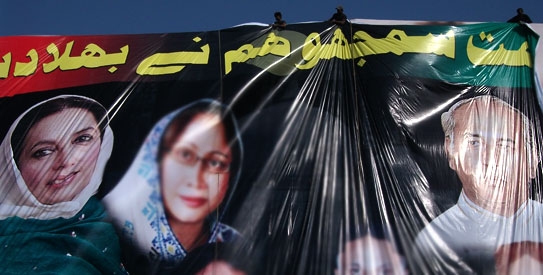
Fort Hyderabad “Mat samjho hum ney bhula diya (do not think we forgotten you),” reads the text on a giant billboard, which also carries pictures of the assassinated leader, that is being erected by PPP youth wing leader Ahsan Abro in Hyderabad.
The district has been PPP’s fort since the party’s formative years. It was the pre-bifurcated district of Hyderabad, which the former PM considered safe enough for contesting the 1997 general elections, in addition to her hometown Larkana. Following the murder of her brother Murtaza Bhutto, Benazir feared the sympathy wave might jeopardise her Larkana constituency, where Murtaza’s widow Ghinwa Bhutto was also contesting. Benazir, however, went on to win both seats.
Upon her return from abroad in 1986, Benazir held a mammoth rally at the famous GTC ground in to lead the Movement of Restoration of Democracy (MRD). And in 2007, she kicked off her Sindh election campaign for the 2008 polls from Hyderabad by holding her first public meeting on December 17.
Contrasting fortunes For locals like Abro, there is ‘sharp contrast’ in the way the party is functioning in the city.
“She (Benazir) used to be in touch with party workers and respond to our emails if any genuine complaint was sent to her,” he says, adding that things are different now.
“We have been complaining against irregularities in the way district leadership is handling workers and their problems but no one listens.”
In the party’s other ‘home ground’, cracks are emerging between the workers and leaders, which may become a cause of concern come the next general elections.
Mehboob Jat, an elderly party member, who once shook hands with Z. A. Bhutto, agrees with Abro.
“My party has been in the government for our years now but even basic issues like sanitation, road infrastructure in this area, the party’s stronghold, remain unresolved,” Jat complains.
A bond of ‘ishq’ For Hina Dastagir, a women’s wing activist, her affiliation with PPP is one of ‘ishq’ (passion).
“So what if I am not considered for the reserved seats of the provincial assembly or Senate? Maybe the party doesn’t consider it appropriate now,” she says.
“I am working for women wing of the party and I am satisfied with it but I can’t behave like those who start screaming once they are not given party tickets.”
The authors are staff reporters at Dawn.