0
0

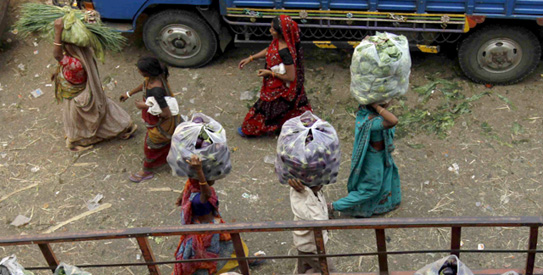
NEW DELHI: The Indian cabinet has approved a landmark bill to provide subsidised food to hundreds of millions of people — a populist but hugely costly project that critics say will strain treasury finances.
The Food Security Bill — greenlighted late Sunday — would provide monthly supplies of cheap rice, wheat and millet to 64 per cent of India's 1.2 billion population — or around 770 million people.
The legislation, which must still be approved by parliament, will increase the government's annual food subsidy bill by nearly 280 billion rupees to 950 billion rupees.
Further substantial funds will be needed to ramp up grain production to meet the subsidy requirement.
Food Minister K.V. Thomas said the bill would be presented in parliament before the current session ends on Thursday.
Critics of the bill say India can ill afford such a costly programme at a time of slowing economic growth, near double-digit inflation and a yawning budget deficit.
There are already concerns that the government will fall short of its target of reducing the fiscal deficit to 4.6 per cent of GDP in the current financial year.
“This bill is just another progressive-sounding legislation that fails to address key issues: the crumbling public distribution system and malnutrition among rural and urban poor,” said food security analyst Sangita Sharma.
“Priority has been given to quantity and not to quality of food grains that will be handed out to the rural and urban poor,” Sharma told AFP.
The food security bill carries enormous political significance for Prime Minister Manmohan Singh's coalition government, which was re-elected in 2009 on the back of a strong pro-poor platform.
The subsidies will target 75 per cent of the rural population and up to 50 per cent of the urban population.
It guarantees a monthly supply of between three kilos (seven pounds) and seven kilos of grain per household, depending on their economic situation.
Existing food subsidy programs in India have been marked by rampant corruption, with little of the grain reaching its targeted recipients.