0
0

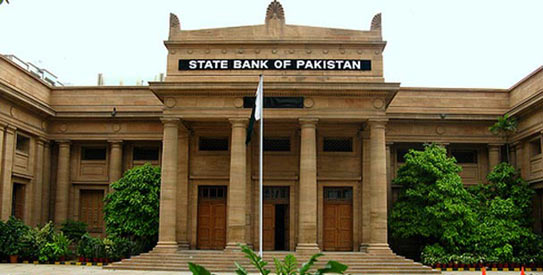
KARACHI: The State Bank has kept the policy interest rate unchanged in the wake of higher macroeconomic risks and inflation holding the government’s borrowing from banking system responsible for inflationary behaviour.
The State Bank on Wednesday announced Monetary Policy for December and January, keeping the interest rate (discount rate) at 12 per cent.
“A reassessment of latest developments and projections indicate that macroeconomic risks have somewhat increased during the last two months,” said the State Bank.
The SBP said the year-on-year CPI inflation stood at 11 per cent in October 2011, the month-on-month inflation trends, averaging at around 1.3 per cent per month during the first four months of FY12, showed existence of inflationary pressures.
The sifting of commodity level CPI data reveal that the number of CPI items exhibiting year-on-year inflation of more than 10 per cent is consistently increasing and almost all of these items belong to the non-food category.
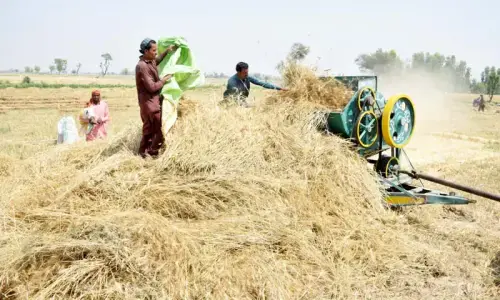
The government has also increased its wheat support price by Rs100 to Rs1050 per 40kg for the next wheat procurement season.
“While the average inflation may settle around the targeted 12 per cent for FY12, it is uncertain that inflation will come down to a single digit level in FY13,” said the SBP. The policy statement said the main determinants of this inflation behaviour were government borrowings from the banking system and inertial effects of high inflation on its expected path. The severe energy shortages are also holding back the effective utilisation of productive capacity and adding to the high inflation-weak growth problem.
“Where the government is the main user of the system’s liquidity and banks remain hesitant to extend credit to the private sector, the SBP faces a dilemma,” said the policy statement.
Efforts to scale down liquidity injections could have implications for settlement of payments in the inter-bank market, which is an important consideration given SBP’s mandate of maintaining financial stability. If these considerations are addressed, the government may end up settling its obligations by borrowing from the SBP.
This does not bode well for government’s own commitment of keeping such borrowings at zero on quarterly basis. The marginally increasing trend of these injections, on the other hand, also carries inflationary risk, which is not consistent with the objective of achieving and maintaining price stability.
The State Bank presented three solutions to the predicament of reconciling price and financial stability considerations and supporting private investment in the economy.
First, the government needs to ensure that all or major parts of budgeted foreign inflows materialize as soon as possible.
Second, sooner than later the government will have to initiate comprehensive tax reforms that broadens the tax base of the economy
Third, efforts need to be stepped up to improve financial deepening and increase in competition in the banking system.
The SBP also expressed serious concern over rising current account deficit. It said the actual external current account deficit of $1.6 billion for the first four months of FY12 is now higher than the projected deficit for the year. The main reason for this larger than expected deterioration is the rising trade deficit.
The exports remain at slightly less than $2 billion per month in September and October 2011 while the total import growth was close to $3.4 billion per month.
“It must be understood that there are uncertainties involved in realising the full benefits of these measures. These uncertainties can potentially have adverse effects on SBP’s recent efforts to support private sector credit and investment in the economy. Therefore, after giving due consideration to the need to revive growth and emerging risks to macroeconomic stability, the SBP has decided to keep the policy rate unchanged at 12 per cent.”