0
0


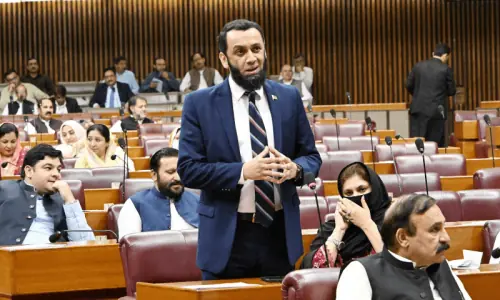
ISLAMABAD: The Supreme Court appeared to be at a loss for words on Wednesday when Dr Babar Awan, the counsel for the government, asked why it had not resumed the hearing of Air Marshal (retd) Asghar Khan’s pending petition relating to the bribing of politicians by the Inter-Services Intelligence (ISI) in the 1990s.
The petition in question had accused the ISI of distributing funds among politicians, including former prime minister Nawaz Sharif, to help them create the Islami Jamhoori Ittehad (IJI).
Chief Justice Iftikhar Mohammad Chaudhry, who heads a 17-judge full court hearing the government’s review petition against its judgment which had declared the controversial National Reconciliation Ordinance (NRO) illegal, simply said the counsel did not understand the strategy of the chief justice and moved on. But this was not the only salvo fired by Mr Awan.
The issue cropped up when Mr Awan insisted that the plundered and swindled money, whether inside or outside Pakistan, should be recovered. Likewise, stays on cases of tax evasion amounting to billions of rupees should also be vacated.
But the counsel was reminded by Justice Jawwad S. Khwaja that the court had once summoned the chairman of the Federal Board of Revenue to explain why his department was not pursuing tax evasion cases. “What you are saying was utterly misinformed and a sweeping statement,” he said, adding that the counsel should remain within the confines of his review petition.
Mr Awan recalled that in one of the cases against Nawaz Sharif relating to the plane hijacking conspiracy, the federation had come forward and relief was granted by condoning the late filing of the petition.
“Are you here to settle political scores against anyone,” the chief justice asked Mr Awan who retorted that all cases had been heard but not the one filed by Asghar Khan.
Justice Asif Saeed Khosa said the court had understood the arguments of the counsel on the legal plain and the real issue which related to a letter should now be discussed.
According to legal observers, the judge was referring to a court verdict which had asked the government to write letters to the Swiss authorities for reopening money-laundering cases.
“Neither we will write the letter nor we are bringing any notification,” replied the counsel, keeping everybody guessing what he really meant by the notification -- reverting the March 16, 2009, restoration of superior court judges through another notification.
The chief justice reminded the counsel that the court was giving him a concession because the review petition had been delayed by 65 days. “Remember law is equal for everyone”.
Except in the Nawaz Sharif case which was entertained after nine months, the counsel said, adding that under rules even one day’s delay had to be explained.
Mr Awan argued that the domains of all organs of the state should be respected and that decisions regarding reconciliation to have a way forward politically towards the opening of democracy fell within the domain of the executive. “Therefore, the apex court should not have interfered in the executive’s domain by going beyond declaring the NRO illegal. Fresh petitions should be filed on reopening of the cases.”
He said that under Article 89 of the Constitution, the powers of the president to promulgate ordinances had the same force and effect as an act of parliament.
“The Supreme Court went beyond its jurisdiction by holding the NRO against the injunctions of Islam since such matters are always dealt with by the Federal Shariat Court. The NRO should not be considered as a deal between two individuals and the set procedures for promulgating ordinances were accordingly adhered to while promulgating the NRO,” Mr Awan said.
Justice Sarmad Jalal Osmany recited a couplet of Faiz Ahmed Faiz: “Woh baat saare fasane mein jis ka zikr na tha; Woh baat unko bohat nagavaar guzri hai.”
In response, Mr Awan promptly said: “Mere mizaj kaa is mein koi qasur nahi; Teray salook ne lehjah badal diya.”