0
0

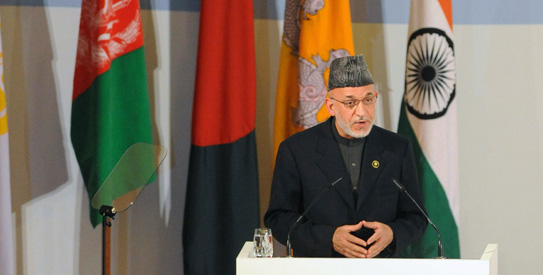
ATHENS: Greece's new leader Lucas Papademos steeled his country for tough times ahead on Thursday, as he assured Greeks of the need for the euro after being named interim prime minister to lead a crisis government.
Giving his maiden speech moments after receiving a mandate from Greece's president, Papademos, a respected former vice-president of the European Central Bank, said the crisis-hit country was at a crossroads as bankruptcy loomed.
“The Greek economy is facing huge problems despite the enormous efforts made,” the 64-year-old told a huge crowd of journalists in a solemn address after political leaders took four days to appoint him. “Greece is at a crucial crossroads ... the course will not be easy,” he added.
He called on Greeks to pull together as it faces up to its worst economic crisis in decades.
“The problems will be resolved faster ... if there is unity, cooperation and wisdom,” Papademos said as the markets reacted favourably to his appointment, with stocks in Athens up one percent an hour before closure.
The country's former central banker, who played a crucial role in Greece's entry into the eurozone nearly a decade ago, played up its benefits after weeks of speculation that its problems could force it out of the 17-nation club.
“I am convinced that the participation in the eurozone is a guarantee of fiscal stability and a factor in economic prosperity,” he said.
Named to lead a transitional government until elections, Papademos said the new team's main task was to implement the terms of a vital EU bailout deal, but said “no exact time” had been set for polls, initially pencilled in by the main political leaders for February.
His first job is to persuade the EU and International Monetary Fund to disburse an eight-billion-euro ($11-billion) slice of aid from a 2010 bailout deal that is needed by December 15.
Then he must force through painful austerity measures exacted as the price for a second EU bailout package which gives Athens 100 billion euros in loans, the same amount in debt reduction and a further 30 billion in guarantees.
Drawing a firm line in the sand, crisis-weary France and Germany last week gave Athens a stark choice: pass these belt-tightening measures or leave the euro.
And highlighting the parlous position of the Greek economy, the European Commission said it had abandoned all hope of a climb out of recession next year, tipping another 12 months of economic contraction for the incoming government.
The previous EU forecast of 1.1-per cent growth was ripped up with a 2.8 per cent contraction now expected in 2012 after a brutal 5.5-per cent recession this year.
Meanwhile, Greek statistics showed unemployment in August, the peak of the country's busy tourism season, at 18.4 per cent with over 900,000 people out of work.
Expressing a frustration felt by many Greeks at the length of time it took to appoint Papademos, former president Costis Stefanopoulos nevertheless welcomed his appointment.
“It has taken five days to appoint a new PM, this is ridiculous,” he said.
“The only pleasant thing is the selection of Mr Papademos.” Leftist Eleftherotypia daily said: “Papademos government born... after a four-day sitcom with many elements of tragicomedy.”
As Greece's politicians squabbled, European and international leaders piled on the pressure for a quick conclusion, as Italy's difficulties threatened to fuel the flames in the eurozone.
“Political clarity is conducive to more stability... it is much needed in Greece, it is much needed in Italy,” IMF chief Christine Lagarde told journalists in Beijing.
Softly-spoken and low-key, Papademos is seen by many as the safe pair of hands needed to haul Greece back from the brink.
“It is a great honour and the responsibility I undertake is greater still. I am not a politician, but I have dedicated the greater part of my life to economic policy,” said the new PM-in-waiting.
The dramatic appointment of Papademos, whose government will be officially sworn in on Friday, capped a chaotic week in Greece that ranged from drama to outright farce.
Outgoing Prime Minister George Papandreou started the ball rolling last Monday when he shocked the rest of Europe by announcing a referendum on the EU bailout deal, sending markets worldwide into meltdown.
The surprise call for a popular vote also sparked a revolt in his own party and forced Papandreou to announce he would step down in favour of a unity government backed by the two main parties.
Then began four long days of haggling, as the world looked on in horror, during which a deal appeared to have been clinched several times.