0
0

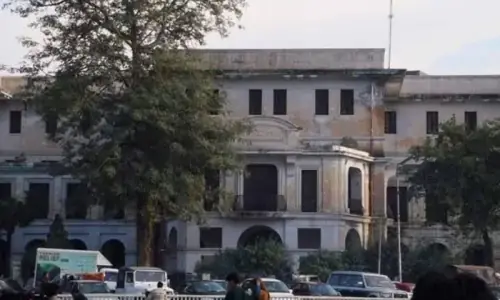
THE Government College University, Lahore, is taking a breath of fresh air with the appointment of new vice-chancellor Prof Dr Khaleequr Rehman, who has practically expressed his will to empower all departments’ chairpersons, deans and provide an enabling environment to students for their all-round growth.
The university students, who had been complaining of suppression and monitoring up to the level of recce, are being allowed to express themselves without any hesitation. The students are not only visiting the vice-chancellor’s office regularly but are also in touch with him on the Facebook.
In order to lessen financial burden on university hostels’ residents, the new vice-chancellor drastically lowered hostels and mess charges after analysing that the respective management was earning 'huge’ profit and piling up its resources. He said he would also make students’ tuition fee realistic as soon as the university would start receiving funds from the Higher Education Commission as promised.
VC Prof Rehman discussed these issues candidly in a meeting with the Lahore Education Reporters Association (LERA) executive and general body members at varsity’s Syndicate room.
In order to transform GCU into a world class institution, Prof Rehman said he had involved all senior faculty members and planners to plan varsity’s New Campus at around 400 acres of land available at Kala Shah Kaku. On the new campus, he said, the university had plans to introduce cutting-edge technologies and modern disciplines that would start meeting the needs of the modern world in next 50 years. He said latest labs would also be set up on the new campus because the existing one had become `landlocked’ and achieved saturation in terms of expansion.
Prof Rehman said the Higher Education Commission and the Punjab government would continuously be asked for release of funds because it was the state’s responsibility to invest in the development of human resources.
Referring to the availability of faculty at GCU, the vice-chancellor lamented that there were only eight full professors in the university and the departments were being run by as junior as assistant professors. Now, he said, the university was in the process of advertising senior faculty members’ posts and attract qualified faculty with market-based incentives. He said he had informed the governor/chancellor about his question about the status of registrar’s post in the university.
As he assumed the charge of vice-chancellor, Prof Rehman said he found university’s system highly centralised. “It was centralised to the extent that the vice-chancellor himself was responsible for allowing even one-day leave to the senior faculty members,” he added.
Now, he said, he had started decentralising powers and empowered department’s chairmen and faculties’ deans to perform their duties at their respective levels instead of coming to the vice-chancellor’s office for even petty issues, including those related to small finances.
Similarly, at students’ level, he said, an enabling environment was being provided to them. The VC said almost 40 societies being run by students were being provided with extra funding despite resource constraints. “The training imparted at societies’ level would help them gain experience of artificial administration.”
He said the university was also offering students career counselling and guidance. He, however, categorically rejected the concept of allowing creation of student wings of political parties on the university campus.
Prof Rehman told reporters that a body of vice-chancellors had recommended the chief minister to abolish the entrance test or transform it into an aptitude test because students were currently choosing their lines of studies on the basis of marks obtained at matriculation and intermediate level.
“I am a teacher for all students studying in the university and vice-chancellor for the planners at provincial and federal government level,” he said.
*****
MOMAL Mushtaq, an undergraduate student at NUST Business School (NBS), has been selected as a runner-up World Summit Youth Award (WSYA) 2011 for her project “the Voice of Youth” (tVoY) – an online community.
An international jury comprising multimedia and IT experts and social entrepreneurs from 17 countries selected the very best entries in each of the six WSYA categories, among which, tVoY project earned UN-wide recognition. The WSYA is an international organisation that selects and promotes best practice in e-Content.
The Voice of Youth was selected as one of the most outstanding examples of creative and innovative e-content, addressing the United Nations Millennium Development Goals including “Create your Culture!”
Ms Mushtaq’s project was selected as runner-up from over 700 entries from 99 countries. The Voice of Youth, an online youth community, was established on June 26, 2010 basically to cultivate relations with youth belonging to different strata of life, providing all with a platform to freely pursue their individuality for collective progression. During one year, tVoY has shown a remarkable success and now it has a network of over 6,000 Facebook fans and 200 young talents from Pakistan, India, Nigeria and Philippines.
Founder and Chief Editor of tVoY Momal Mushtaq says: “It is certainly a matter of pride for the whole nation that something that I did for Pakistan is recognised as one of the best throughout the world, by the experts.”
The official public celebration of the winners is at the WSYA Gala which is part of the WSYA Festival 2011. The festival is taking place this year in Graz, Austria, Unesco City of Design.
The team of tVoY has been invited to join for the whole four-day event in Graz from Nov 10-13.