0
0

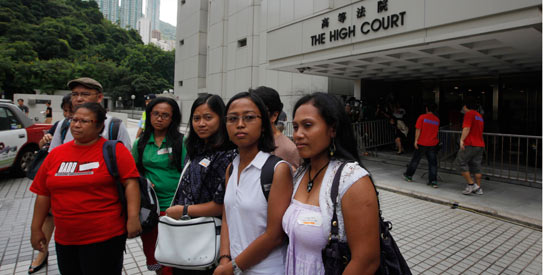
HONG KONG: A Filipino woman is challenging a legal provision denying permanent residency to the hundreds of thousands of foreign maids in Hong Kong in a landmark court case that sees them fighting for equal treatment with the city's other foreign residents.
A Hong Kong High Court judge started hearing arguments Monday in a judicial review launched by Evangeline Banao Vallejos, a longtime foreign domestic helper.
Lawyers for Vallejos argued that the provision denying helpers the right to apply for permanent residency after seven years in Hong Kong contravenes the Basic Law, Hong Kong's mini-constitution.
Other foreigners in Hong Kong can apply for permanent residency after seven years.
Vallejos came to Hong Kong in 1986 to work as a maid and has been employed by the same family since 1987. She decided to apply last year for a judicial review of a decision denying her an appeal against an immigration department decision in 2008 rejecting her permanent residency application.
Vallejos' case is the first of five launched by current and former Filipino helpers who are challenging the rule. The other cases are expected to go to court later this year.
The maids, officially known as foreign domestic helpers, are a big part of the economy in Hong Kong, where it's common for families to employ one or more maids to live with them to do household chores and look after children. About 290,000 of Hong Kong's 7.1 million people are foreign maids, most of them from the Philippines or Indonesia.
The number of Filipino workers in Hong Kong has dropped to about 120,000 last year compared to more than 200,000 several years ago, while those from Indonesia have grown.
The money the maids send back to their home countries is a big source of income for their families. According to Philippine government figures, workers in Hong Kong sent home $312 million in 2010 out of a total of $18.8 billion sent home by its nationals working overseas, or about 10 percent of the country's annual gross domestic product.
Vallejos' case has become highly divisive in Hong Kong, with some arguing that the provision amounts to ethnic discrimination. But opponents say that allowing the maids to have permanent residency would allow a flood of workers and their families to settle in the densely populated city, putting a strain on resources and social services.
Gladys Li, a lawyer for Vallejos, denied that would happen, saying it would merely give the helpers the same right to apply that others have and that they may still have to fulfill other criteria.