0
0

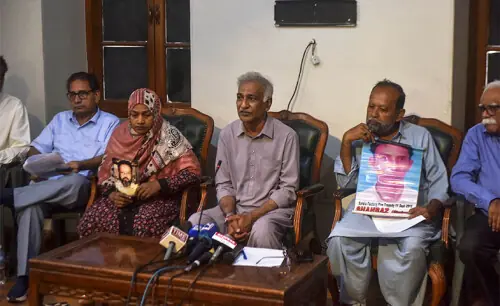
KARACHI, July 16: Intolerance, lack of political will and proliferation of weapons were cited as some of the main reasons for the violence that recently engulfed Karachi at a roundtable meeting of political parties, civil society and trade unions representatives held at a local hotel on Saturday.
Titled “Karachi violence: exploring challenges of governance, political will, state resources and ethnic fault-lines”, the programme was organised by the Pakistan Institute of Labour Education and Research (Piler), the Joint Action Committee for People's Rights (JAC), the Pakistan Medical Association (PMA), the Pakistan Peace Coalition, and the Pakistan Workers Confederation (PWC) against the backdrop of violence that paralysed the city a few days ago.
Lawmaker Khalid Ahmed representing the Muttahida Qaumi Movement at the meeting said that political will should've topped the order of the agenda of the meeting, for there were no ethnic fault-lines in the city. He said had there been any such fault-lines the euphoria witnessed during the Pakistan-India cricket World Cup semifinal in Karachi wouldn't have been possible.
He said what happened in the city after Dr Zulfikar Mirza's statement was an undemocratic behaviour, but such kind of behaviour was also witnessed in different incidents in Sialkot and Lahore. He said violence was never the solution to any problem, and all problems should be dealt with through the process of dialogue.
Sindh Tarraqqi Pasand Party's Ali Hasan Chandio said what Dr Zulfikar Mirza said was condemnable, but people who believed in democracy respond to things in a democratic way.
He also said that in order to rectify the Karachi situation illegal immigration must be checked. He said people should accept the fact that there were other stakeholders in Karachi, and Sindh's division could not be tolerated at any cost. He also laid emphasis on deweaponisation in the city. He said if these things weren't checked Karachi could become another Beirut.
Pakistan Tehrik-i-Insaf's Dr Arif Alvi said every time violence erupted in Karachi, agencies were blamed for it. He said it's time that those agencies were exposed. He said the demographic undercurrents of the situation must be taken into account, for it's a 'demographic war' that's being fought in Karachi. He said things should be understood in the demographic context, otherwise the frustration would increase.
Yousuf Mastikhan of the National Workers Party said Karachi was a peaceful city until General Ziaul Haq came to power. He said it was in political parties' hands to deweaponise the city, but those parties themselves weren't democratic.
Patronage
Former law minister Iqbal Haider said there's nothing new about Karachi violence for it began with the Bushra Zaidi case in 1986. The parties who're in power since then were responsible for all the carnage, he said, and argued they're never held accountable.
“The question is who will bell the cat?” he asked. He said it was the duty of the rulers and the establishment to ensure peace in the country, but the establishment was supporting and patronising terrorists. In that regard he cited the example of the recently released prisoners from Lahore and Multan jails.
He said in 2010, 1,800 people lost their lives and this year the number had already reached the 500 mark. He iterated there's no writ of the government, there's no will of the government, and on the other hand extremists and terrorists found the establishment's patronage. He said sectarian and ethnic parties were banned from taking part in elections yet they were doing so.
Progressive Writers Association's Rahat Saeed said it was established in 1958 that whoever had the gun in his hand could wield power.
Syed Shams of the Human Rights Commission of Pakistan said the country's political parties were not political entities in the true sense and the law-enforcement agencies were actually law-breaking agencies. He also said that it'd be living in a fool's paradise to expect anything positive of the political parties.
Fascist tendencies
Fahim Zaman of Citizens For Democracy said the constant derailing of democratic governments was one of the reasons that fascist tendencies crept into our political parties. The reason for the worsening of the political process was those powers who never let the political process function. He said it wasn't just the political failure that caused violence in the city, but also the administrative failure.
Idrees Chandio of the SUP, Mehnaz Rehman of Aurat Foundation, Tariq Hasan of the PML-Q, Hafiz Siddique Memon of Jeay Sindh Mahaz, Dr Tipu Sultan of the PMA, Noor Mohammad and members of the URC, the Hotel Workers Union, the KCCI, the Pakistan Fisherfolk Forum and the Network for Women's Rights also spoke.
Four demands
In the end, a resolution was passed in which four things were demanded: (1) the democratic system wouldn't be opposed (2) political parties should come up with a code of ethics (3) the media would be requested to help cool down temperatures in the country (4) leaders of political parties would be requested to initiate deweaponisation.