0
0

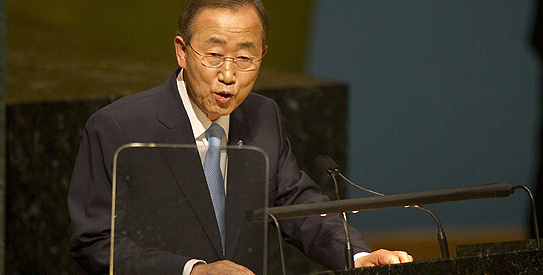
UNITED NATIONS: The United Nations unanimously elected Ban Ki-moon to a second term Tuesday as its leader with the major powers hailing his work in turbulent times.
The 192-member UN General Assembly voted the 67-year-old former South Korean foreign minister by acclamation. His new term will start on January 1 and run through 2016.
Ban declared his candidacy two weeks ago, got formal backing from the UN Security Council on Friday and with no challenger to force a contest, the General Assembly meeting was only going to be an official celebration.
A beaming Ban bowed to envoys that paid tribute to his work since taking over from Kofi Annan in 2007. In that time, the United Nations has had to battle disasters in Haiti, Pakistan and Myanmar, douse conflict in Africa and now support protesters in the Arab Spring uprisings.
South Korea's Foreign Minister Kim Sung-Hwan told the assembly that the UN secretary-general had probably “the most impossible job on Earth” but that the reappointment had caused “great joy” in his home country.
“No one understands the burdens of this role better than he, and my government is grateful that he is willing to continue to take them on,” said US ambassador Susan Rice in her tribute to the UN chief.
She called the veteran diplomat “a champion for peace and security.” French President Nicolas Sarkozy also highlighted Ban's “commitment” in his first five years to peace and security.
“France is fully confident that the secretary general will pursue these efforts over the next five years, and will support him in his endeavors, so that the UN may lie more than ever at the heart of effective global governance, for a safer and more just world,” Sarkozy said in a statement.
In Beijing, China's foreign ministry said the Asian giant “will continue its support for the work of Mr. Ban and the United Nations.” Ban said he “will continue to act as a bridge-builder and a catalyst for global action.” The UN chief promised to put climate change - a topic the United Nations struggled with during his first five years - nuclear disarmament and the search for Middle East peace at the forefront of his agenda.
He will only set out official priorities at the UN General Assembly annual debate in September, however.
Outspoken in faulting the leaders of Arab countries facing protests, he has himself been criticized by some human rights groups.
The UN chief has vowed to keep speaking up for the protesters taking on long-ruling leaders in the Arab world.
Ban again urged Syria's President Bashar al-Assad to carry out credible reforms and for other leaders in the region to listen to the legitimate aspirations” of their people.
“In all the Arab world, the leaders should listen carefully... to what their people are really asking to their governments: to promote their well-being, to promote this genuine freedom, greater and participatory democracy,” he told a press conference.
Ban has had tense telephone rows with Assad, Libya's Moamer Qadhafi and other Arab strongmen in recent months. Assad is now refusing to speak to Ban.
His aggressive line on Libya and Syria and call for an investigative panel into Sri Lanka's military assault on Tamil separatists have not always pleased China and Russia.
But Ban did nothing in his first five years to tempt the Security Council permanent five - China, Russia, the United States, France and Britain - to use their veto to stop his second term.
His insistence on “quiet diplomacy,” however, has got him into trouble, first over Myanmar and more recently China.
Rights groups were particularly critical when he failed to raise the case of detained Nobel Peace Prize winner Liu Xiaobo in a November meeting with China's President Hu Jintao.
Ban's entourage has indicated that he will be tougher in his second term. But he has also acknowledged his critics.
“I know that I am not the perfect person. You know, everybody has some strength and weakness,” he said in announcing his candidacy this month.
“I am also a man with some weaknesses but these weaknesses can be complemented by your wisdom, by your support and by the support of my senior advisers,” he said in surprise comments to reporters.