0
0

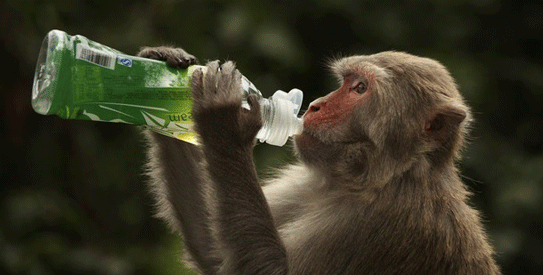
WASHINGTON: A certain gene in some monkeys can help boost vaccine protection against simian immunodeficiency virus (SIV), a trait that could help researchers develop better AIDS vaccines for humans, suggested a study out Wednesday.
Researchers vaccinated a large group of rhesus monkeys and then exposed them to SIV repeatedly over the course of two weeks. Half became infected, but the other half did not. Those who resisted infection were more likely to express a certain gene, identified as TRIM5.
The findings could help researchers in the elusive search to develop a vaccine against human immunodeficiency virus (HIV), which causes AIDS, said lead author Norman Letvin.
“It tells us – probably much to our surprise – that there will likely be in humans certain genes expressed by some people but not in others that may well be contributing to protection,” said Letvin, a Harvard Medical School professor.
“So that we not only have to look at vaccine-induced antibody responses but we also have to look at the genetic makeup of the individuals who are being vaccinated because these data in monkeys suggest that both of these can be contributing.” The study appears in the journal Science Translational Medicine.
A 2009 AIDS vaccine trial on humans in Thailand showed a partial shield against HIV – 31.2-per cent reduction in the risk – but effectiveness dropped after three years, Letvin said.
“We have demonstrated in the Thai vaccine trial that with existing technologies we see modest protection against HIV infections,” he said.
“If we couple that optimistic data in humans with the kind of data we generated in this study with monkeys, as well as other studies in monkeys, it suggests that if we can induce an even better antibody response through vaccination.
“Maybe with our next generation vaccine we can get that up to 50 per cent or 60 per cent or even higher levels of protection, and that protection can be even more durable,” he said.
The quest continues for a vaccine against AIDS, which has claimed more than 25 million lives since 1981 and infected some 33 million people worldwide.