0
0

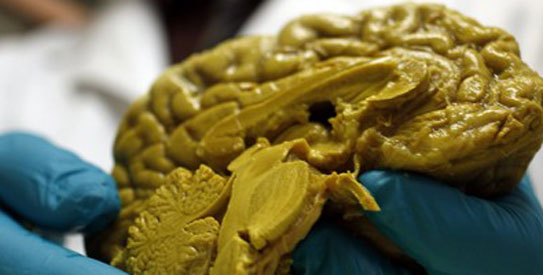
PARIS: Skin cells have become lab-dish tools for probing one of the most enigmatic and distressing disorders of the mind, scientists reported on Wednesday.
Researchers in the United States took samples of skin cells from schizophrenic patients and turned them back to a primitive, versatile state called induced pluripotent stem cells (iPSCs).
From this blank slate, the cells were then cultured to become brain cells, enabling them to be used for lab-dish investigations into schizophrenia that can be tailored to the individual.
“Using this method, we can figure out how a particular drug will affect that particular patient’s brain cells without needing the patient to try the drug and potentially suffer the side effects,” said Gong Chen of Penn State University in Pennsylvania.
“The patient can be his or her own guinea pig for the design of his or her own treatment, without having to be experimented on directly.” Schizophrenia is a complex condition that is believed to have environmental as well as hereditary factors.
It is characterised by paranoid delusions and hallucinatory voices. Around one percent of the population worldwide are believed to be afflicted by the disorder.
Tests found that lab-dish neurons from schizophrenic patients had fewer connections with each other compared to cells taken from healthy individuals.
The scientists then used commonly-prescribed anti-psychotic drugs to see whether this boosted communication between neighbouring cells. The only one that worked was Loxapine, although it also had an unexpected cascade effect on hundreds of genes.
The work is reported online in Nature, the British science journal.
iPSCs have generated huge excitement since they were discovered in 2006.
The idea is that they can be a testbed which does not carry the ethical burden of embryonic stem cells.
Some scientists question, though, whether iPSCs are a biologically unblemished source. A study published in Nature in February found that peripheral parts of their code, known as the epigenome, was marked with reprogramming errors.